










Most time travel movies don’t sweat the math — or, more accurately, the physics and/or quantum physics of how time travel might actually work. The writers and directors include the time travel concepts that will help their story and ignore the ones that won’t. For example, when Doc Brown takes Marty and Jennifer to the future in Back to the Future Part II, they can’t meet their kids because Marty and Jennifer would have been absent from the timeline for the past 30 years.
That’s just one example of how the most beloved time-travel franchise ignores the theoretical rules of time travel, and the same is true of nearly every other time travel movie ever made. The moment you apply even basic real-life science into the equation, it all falls apart.
However, there are a select few movies that actually do make some scientific sense, where the writers either meticulously researched the laws of quantum physics for their story, or they started with the laws of quantum physics and built a story from there. While it’s certainly rare, here are five such examples.
5
Interstellar
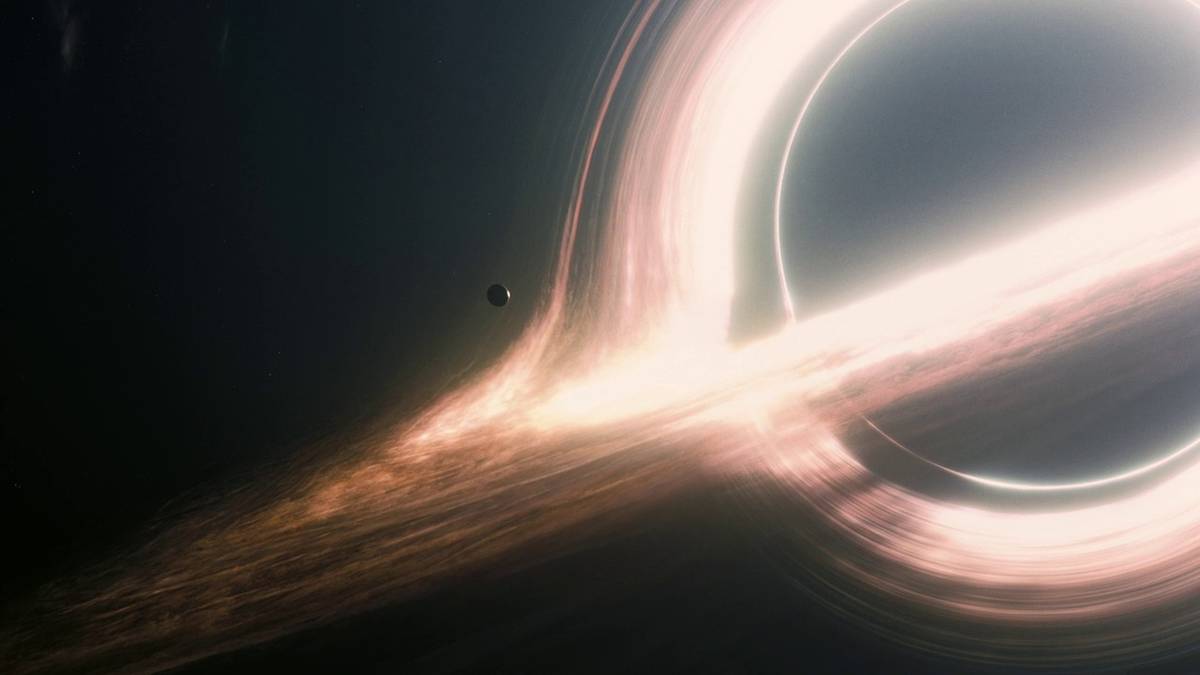
Christopher Nolan’s 2014 science-fiction epic Interstellar is undoubtedly the best-known movie to meticulously explore the laws of quantum physics as thoroughly as possible. Most likely that’s because, along with producer Lynda Obst, the concept was developed by theoretical physicist Kip Thorne, who also served as a scientific consultant.
The movie explores things like black holes and time dilation. Along with that, it depicts time travel in its final act. In the movie, the astronaut named Cooper (Matthew McConaughey) goes into a black hole and arrives in something called a “tesseract,” a device constructed by future humans which can represent time as physical space, thus allowing Cooper to communicate with his daughter in the past.
Granted, the tesseract is explained away by the fact that future humans built it, the story device is used to explore how time travel might come about and makes use of the very fact that black holes are still largely a mystery to us.
4
Planet of the Apes
Technically, any depiction of time travel where someone goes forward in time and does not also go back in time has a scientific leg up on other time travel stories. That’s because forward time travel is entirely possible, you just need to travel really fast — like, close to the speed of light fast.
Time moves slower the faster you’re going. The effects of this are imperceptible on Earth, but become noticeable at extremely high speeds in space. For example, the satellites orbiting Earth experience time differently than we do. So, if an astronaut goes super-fast in space, time will move super slow for them. Meanwhile, time will pass normally on Earth. This is called time dilation and Interstellar actually explains the concept really well.
As it pertains to Planet of the Apes, astronaut George Taylor (Charlton Heston) was on a space mission on a ship going near light speed, then he crash lands on a mysterious planet. While he doesn’t realize it until the end of the movie, the planet is actually Earth far into the future.
This kind of time travel is entirely possible, whereas backwards time travel is generally considered to be impossible by many top scientific minds. (To be fair, backwards time travel is depicted in some of the Planet of the Apes sequels, but if you’re only looking at the original 1968 film, the science checks out.)
3
Avengers: Endgame


Yeah, it does seem kind of silly to include a movie where time travel is explained by a green, irradiated monster and one of the time travelers is a talking raccoon, but Avengers: Endgame deserves some credit for disavowing the most flawed trope of most time travel stories. Generally, the point of time travel movies is that people go into the past to “fix” the future by rewriting its events.
Avengers: Endgame does not do that.
The movie sees the Avengers venture back in time to steal items from the past, then return to the present to make use of them. While Ant-Man (Paul Rudd) thinks this will alter history, Hulk (Mark Ruffalo) explains that this isn’t possible. Instead, time would branch off and create new timelines where the objects go missing.
British physicist David Deutsch has proposed that any time travel that alters the past would not alter the timeline, but create a brand new timeline. This makes use of the Many Worlds Interpretation — which Endgame also embraces — which is a legitimate, scientifically-recognized understanding of quantum mechanics.
And while Avengers: Endgame definitely gets very hand-wavey when it comes to how Tony Stark (Robert Downey Jr.) creates his Time-Space GPS, the very fact that time travel is accessed via the quantum realm — where, in real life, time operates very differently and may not exist at all — seems to be an acknowledgment of that.
2
Primer
Avengers: Endgame may explore some complex elements, it can still be enjoyed by a casual observer who isn’t paying too much attention to the time travel stuff. In contrast, the low-budget 2004 film Primer requires your utmost attention at every turn. The film was written and directed by Shane Carruth, who also stars as one of the two main characters. Carruth has an undergraduate degree in mathematics and has been a software engineer, and he used his technical know-how to tell a time travel story that is often considered to be the most scientifically thought-out time travel movie ever.
Primer is about two engineers who conduct scientific experiments in a garage. During an experiment involving gravity, they accidentally discover the means by which to travel backwards through time. With that discovery, they then build a box that’s large enough for them to both fit in.
Throughout the film, both characters use the box with abandon. They’ll look at the stock market to see which stocks do well, then go back to the past to buy the stocks before the prices rise. They also end up creating doubles of themselves and begin lying to each other and breaking all the “rules” time-travel movies warn about.
The movie has some very strict time travel parameters. For one, no one can travel back to before the creation of the box. Second, if you want to go back an hour, you must turn on the box, wait an hour, then get in the box, wait for an additional hour, then emerge. This will bring you back to the point where the box was turned on. For example, if you turn the box on at 1:00pm, then get in the box at 2:00pm, you would then wait another hour and emerge back at 1:00pm. While time is traveling backwards for the person in the box, there is no portal. They must experience that amount of time, even if it’s going backwards.
Carruth based this version of time travel on a Feynman diagram, which describes how subatomic particles move forwards and backwards in time simultaneously. Carruth also used purposefully complex scientific language in the film to realistically portray how the two engineers would converse. The result is a mind-bending movie that never trips up and never breaks its own rules, but that people have been interpreting and diagramming for over 20 years.
1
Predestination
In 1978, astronomer Carl Sagan wrote a piece about the nature of science-fiction stories for The New York Times where he explained how they can help viewers glimpse the real truths of the universe by fictionalizing real scientific principles and theories. Among the stories he praised was “—All You Zombies—,” a 1959 short story by Robert A. Heinlein. “—All You Zombies—” is about an intersex male with both male and female reproductive organs. With the use of time travel, he goes back and impregnates his younger, female self. The child born is a female who is brought back in time. That child is revealed to be the same woman that gave birth to her and the man who impregnated that woman. The story also makes clear that there is no “original” timeline where this baby is the product of anyone other than the two older versions of themself. Their life is just this unaltering loop.
The story is basically a thorough explanation and exploration of a “causal loop,” which is essentially the “paradox” time travelers like Doc Brown warn about in movies. If someone is going back in time to “fix” something, and they succeed, they will no longer have a reason to go back in time. Thus, the problem will reappear, prompting them to go back in time, and so on.
This concept is thoroughly explored and explained in ‘—All You Zombies—’, which was very faithfully adapted into the 2014 film Predestination starring Ethan Hawke as the main character’s older, male self, and Sarah Snook as the younger female version of the same character.
In a way, the story isn’t so much a more scientifically accurate depiction of time travel as it is a rigorous explanation as to why time travel stories really make no sense.
