

Winter Stations, Toronto’s beloved public art competition, has announced this year’s winners. Showcasing new and exciting installations, the annual event will bring several structures to life this February on the shores of Woodbine Beach.
Since starting back in 2014, Winter Stations has reimagined lifeguard stations in Toronto’s beaches with art and designs on an international scale.
This year’s theme
Beginning Family Day, Winter Stations invites all to embrace and experience this year’s theme, Mirage. According to organizers, the competition “invited proposals that play with the boundary between what is seen and what is real in the age of AI, and explore public art as infrastructure that gathers people in shared reality.”
“A mirage is a shimmer at the edge of reality, appearing real only to dissolve when approached. The present moment feels much the same, bent and distorted by the rise of digital silos and artificial intelligence, where the truth we seek is always shifting,” the organizers add.
This year, only five artistic displays were chosen, three of which are Canadian.
“Huge thanks to everyone who applied! All of your ideas and passion for bringing new art into public space keep us motivated year after year,” shared organizers on Instagram.
“Endless gratitude to all our sponsors, the creative, urbanist minds of our competition jurors, and shoutout to the scrappy Winter Stations team who have all made this year’s exhibition possible.”
In the past, we’ve seen massive installations like the infamous “Pussy Hat” structure and “Conrad,” a raccoon installation in honour of the real trash panda that died on the corner of Yonge and Church in 2015.
Expect the same creative energy this time around.
Winter Stations 2026 winners
CHIMERA by Denys Horodnyak and Enzo Zak Lux
“Chimera engages with the notion of mirage through a twofold perspective. On a material level, it offers a direct, tangible interpretation of illusion, employing fisheye mirrors as aesthetic modules that distort perception,” reads its description. “On a sensory and conceptual level, it serves as a dialectical reflection on the fragmentation of physical and digital realities, exposing the delicate imbalance between control and security – two cornerstones that define modernity.”
It continues: “From a distance, the installation blends seamlessly with its surroundings, dissolving into space through a cascade of mirrored repetitions. Moving closer – the illusion unravels, revealing the framework that sustains it. In this encounter, the viewer meets their own reflection multiplied and displaced, a shifting constellation of selves that provokes an uneasy awareness of being observed. The viewing platform becomes a temporary sanctuary – a cocoon of quiet detachment – from which the gaze can wander freely into the open expanse beyond.”
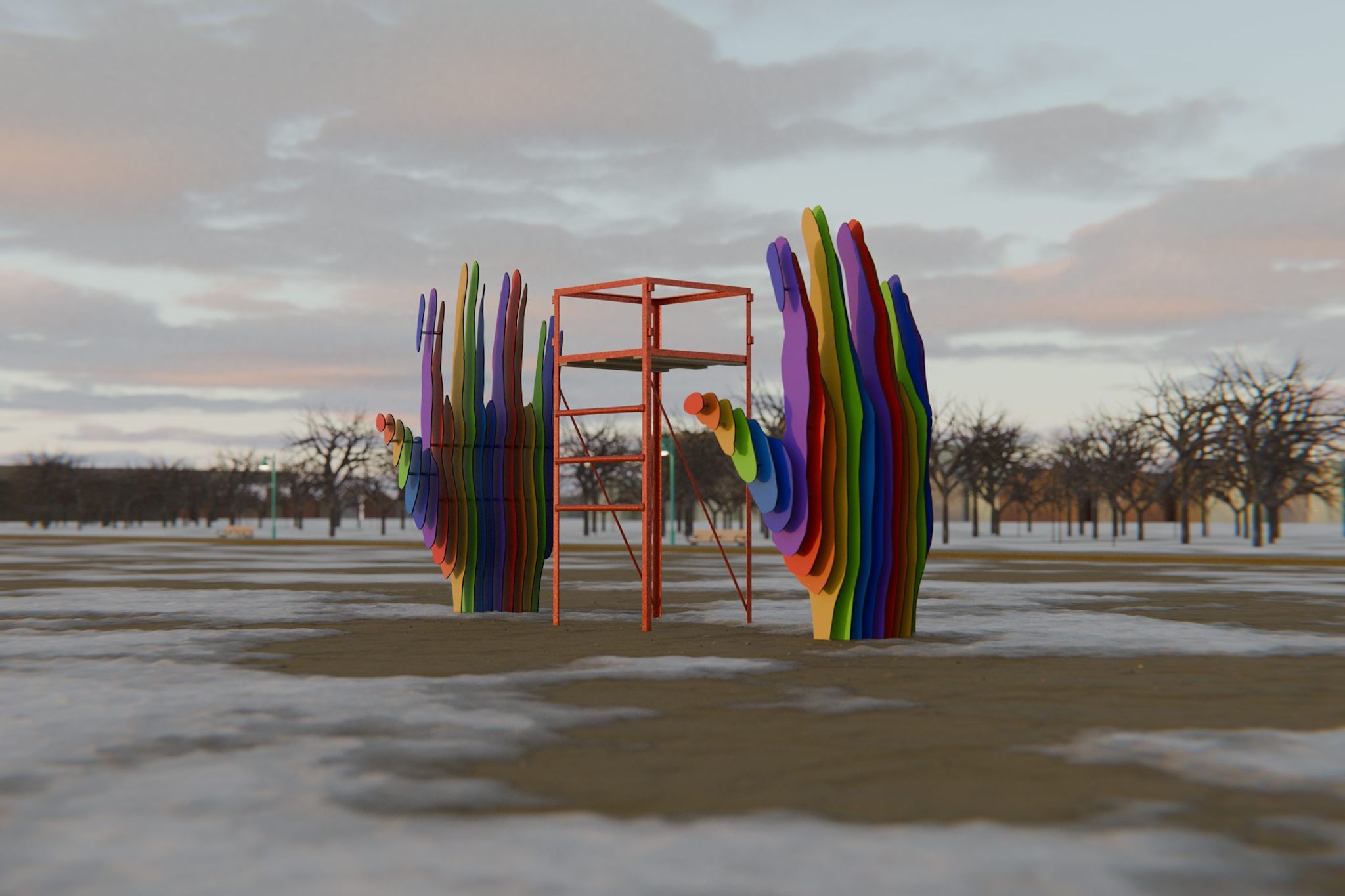
Embrace by Will Cuthbert
“Playing off this year’s theme, mirage, Embrace is a ~12’-tall sliced sculpture of my hands that changes perspective as you move around them,” shared Cuthbert on Instagram. “From some angles barely visible, others, silhouetted against the lake and the sky, and lastly, opening up into a bright and colourful array.”
SPECULARIA by Andrew Clark (TORNADO SOUP)
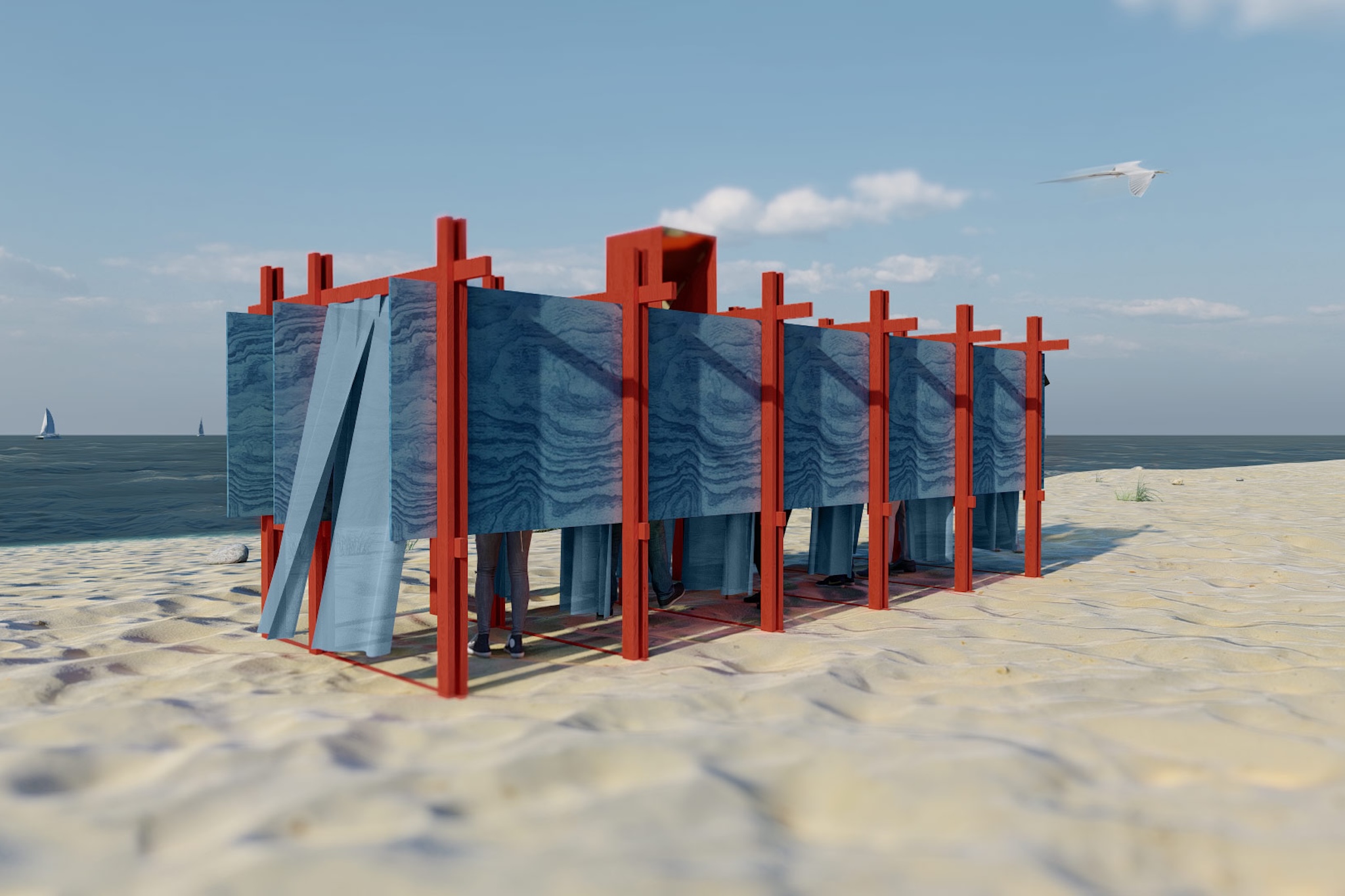
“Five framed openings facing the lake offer a glimpse into a blend of reality and deception. One of the openings reveals the truth, while the others show mirages, pieces of the surroundings, stripped of context, confusing distance and direction,” reads the description.
“Each opening is cut to familiar digital proportions. The visual ratios of 9:16, 1:1, 2:3, and 4:5 suggest a fabrication akin to the deception of the virtual world, yet here these ratios frame physical realities like air, water, light, and oneself. From a distance, the pale blue walls and repetitive red frames appear as a fractured mirage of the lifeguard chair and lake beyond. The structure blurs between object and atmosphere.”
Crest by University of Waterloo – Clay te Bokkel, Isabella Ieraci, Matthew Lam, Sasha Rao, Simon Huang, Oskar Peng, David Shen
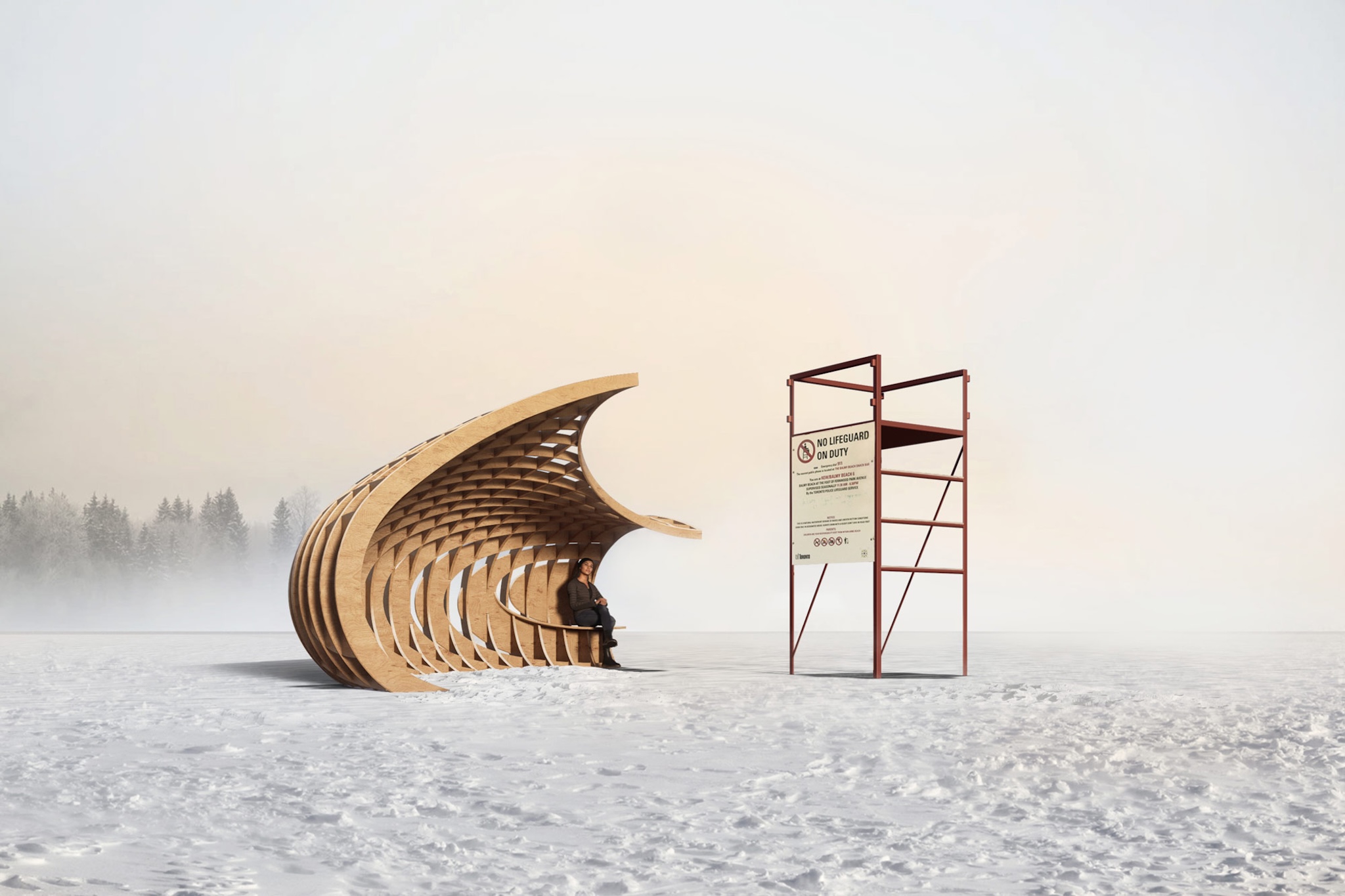
“Crest emerges from the sand and snow of the Toronto Beaches as a sweeping wave positioned moments before break. From afar, the installation resembles a mere pile of driftwood washed up on the beach. As one approaches, the geometry of the wave gradually reveals itself,” explains the team on Instagram.
“Like the fleeting moment of a wave crashing onto shore, the installation serves as a reminder that reality is finite, and fulfillment is found in being present.”
Glaciate by Toronto Metropolitan University in collaboration with Ming Chuan University: Finn Ferrall, Nicholas Kisil, Marko Sikic, and Vincent Hui
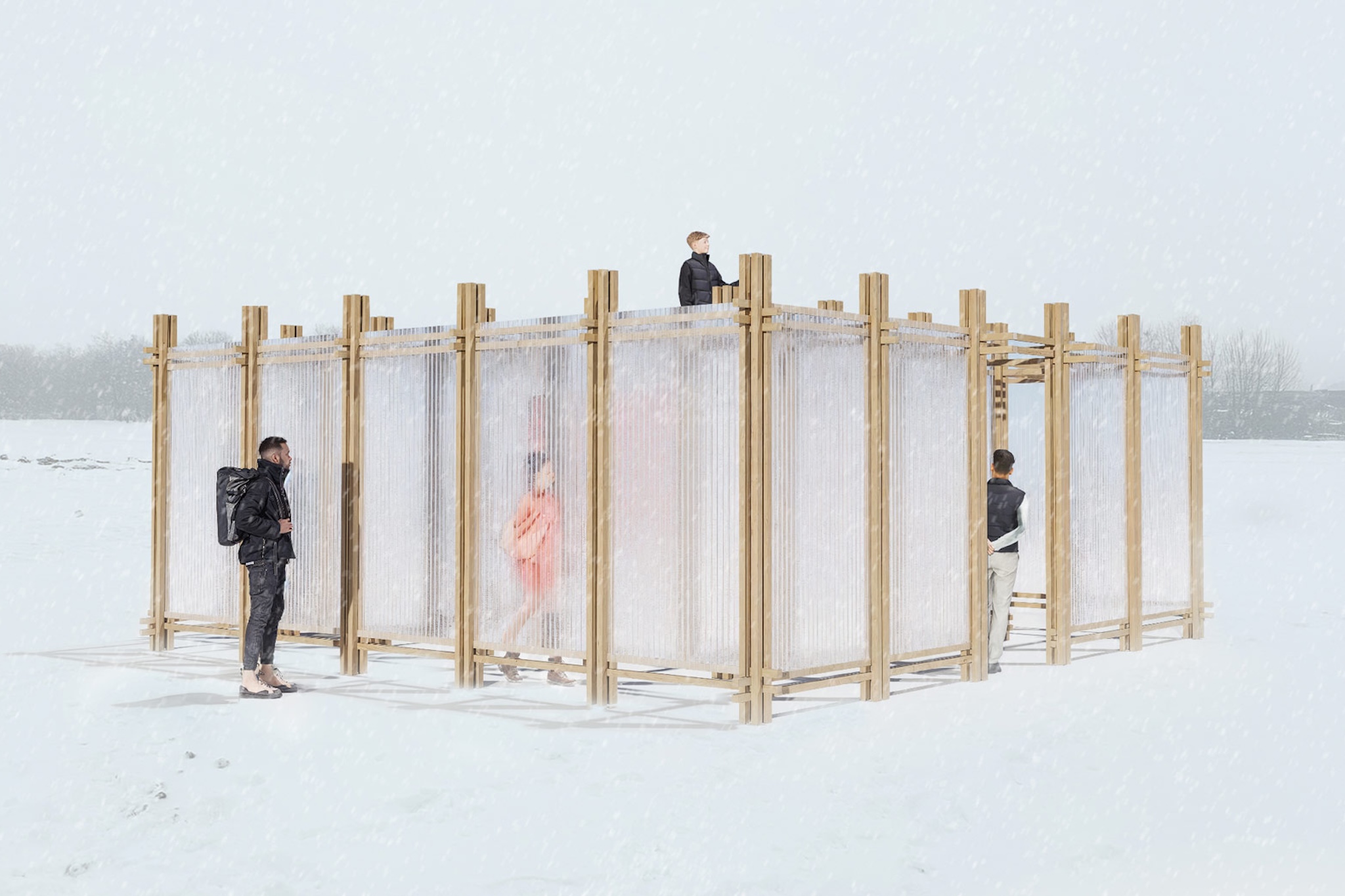
“A series of vertical polycarbonate panels, filled with water from the lake nearby, creates a set of ice lenses that glaciate the stand. As the lake water freezes and thaws, the panels cycle through phases of transparency, translucency, and full opacity. The stand is never wholly visible or wholly concealed; instead, it appears through fragments, outlines, and momentary flashes of red. This collage of visual clarity creates a celebratory mirage of the lifeguard externally, and a mirage of Woodbine Beach from within,” reads the description.
Winter Stations begins Feb. 16, 2026, and will be available for public viewing until March 30, 2026.
Recent Posts:
One of the world’s rarest violins is taking centre stage in Toronto
Here’s when Toronto will see its most breathtaking sunset of the year
Karen Doradea
Senior Staff Writer, Toronto – Karen is a multimedia journalist based in Toronto. With a strong knowledge of reporting and editing through all forms of media, she has a true passion for storytelling. She carries several years of journalistic experience and has covered the Toronto scene from local stories to national news. When Karen isn’t publishing fire content, you can find her binge-watching sitcoms on Crave, at a must-try restaurant, or scrolling endlessly on TikTok looking for the next best thing – News never sleeps.
Read articles