


![2nd Feb: Friendship Playlist (2026), 2 Seasons [TV-Y7] – Streaming Again (6/10)](https://occ-0-1081-999.1.nflxso.net/dnm/api/v6/Qs00mKCpRvrkl3HZAN5KwEL1kpE/AAAABWh0RyjR1suvN9N7IkSMXc9h_4AMzYOgGbJ57TfQHZky1yCpxrB6Igk6rFwSrxXGTuVlxXeNvfj1yDzd5OhXUGZz50w_vCpwyoYi3Je43lkEf5V5F0ErmpdGbhSjDTO04wrW6uhxvFRhRHoXBZq9CRfmCAy-M8TzDsbwH3QO.jpg?r=69b "2nd Feb: Friendship Playlist (2026), 2 Seasons [TV-Y7] – Streaming Again (6/10)")


As generative AI is currently annoying the crap out of everybody with faulty search engine results and overly “helpful” chatbot assistants, it would be understandable if a movie about AI isn’t the first thing you turn to right now. Yet, Alex Garland’s 2014 science-fiction film Ex Machina, which is about a man testing an artificial intelligence to see if it feels human, is so smart and gripping and well-acted that the movie makes an irresistible addition to Netflix’s library.
Ex Machina begins with Caleb Smith (Domhnall Gleeson), an employee at a tech firm who wins a companywide contest to meet the mysterious, visionary CEO Nathan Bateman (Oscar Isaac), who lives in a remote compound deep in the wilderness. Shortly after Caleb arrives, Nathan makes clear that Caleb wasn’t just brought here for a meet-and-greet. He has a more important task: administer the Turing test on his new robot, Ava (Alicia Vikander).
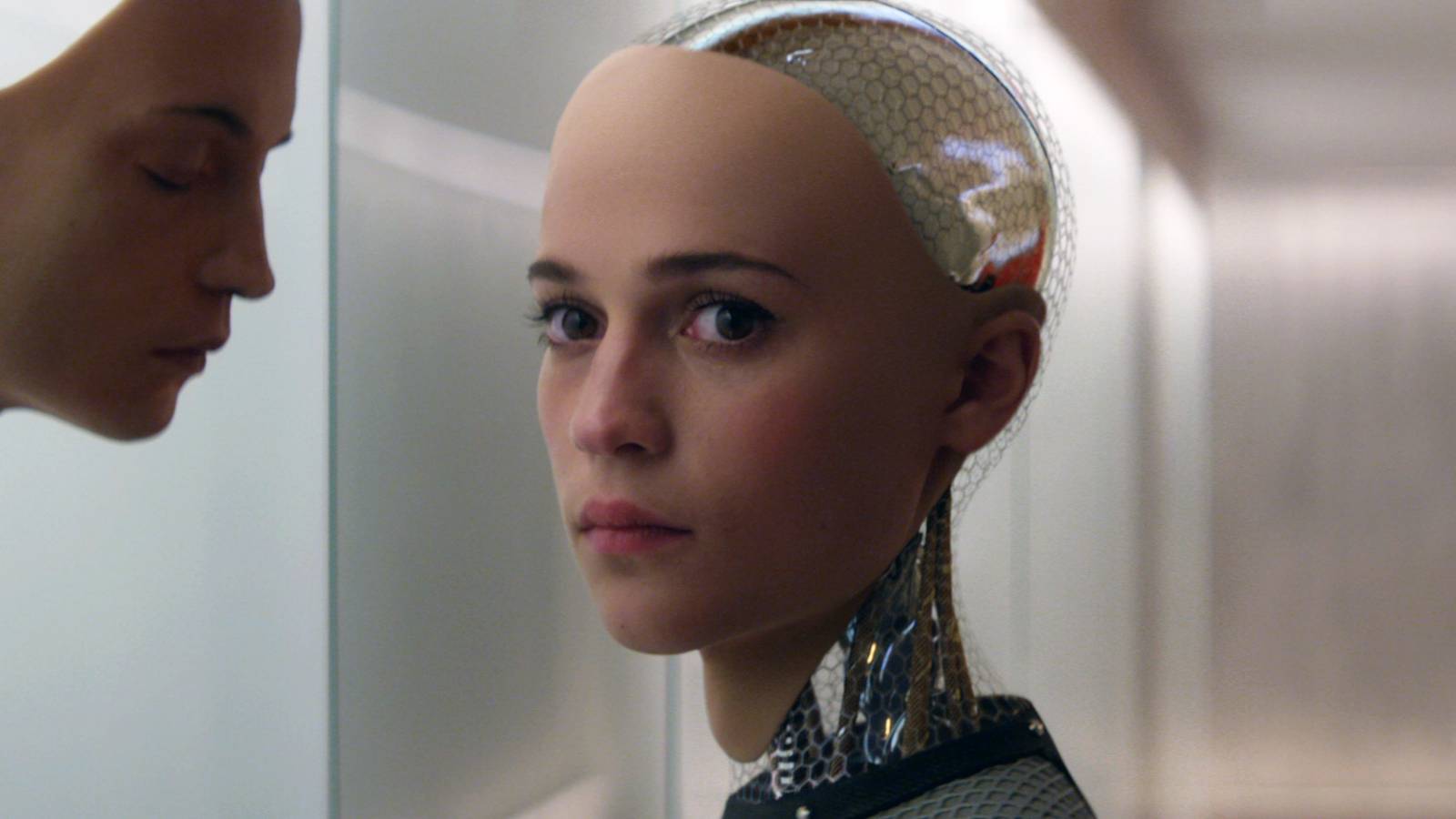
The Turing test is a real-life experiment introduced by mathematician Alan Turing in 1950. In it, a tester would hold two written conversations with unseen respondents. One respondent would be human and the other would be a machine. If the tester cannot tell which respondent is a machine, the machine passes the test. In Ex Machina, the test is modified so that there’s only one respondent, Ava, who Caleb has extensive conversations with through glass. While Ava is obviously a robot as evidenced by her very visible machine parts, Nathan explains that, if Ava can convince Caleb she has human feeling and intelligence despite her appearance, Ava will pass the test.
Caleb begins the test through a series of conversations over the course of a week. During that time, not only does he become convinced of Ava’s humanity, he begins to develop romantic feelings for her too. These conversations are intercut with conversations between Caleb and Nathan, who proves to be erratic and sometimes even cruel.
With the confined setting of Nathan’s compound (most of which is off-limits to Caleb), its small cast and simplistic scenes that are mostly just two people talking to each other, Ex Machina almost feels like a stage play, but none of that should scare anyone off. The confined setting, which sporadically goes on lockdown without warning due to a computer glitch, makes Caleb feel trapped and as a result, the viewer feels trapped along with him. Meanwhile, Nathan comes off as an eccentric billionaire, and Isaac’s performance is genuinely intriguing; you never quite know if he’s playing mind games with Caleb.
The most impressive story arc in the movie though takes place between Caleb and Ava, which moves in a thoughtful, slow burn that makes Caleb’s emerging feelings entirely believable. In their earlier conversations, he administers the test like a dutiful employee with a curious mind. Ava, meanwhile, has a childlike naivete to her, but also a bit of a flirtatious side, which is only intensified by her tendency to look deep into Caleb’s eyes while locked in conversation. This leads to Caleb’s romantic feelings and a desire to protect Ava from what happens to every piece of technology: it gets outdated and eventually discarded for the newer model.

Ava, as a character, would not have been possible without the masterful special effects work in Ex Machina. She has the face of a beautiful woman as well as a shapely, usually naked woman’s silhouette, both of which are key to Caleb’s attraction. Yet she’s undeniably a robot complete with a see-through frame and metal skeletal structure with light-up components. The effects are seamless, which is why the film won its sole Academy Award for Best Visual Effects.
However, the woman who played Ava has been comparatively overlooked.
While much of Ava’s appearance was created with special effects, she is not a motion-capture character completely rendered by CGI like so many Marvel and Star Wars creatures. Vikander played Ava in-person, and Ava’s face is entirely hers. Vikander was really there performing with and connecting with Gleeson. She plays Ava as kind, quiet and curious, yet there’s still something blank, stiff and distant about Ava. There’s a disconnect with her character that feels a bit like one of those motion-capture CGI characters in that you can never quite connect with them the way you do a real human. While this would be a disaster for a human character, it’s all intentional and beneficial here. Vikander disappears into a character that you never question as being anything other than a robot.
In a way, while the movie is about Caleb proving Ava’s humanity, Vikander proves to the audience that Ava is, indeed, a robot, so much so that it’s easy to overlook the complexity of the performance.