



Balding men are often precious about their hair. Pablo Picasso (1881-1973) was no exception. First in Spain, and later during his exile in France following General Franco’s victory in the Spanish Civil War (1936-1939), the women of his life groomed his few remaining follicles. Everything changed when he met Spanish barber Eugenio Arias (1909-2008), to whom the painter remained uncharacteristically faithful. No money exchanged hands, but Picasso would occasionally gift him art. Catalan filmmaker Jaime Camino harboured ambitions to shoot a film about their friendship. The project never made it onto the silver screen but a comic play by Borja Ortiz de Gondra about the unusual friendship was first staged in 2013. A new production, directed by Chiqui Carabante, opened last year at the smaller room of the public Teatro Español in Madrid before embarking on a nationwide tour.
El barbero de Picasso/Picasso’s Barber is more invested in the personal than the political. It ignores the fact Picasso and Arias were first introduced in 1944 by Communist leader Dolores Ibarruri “La Pasionaria” (who turned “No pasarán” [They Shall Not Pass] into a battle cry) and opens with the two men arguing about the merits of different matadors. In reality, taurine as opposed to ideological matters could be more important to Picasso. There were many political exiles Picasso did not befriend (he never reached out to filmmaker Luis Buñuel despite moving in similar circles), and the painter and his barber often attended corridas in the South of France together in the 1950s and 60s. A modest realist set designed by Walter Arias of a barbershop remains throughout the ninety-minute production in which the two lead actors – Pepe Viyuela as Picasso and Antonio Molero as Arias – barely leave the stage, their quick-witted rapport and banter central to the audience remaining engaged. A farcical dimension was heightened through intermittent appearances by Picasso’s second wife, Jacqueline (Mar Calvo); appearing in a perpetual flurry and hurry, the character has idiosyncratic mannerisms and speaks Spanish with a deliberately exaggerated French accent.
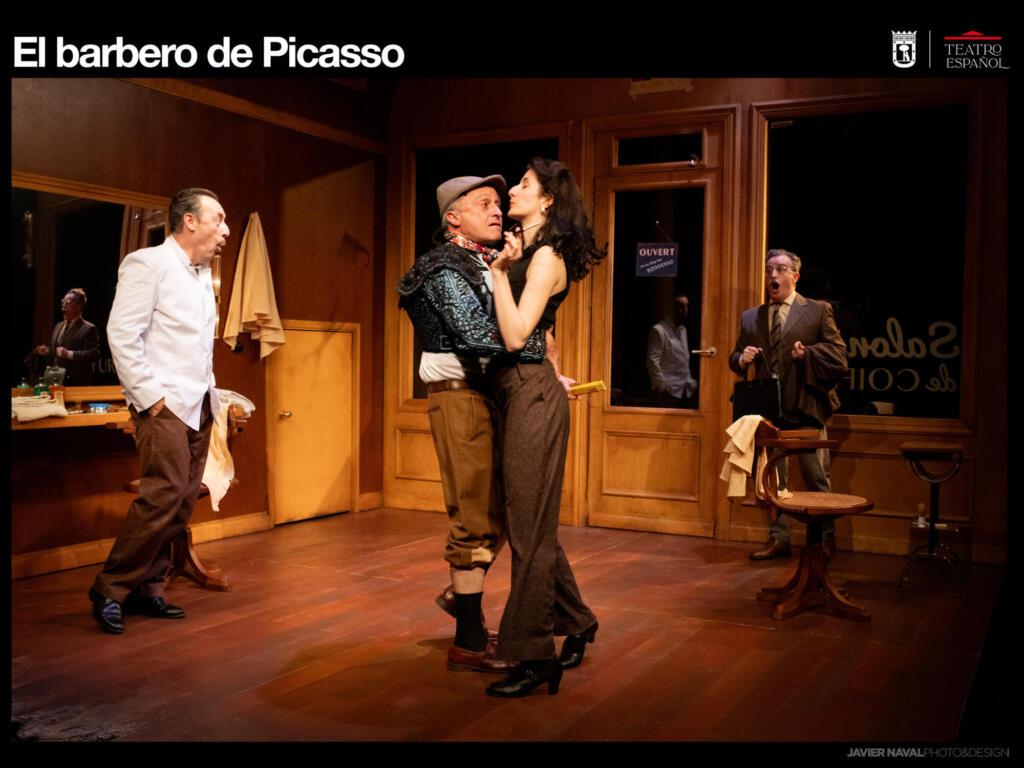
El barbero de Picasso [EN: Picasso’s Barber], by Borja Ortiz de Gondra, directed by Chiqui Carabante. Courtesy: Spanish National Theatre.
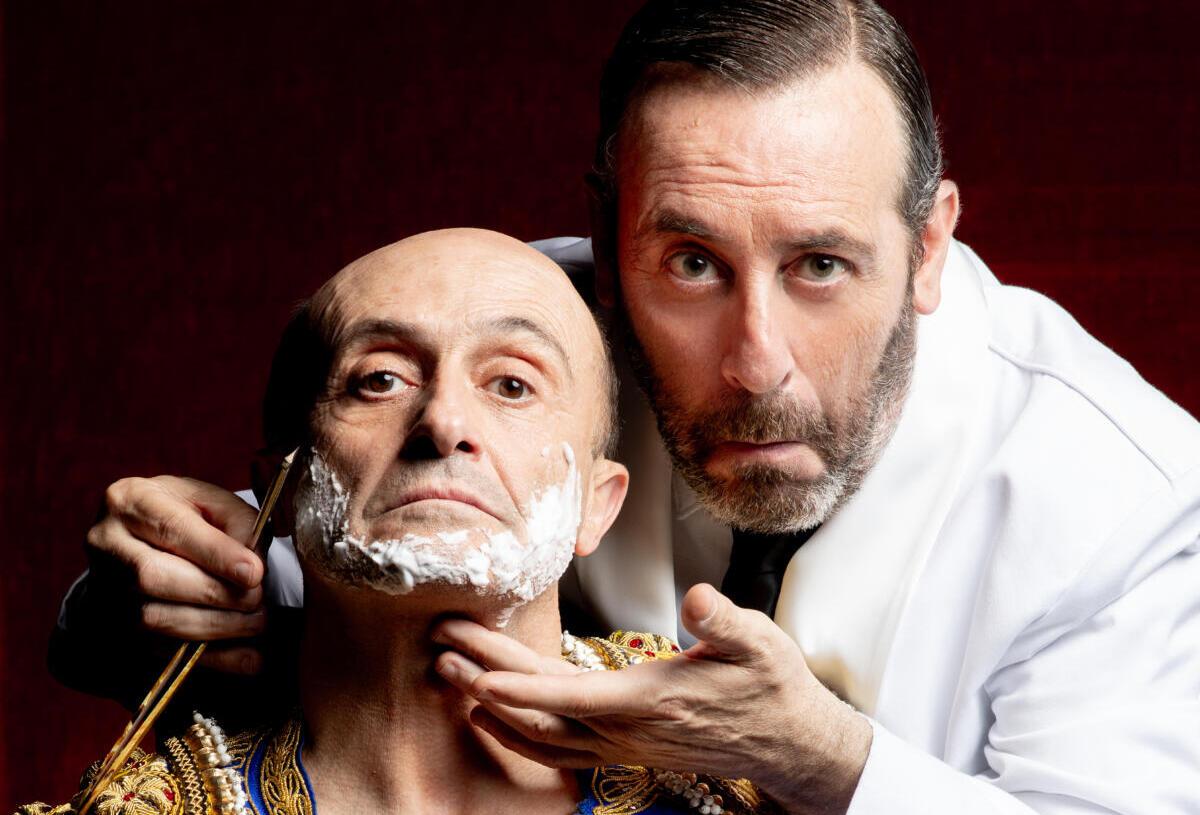
As the promotional poster of Viyuela being shaved wearing a matador’s suit of lights intimates, Ortiz de Gondra’s play is a potentially anachronistic example of the so-called costumbrista (comedy of manners) genre. Much like Miguel Mihura’s much-loved Paris-based 1964 play, Ninette y un señor de Murcia /Ninette and a Gentleman from Murcia, exile and nostalgia nevertheless infuse ostensibly lightweight drama with gravity and pathos. Although professional corridas were held in the South of France at the time, licenses stipulated that the bull could not be killed in the ring. Picasso and Arias’s frustration at watching a simulacrum of the real deal encapsulates sadness at not being able to return home.
In real life, matador Luis Miguel Dominguín, a friend of both Picasso and Franco, sought to facilitate the former’s return. The negotiations went nowhere; the dictator outliving the painter by two years ensured Picasso never saw home during his long exile. It was, as such, a compensatory gesture for the artist to break French laws, ensuing a fine, and order the matador to kill the bull in a corrida that Dominguín organized for Picasso’s eightieth birthday in 1961. None of this is covered in the play, which instead focusses on the personal and political drama of Arias – who, unlike Picasso, saw active combat in the Civil War on the Republican side – wondering whether it is safe to return to Spain on receiving news of his mother’s death. His decision to risk returning to the madre patria marks the end of the play.

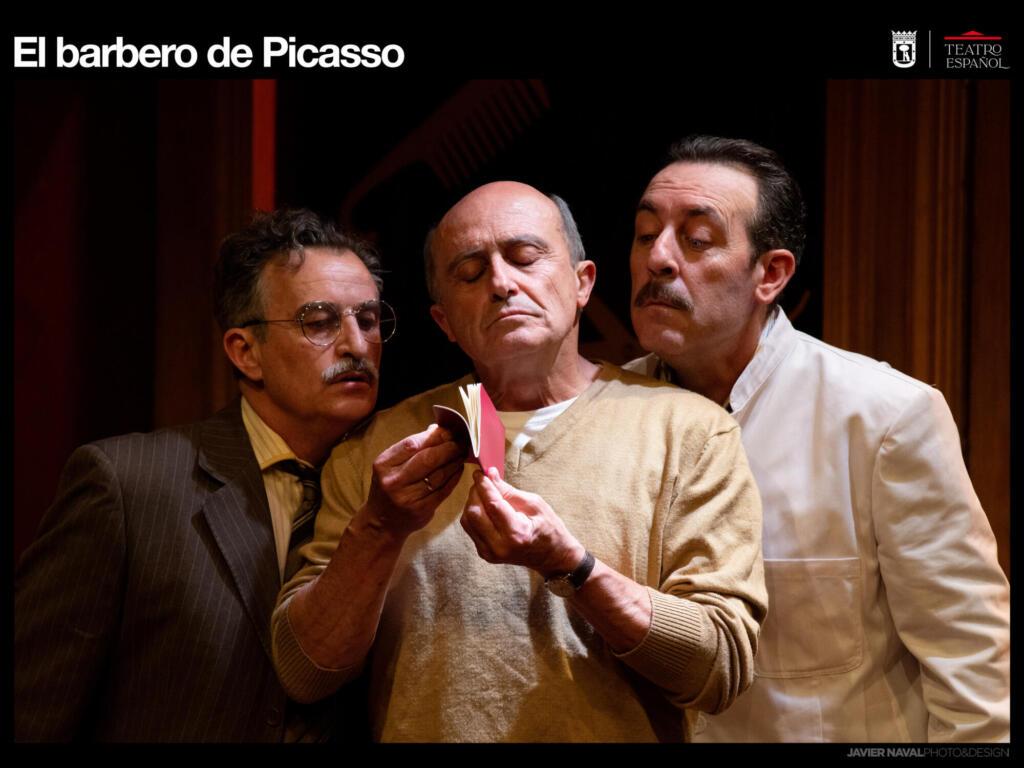
El barbero de Picasso [EN: Picasso’s Barber], by Borja Ortiz de Gondra, directed by Chiqui Carabante. Courtesy: Spanish National Theatre.
On the night I attended during a short sold-out run, a middle-aged and elderly-audience gave a heartfelt standing ovation. On the one hand, El barbero de Picasso is less ambitious or groundbreaking than what might be expected of the national theatres of a major European country – it plays to the gallery, delivering just what its target demographic looks for in a night at the theatre. The decision to simply ignore broader conversations in Spanish society surrounding Picasso’s treatment of women and bullfighting is also questionable, albeit consistent with the unapologetic character and politics of Eduardo Vasco, the theatre’s artistic director since 2024. Conversely, Madrid being a European capital in which theatre continues to constitute such an unusually prominent part of the urban social and cultural fabric is a result not just of the quality of productions, but also of loyal local audiences who maintain a dialogue with each other and in response to what takes place on the stage.
Subsidized theatre being unusually cheap (admission rarely costing more than twice that of a cinema ticket) helps. Irrespective of external factors at play, it is however a (sadly increasingly rare) pleasure to be in a city where young and elderly people regularly congregate to attend the theatre. In his time as artistic director of the Spanish National Classical Theatre Company (2004-2011), Vasco successfully prioritized attracting younger audiences. This does not thus far appear to be a priority in his new post, but he has some very satisfied customers. Much as was the case with the Federico García Lorca-inspired Poncia, starring the daughter of folkloric superstar Lola Flores, playing nearby, the audience for El barbero de Picasso raises the experience of seeing an otherwise solid play to the next level.
This post was written by the author in their personal capacity.The opinions expressed in this article are the author’s own and do not reflect the view of The Theatre Times, their staff or collaborators.
This post was written by Duncan Wheeler.
The views expressed here belong to the author and do not necessarily reflect our views and opinions.