




Jump Links
-
Designing Rango and the townsfolk
-
Verbinski’s biggest challenge
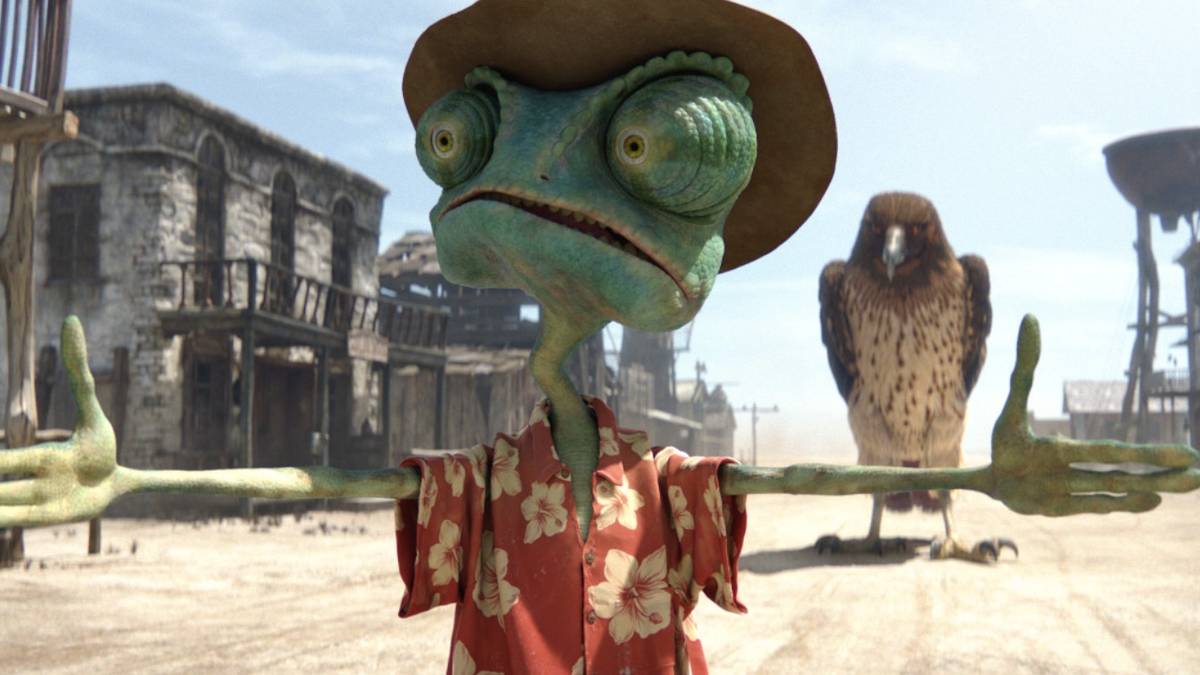
Rango still stands alone. Beginning as an independent venture from Pirates of the Caribbean trilogy director Gore Verbinski, the animated western was rejected by several studios before being brought to life, not by Pixar or another well-established animation studio, but by special effects house Industrial Light and Magic as its first fully animated film. To date, the movie remains Verbinski’s only animated feature, and even more impressively, there’s still nothing else like its dusty Western aesthetic populated by wonky, wacky anthropomorphic animals.
Rango tells the story of a pet chameleon who gets stranded in the desert. He soon finds a small town called “Dirt,” which looks like something out of the old west. To fit in, Rango pretends to be an accomplished gunslinger. When he half-accidentally kills a hawk that’s terrorizing the townsfolk, he’s suddenly anointed as sheriff. But when Dirt’s entire water supply is stolen, Rango has to step up and find out who is responsible. (Yes, it’s a blatant Chinatown knockoff, a reference Verbinski happily admits to.)
Production began small, in Verbinski’s own home and one-by-one he added writers and artists to flesh out the story and characters. Accustomed to live-action filmmaking, Verbinski developed a unique process of having his actors provide a physical performance along with their vocal one, which animators used for reference. While entirely unconventional in its production, Rango then went on to win the Academy Award for Best Animated Feature, beating out two Dreamworks movies (Kung Fu Panda 2 and Puss in Boots).
“We didn’t know how to make an animated movie,” Verbinski tells Polygon, “but we knew how to make shots and how to put them together to tell a story.”
Here, in his own words on the 15th anniversary of the film, Verbinski looks back at his singular process for Rango, his biggest challenges coming from live-action and whether he wants to revisit animation, or even Rango himself, ever again.
The birth of Rango
Coming off his third Pirates of the Caribbean film, Verbinski was looking to try something new by getting into animation. The fact that he’d never directed an animated film before didn’t scare him off. In fact, that’s what drew him to it.
Gore Verbinski: I’ve always enjoyed animation. I storyboard a lot of stuff, so I think in terms of shots and I sort of think like an animator. Not knowing how to do it [drew me to it] — being drawn to “Oh, I haven’t done that. Let’s try that.” There’s a curiosity that is a big motivating factor.
It all started at a breakfast meeting at Art’s Deli in 2007 with a good friend, David Shannon and producer John Carls. David mentioned, “What about an animated Western with creatures of the desert?” It was not really a premise, but sort of a delicious prompt that stuck with me.
I took it home and over the next few weeks wrote this 12-page outline. I’m a huge Sergio Leone fan. I’m a huge Western fan, so the thinking went something like: Okay, Western. There needs to be an outsider coming to town. Who is he? If it’s creatures of the desert and he’s an outsider, why not make him aquatic just so he’s literally different? If aquatic, then how about a chameleon? You think chameleon, he can change his colors, he can be the great pretender.
Rango is a byproduct of not knowing.
As soon as you have this great pretender narrative, you’ll get into a scenario where, when the town needs the hero the most, they find out they have a fraud who ultimately must face this identity issue, overcome it, and be the thing that he’s been pretending to be.
Then I needed a plot: Okay, deserts need water, water plot. What’s the best water plot? Chinatown.
All that stuff made its way into the basic outline. It was like, 12 pages. It was very loose. I met with a friend, writer John Logan, who immediately got the identity questions. Then I met with a producer named Graham King and we raised a little bit of money to do a story reel. I reached out to my friend, James Byrkit, who I’d worked with on storyboards on a lot of my movies. John Logan, myself, and Jim started taking long walks, opening up that story.
Designing Rango and the townsfolk

While Verbinski developed the story with Logan and Byrkit, he brought in a team of character designers — including Mark “Crash” McCreery, David Shannon, and Eugene Yelchin — to find the unique look of the characters.
Gore Verbinski: We brought these artists to my house and I said, “Okay, I’m going to take these walks and work on this story. I want you guys to just go, Creatures of the desert, Western. Anything can happen. But think character first. Think Klaus Kinski as a rabbit. Think of Strother Martin. Think of Slim Pickens. Then take birds and lizards and beetles and rodents and make a character.”
Asymmetry was really critical.
There was a question of scale. Can a spider be the size of a rabbit? I’m like, “Don’t worry about scale. Just think [of a] guy from that kind of Western and go, ‘He’s a mole or he’s a snake or he’s a lizard.’” They started crafting all kinds of crazy ideas, not really knowing what the story was.
Asymmetry was really critical. We’re going to fight the computer’s tendency to make everything symmetrical, to draw our characters where, when they’re in a T-pose, it’s lopsided. It’s not balanced. I wasn’t interested in the aesthetic of Pixar and all these places, which I think are doing really great work, but there’s already 10 people in line chasing Pixar. I don’t want to be number 11 trying to do what those guys do so well. Let’s go over here, a completely different area. Also, I just think Westerns need to be greasy. They need to be dirty.
Finding a home for Rango

Once the script was developed enough, Verbinski hired editor Wyatt Jones to put together an animatic — a version of the entire film, but with rough storyboard drawings and audio. While Verbinski had already arranged for his Pirates of the Caribbean star Johnny Depp to play Rango when the time came, for this rough version, the director himself did most of the voices, along with Byrkit and Logan.
Gore Verbinski: The whole thing was a super low-fi version of the whole movie. It was just drawings and mono recordings. That went on for about a year, then we brought all these studio executives over to the house to watch and they were all just like, “What the fuck is this?”
Then Brad Grey [from Paramount] came over. Brad needed an animated movie because DreamWorks had just left Paramount and he needed to prove to Jeffrey Katzenberg [of DreamWorks] that “I don’t need you.” It was just one of those kismet things. So he was like, “Johnny Depp, lizard, desert. I don’t know what you just played me, but we’re making it.”
Recording Rango
When it came time to record the actors, Verbinski again did something unique. Rather than bring them to a recording studio to record just their voices, they rented an empty studio stage at Universal and acted out every scene with very basic props and settings. Verbinski then shot it like a traditional film, capturing both audio and video. The latter was used as a visual reference for the animators.
Gore Verbinski: We got the actors together in one place and for 12 or 13 days we just rerecorded over my voice and Jim’s and John’s. It was great because I could then go to the animators [with] this visual reference of the actor’s performance, which we kind of jokingly called “emotion capture.” There were no dots on anybody’s face, but we’d tell the animators, “Hey, look at how fast that neck snaps or look at the twitch in the eye.”
We didn’t know how to make an animated movie, but we knew how to make shots and how to put them together to tell a story. There’s something about not knowing how to do something that is often your greatest asset. Rango is a byproduct of not knowing.
Verbinski’s biggest challenge

Coming from live-action filmmaking, Verbinski says his most difficult transition came during the animation process itself.
Gore Verbinski: The computer wants everything to be perfect and pure and clean. Everything’s conspiring to make it clean and symmetrical and perfect. And so, putting in film weave, putting in lens flares, having a character stumble or get a piece of dust on their shoulder. Those are all gifts that come in live action. You don’t have to think about it. Usually you’re fighting against them because it’s like, “Let’s do a take two. You tripped.”
Instead, [in animation], we’re like, “Can you make him scuff his knee or trip or the door gets stuck a little?” You have to fabricate anomaly.
Will Rango return?
Though unconventional, Rango was a big success both critically and commercially, which begs the question if Verbinski will ever revisit the character with a sequel, or if he’ll at least return to the medium of animation.
Gore Verbinski: I don’t think [I’d do] a sequel on Rango, but I do like animation. We’ve worked on an animated musical for about seven years that we’re still trying to get made. It’s called Cattywampus. It’s about these funky space cats and it’s really outrageous. We tried to push the Rango boundary even further and take on the challenge of a musical as well. So I’m still hoping to get that made.