





The Broadway Theatre Review: Daniel Radcliffe invites us into a deeply personal, quietly communal experience
By Ross
A handshake shouldn’t feel like a high-stakes audition, but that is exactly how my night at Every Brilliant Thing began. Daniel Radcliffe met my eye before the show had even properly started, asked my name, and gently tested whether I might be willing to step into his story. My answer hovered somewhere between yes and no, and he read it perfectly, smiling with a kind of intuitive grace before moving on. I know many of my friends would have jumped at the chance to engage, but the relief I felt was immediate and clear, and so was the realization that I had already been folded into the fabric of the evening. Even from my seat, I was part of it.
That sense of inclusion defines this Broadway staging of Every Brilliant Thing, now playing at the Hudson Theatre. Written by Duncan Macmillan (People, Places and Things) with creative consultant Jonny Donahoe (Thirty Christmases), and directed by Jeremy Herrin (West End’s Best of Enemies) alongside Macmillan, the play takes on the weight of depression and suicidal ideation with a structure that is deeply connecting, but deceptively simple. A child begins a list of everything that makes life worth living in an attempt to save their mother. And that list grows, and grows, over the years into something both personal and communal.

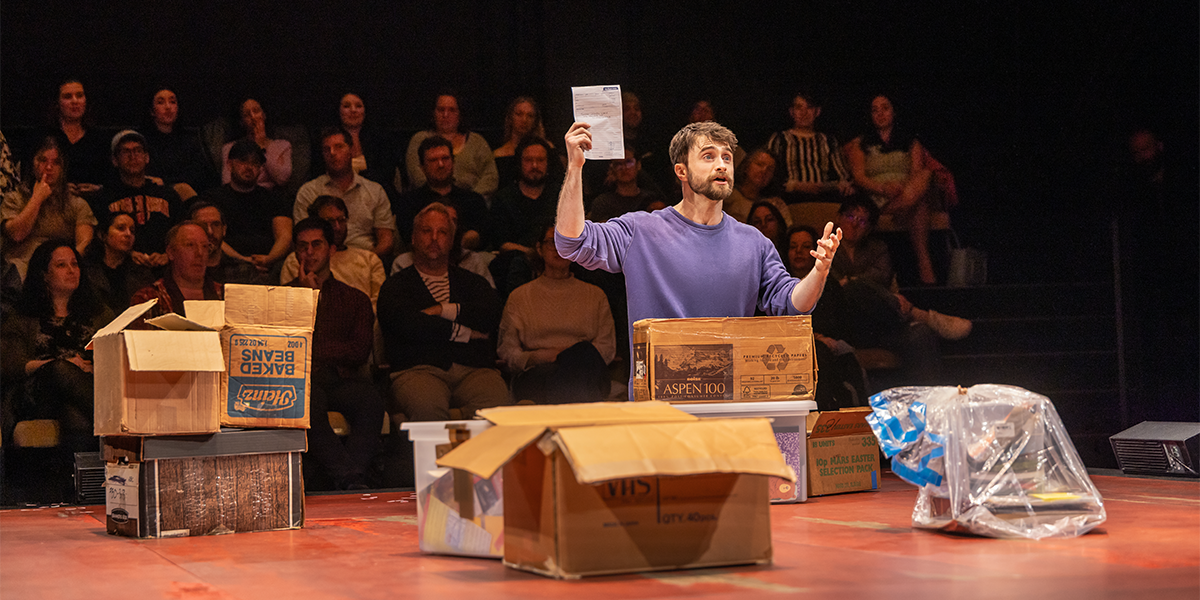
Radcliffe, last seen on the New York stage in Merrily We Roll Along, proves to be an ideal guide through that terrain. His performance is marked by an open, searching earnestness that never feels forced or inauthentic. He greets the audience not as spectators but as collaborators, moving through the space before the show begins with an openness that is inspiring. He connects, placing list items into eager hands, and establishes a tone of trust that carries through the entire seventy minutes. His improvisational ease is particularly striking, allowing each interaction to feel spontaneous and utterly caring, while maintaining a clear emotional through line. It is not simply charm at work, though there is plenty of that. It is a careful calibration of tone, knowing when to lean into humour and when to allow silence to settle or a disco ball to highlight the mood.
The production itself expands the piece’s intimacy into something that feels personal despite its Broadway scale. Vicki Mortimer’s design places a simple platform at the centre, surrounded by hanging bulbs that extend outward into the audience, creating an environment that feels shared rather than observed. That sense of shared space is crucial because the play relies on participation as a means of storytelling. Audience members are invited to read lines, embody figures from the narrator’s life, and contribute to the ever-growing list of brilliant things. Each performance becomes its own living organism, shaped by the people in the room and the energy Radcliffe brings to it.

That interactivity, however, carries its own tension. There are moments when the lightness of participation tips too far toward whimsy, brushing against the heavier themes without fully settling into them. I found myself admiring the craft more than feeling fully immersed in its emotional depth, a distance that occasionally undercuts the impact of its most vulnerable ideas. The balance between playfulness and gravity is delicate, and not every moment lands with equal clarity, yet even within that fluctuation, the intention remains clear. The production is not interested in presenting a polished, distant exploration of mental health. It is interested in proximity, in asking the audience to sit inside the experience rather than observe it from a safe distance.
What emerges most lovingly is the way the play charts a life over time. The list that begins with something as simple as ice cream grows into a catalogue of survival, a way of marking moments of joy against the persistent presence of darkness and despair (a much-needed ideal at this moment in time). The narrative moves through childhood, adolescence, and adulthood, tracing not only the mother’s struggles but the narrator’s evolving understanding of their own mental health. It becomes less about rescuing someone else and more about learning how to live with the knowledge that not everything can be fixed or saved.

Radcliffe holds that shift with a quiet precision that deepens as the evening unfolds. His performance allows for humour without deflection and vulnerability without sentimentality. When the play gestures toward the language of crisis, even referencing real-world, much-needed guidelines on how to speak about suicide responsibly, it does so with a clarity that cuts through the surrounding theatricality. These moments ground the piece, giving weight to what might otherwise feel fleeting and connecting us to what is ultimately at stake.
By the time the final moments of Every Brilliant Thing arrive, that early interaction lingers in a new light. The question of participation no longer feels like a test or a moment of nerves, but an entry point into something shared. The list, in all its specificity and randomness, has become a collective act, built not just by the performer but by everyone in the room. What began as a private attempt to hold onto a mother’s life opens outward into a communal gesture, one that quietly insists that even the smallest things, spoken aloud and held together, can carry more weight than we expect. And that means more than one could ever imagine.