









Picture Courtesy of Netflix and Theo Demiris
Peaky Blinders: The Immortal Man is a world of lived-in, substantial style. The Tom Harper-directed and Steven Knight-scripted gangster story is every bit as transportive as the series. The VFX supervisor behind the film, Theo Demiris, is one of the artists responsible for the impeccable result.
From World War II, explosive action, and the city of Birmingham – Demiris and the effects team had an epic backdrop to create for Thomas Shelby (Cillian Murphy). “When you give the people something they don’t expect, they accept it as realism,” Demiris said, paraphrasing the production designer Jack Fisk (Chinatown). “If you give them exactly what they think they should see, then sometimes that feels fake. But if you add a little twist, if you make it slightly different, then that can add to the realism.”
Recently, the visual effects supervisor spoke with What’s On Netflix about building Shelby’s world.
How do you and the visual effects artists want to set the tone and vision for Immortal Man with the bombers, the train, and all the elements going on in the opening of the film? How much World War II research was required?

It’s very interesting because the world of Peaky Blinders is not quite the “real” world. Everything is slightly heightened. The music is modern and cool, the characters are larger than life, and the dialogue often has that same quality. It is a bit like a graphic novel, though not quite. But for the film, we wanted to take a small step back from that. We wanted it to feel bigger, but also slightly more naturalistic.
We shot parts of it on 35mm film and favored real locations for almost every part of the story. As a result, the first 15 minutes of the film needed to capture and convey that slight shift in tone. This is still very much the Peaky Blinders you know and remember, but bigger and ever so slightly different. A feature film rather than a television series. So those opening moments are all rooted in reality, from the concentration camp and the inmates forging five-pound notes (part of a real-life ploy to topple the UK government) to the bombing of the BSA factory in the heart of Small Heath, Birmingham, where 53 munitions workers lost their lives.
At the same time, they are expressed through a slightly heightened lens: the first line of the film, “Hail fucking Hitler” (which I believe Tim Roth improvised on the day), the workers’ bikes flying through the air, and finally the main titles dropping in and graphically interacting with the smoke from the collapsing factory behind them. It is all ever so slightly heightened, while still remaining tangible and visceral.
For the bombing, did you and the artists want to stay true to the scale of the explosions caused by those bombers? How’d you all want to get the interior of those war planes just right too?
The bombing of the BSA factory was by far the most challenging part of our work, from the interior of the plane, to the bombing itself and the explosions, and finally, the reveal of the aftermath the following morning. Lighting is easily the most important component in making a scene like this feel tangible and real. For the cockpit shot, that meant simulating the light coming from the flak on set, so you get real light hitting the actors and real shadows playing across the interior. It is such a beautiful shot, and I think what really brings it together is how organic the camera move is, in this particular case operated by Tom Harper himself, along with the drops of water sliding down the windows.
For the destruction of the BSA factory, it meant doing a practical explosion, as large as the limitations of the location would allow us, filming it with seven cameras, and then enhancing it digitally in post. The explosion, of course, could not actually damage the location, so we had to add the collapsing walls, debris, lots of flying CG bikes, and so on in post, while still preserving parts of the real explosion and smoke from the plates. We then had to transition organically into a CG version of the location in its destroyed state.
By the end of the sequence, we are looking at almost fully CG environments. The big trailer shot from that sequence, the wide shot showing the main explosion and the larger scale of the damage across the area, took a long time to get right. Halfway through the post, there was an explosion at a fireworks factory in the United States, which we used as reference to make our own explosion more interesting, adding smaller secondary puffs as though the ammunition stored in the factory was also reacting to the bombing.
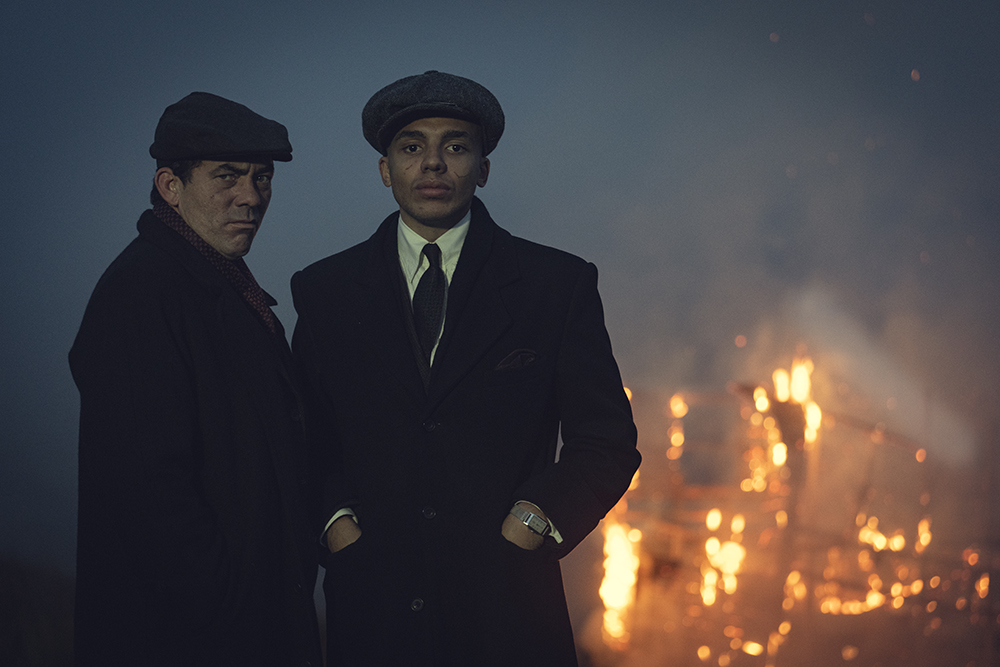
Peaky Blinders: The Immortal Man. (L to R) Packy Lee as Johnny, Jay Lycurgo as Elijah in Peaky Blinders: The Immortal Man. Cr. Robert Viglasky/Netflix © 2026.
CG blood is always tricky, especially in horror movies, but what about period pieces? How do you and the VFX team get blood accurate but cinematic?
All of the blood in the emotional finale is entirely digital. Everything from the blood on their clothes and hands to the pools of blood on the floor was added later and carefully art directed for believability and maximum impact. It was probably one of the fiddliest parts of our work, and Guillaume Menard and the rest of his team at One of Us absolutely nailed it.
In terms of getting it right, the challenge is really about colour and sheen. Blood is much, much darker than we tend to imagine. You also have to fight the temptation to go too big. “No Zack Snyder shots” was our motto.
How was the final explosion in the film pulled off?
There are the crates holding all the money. Cillian slides in a mine and they explode. That explosion, which I think looks real, and I don’t think you could tell that it wasn’t real, that one has a lot of CG stuff. Applied to it to make it feel bigger. It had a base, a practical base, and then CG all around it, but no green screens. If you think about it, it’s difficult to put things behind other things, let alone when it’s a lot of small parts. The amount of time and effort it takes to blend CG behind a real explosion of debris is mind-blowing.
How you get all those layers to work together and have depth, it’s difficult. And then make the whole explosion interact with the roof of the building and the glass falling down. There’s so much detail there. It’s a shot that we realized late in the edit that we needed to enhance it because it didn’t quite feel big enough or a climactic ending. We didn’t have much time. We had about a month to turn it around, and we made it 50% bigger.
Are there any major or minor differences in post-production when it comes to working on 35mm film than digital?
Really, the work is the same. You just have to go through a few more steps in the beginning and a few more steps at the end. Now, we did something very interesting, which I had never done before on this one. We shot film, but we didn’t shoot everything on film. We shot a small part of it on film.
Why’s that?
We couldn’t afford to do all of it on film, and actually, Netflix didn’t really want us to do it on film, but we shot basically a few scenes on 35. The idea being we then used that as a grading reference for everything else, to grade to that and make it all look good. But then what we also did is everything that was shot digitally, we transferred to film at the end. We did what is called the DFD process.
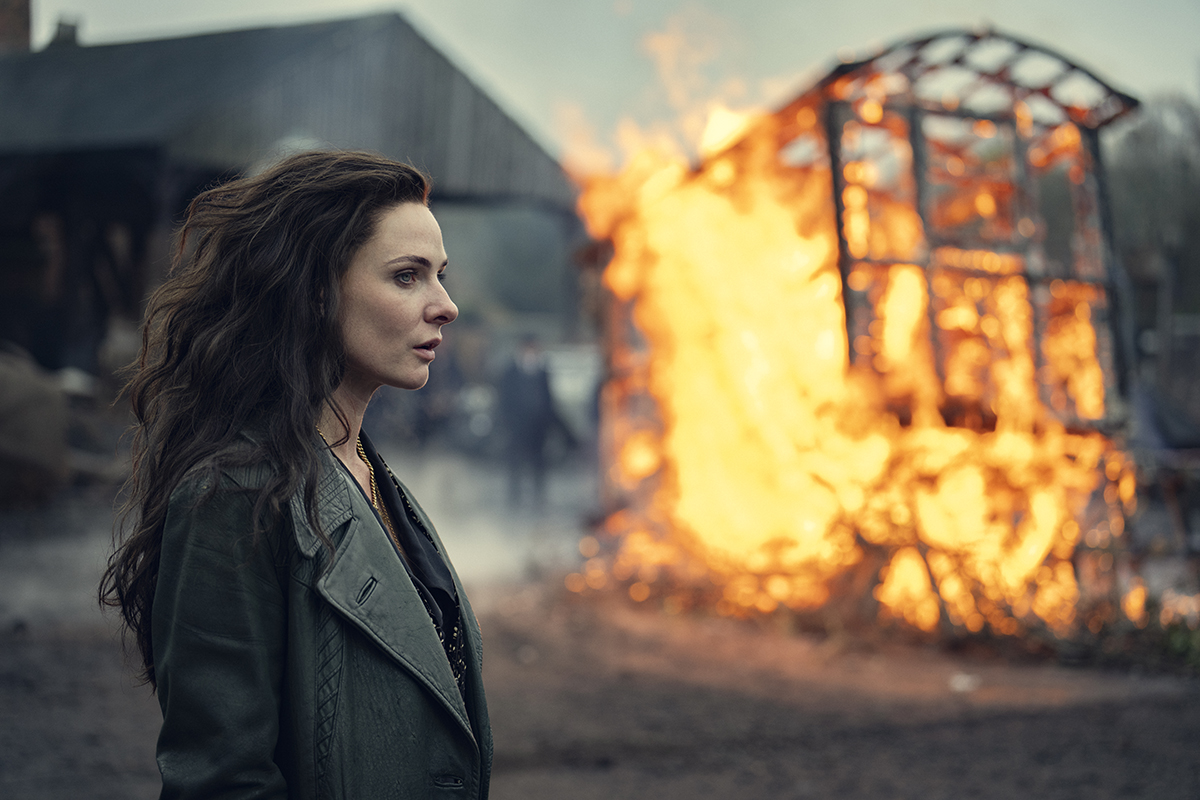
Peaky Blinders: The Immortal Man. Rebecca Ferguson as Kaulo in Peaky Blinders: The Immortal Man. Cr. Courtesy of Netflix/Steven Barham © 2025
Can you break that down for our readers, please?
We used the same stock that was used on set. Then basically everything that was digital – all the VFX shots at the end after delivery — was graded and then taken back and projected again and scanned onto that same stock to bring everything together. What it did was make the VFX look a little bit better, because it applied grain, imperfections, and everything on top of everything. So a full CG shot, a shot that would otherwise maybe look a little bit too sharp, now looks perfect.
A pivotal location in the film is the Waterloo Dock. You have to do some big establishing shots of the location. What’s the challenge there?
The interesting challenge in creating the Waterloo Docks was really the limitations of the locations. The exterior of the docks was actually put together by combining three entirely different places, along with some large-scale CG shots. Our job was to bring all of that together into one coherent landscape.
Knowing the main beats of the story, we designed the environment and created concepts using those different locations early in pre-production. We even adapted our storyboards to reflect the CG environments that would be added later. By the time we came to shoot the sequence, we already knew where everything was, which meant we could frame the cameras accordingly.
Our main “water” location gave us a surface to work with, so we could film real canal boats, but pretty much nothing else. There were no tunnels for them to exit from, and of course, no period-appropriate buildings. We avoided large water simulations, but we did have to render CG water surfaces to remove some of our lighting cranes and the multiple moonlights in the reflections. [Cinematographer] George Steel still owes me a beer for that one.
I’m very happy with how it all came together, and some of the wide establishing shots of the docks I consider some of the best VFX in the film.
The set extensions in the movie are wonderfully done. How do you always want them to communicate depth and scale?
First, a hell of a lot of research. Our office was literally covered in pictures. I’m big on Pinterest, so I make boards for everything. While scouting, I was also collecting books from local museums. They often had material on the various places and how they had changed over the years. That allowed us to look at our filming locations and compare them to how they would have looked in the 1940s. It is invaluable intel because it gives you a base level of realism that then feeds directly into the concepts.
Then, when building the environments in the layout phase, you always, always, always aim for architectural coherence — correct distances, real scale. Does this back alley make sense? Where does it lead? Can a truck park there? Never dress for the camera, because that only comes right at the very end. I always want a bird’s-eye view of the CG environment so we can properly evaluate those things.
Finally, you add a huge amount of detail, even the detail you think will never really be seen, and then you hide most of it with atmosphere. You still feel that detail and realism, even if you do not necessarily see it.
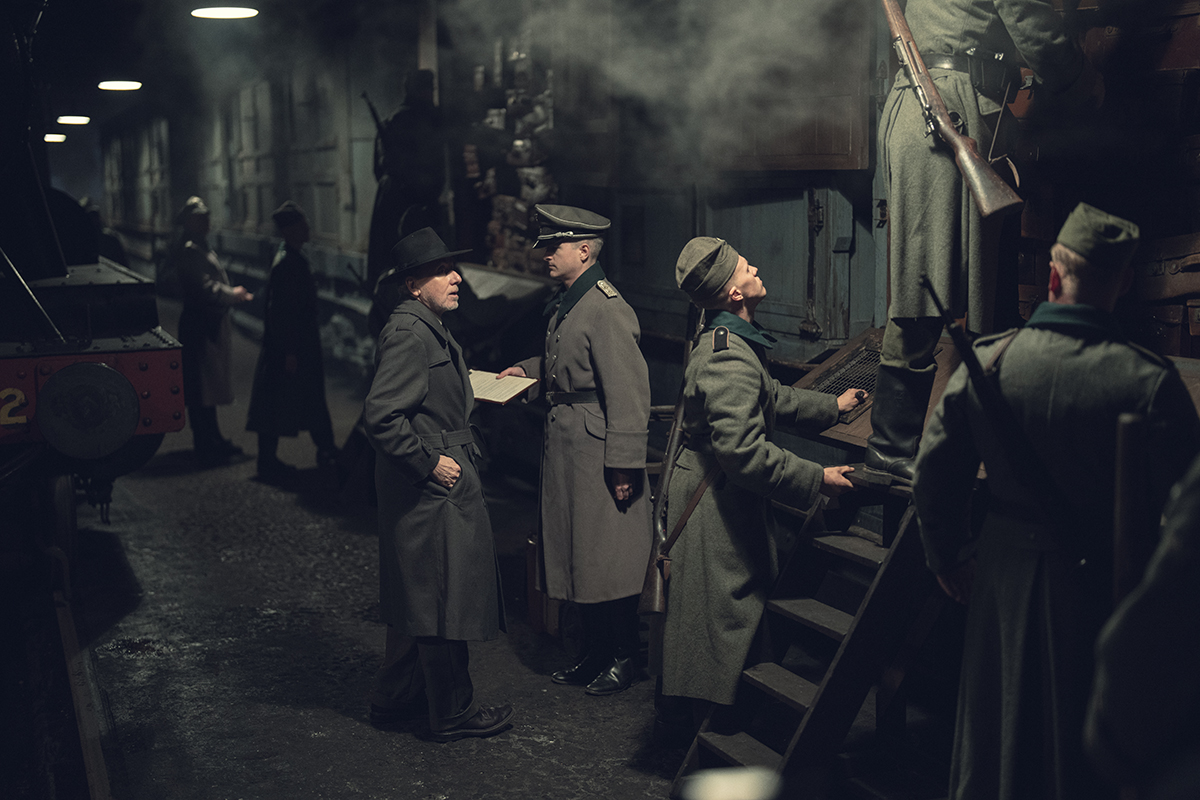
Peaky Blinders: The Immortal Man. Tim Roth as Beckett (Left) in Peaky Blinders: The Immortal Man. Cr. Robert Viglasky/Netflix © 2026.
What would surprise readers about just the challenges of creating a background, the CG set extensions they see in the movie?
It used to be that you would do matte painting. You would do a painting, put it on glass, and film it. Even though it’s digital now, you want to put more thinking into it. You want to treat it like urban planning. You want to think about the logic of an environment. If you’re doing something realistic, you don’t want to design it for an angle. It’s what I call architectural sense. It needs to exist. It needs to be a real place that people can navigate through.
Even if you don’t see the roads or the distances between the buildings, you’re going to feel that gap. If you start cheating too much, if you start making everything perfectly hyped to the camera, then it’s kind of like Gotham City in early Tim Burton. Everything is exaggerated. You don’t want that.
You often hear from VFX supervisors and artists that they don’t want that perfection.
It’s okay for something like Avatar, something that lives in that world, because then it doesn’t stand out. Something in the real world, I think you need to mess it up ever so slightly. Nothing is perfect. Look at this behind me — the atmosphere and blur. You can’t really see what it is. You kind of know what it is, but you don’t fully see it.
What I mean by imperfections: little blur, slight distortion, chromatic aberration, a bit of grain, all of those things. By doing so, you are hiding stuff and making it feel more real.
Whenever they would show me something, they would show it from the camera, and I would ask, can you put a camera up here and show me basically the top-down angle of that same environment? Sometimes you would see that the artist was cheating — moving things around to make it look prettier — but the job isn’t to make it prettier. It’s to make it more realistic. Prettier comes later, maybe.