








In June 2025, Israel launched “Operation Rising Lion,” a sweeping aerial campaign against Iranian nuclear facilities at Natanz, military and political leadership, and missile infrastructure. The 12-day exchange of strikes that followed briefly threatened to draw the United States into direct, large-scale combat with Iran. Missiles flew, air defences were tested, civilian areas suffered collateral damage, and both sides declared victory. Yet within weeks, the most striking feature of the conflict was not the kinetic damage, but the avalanche of lies, half-truths, and fabrications that flooded global discourse.
To apply an indelicate phrase to the strategy: flood the zone with shit.
The Iranian flashpoint is in a new cycle – the shadow war turns hot in 2024, boils over in 2025, and explodes in 2026. It serves as a constructive case study in how modern warfare is increasingly fought through narrative control as primary firepower. In an era of instant global communication, precision munitions, and both functional[1] and generative AI, “truth” becomes the first casualty. What this reveals is not the mere persistence of propaganda, but its evolution into something more sophisticated, decentralized, and harder to debunk.
Clausewitz’s “fog of war” is now thickened by algorithms, state media, and viral disinformation campaigns that serve domestic audiences, engender international legitimacy (with blowback illegitimacy), and signal deterrence (real and imaginary).
Consider the opening salvos.
Israel portrays its strikes as a necessary preemption against an existential nuclear threat, eliminating IRGC commanders and damaging enrichment sites. Iran responds with ballistic missile barrages, framing them as righteous retaliation while downplaying the effectiveness of Israeli (and later U.S.-assisted) intercepts, and exaggerating the destruction caused on the ground. Iran also hammers neighbouring Gulf states and even reveals long-range capabilities that threaten European capitals.
Both sides release selective footage: pristine videos of successful intercepts on one hand, dramatic claims of devastated airbases or cities on the other. Independent verification lags far behind the claims. By the time fact-checkers weigh in, the narrative has already hardened into competing “truths” for different audiences.
These falsehoods are not merely performative tennis. They are structural lies.
What makes the conflict particularly instructive is the explosion of AI-generated misinformation.
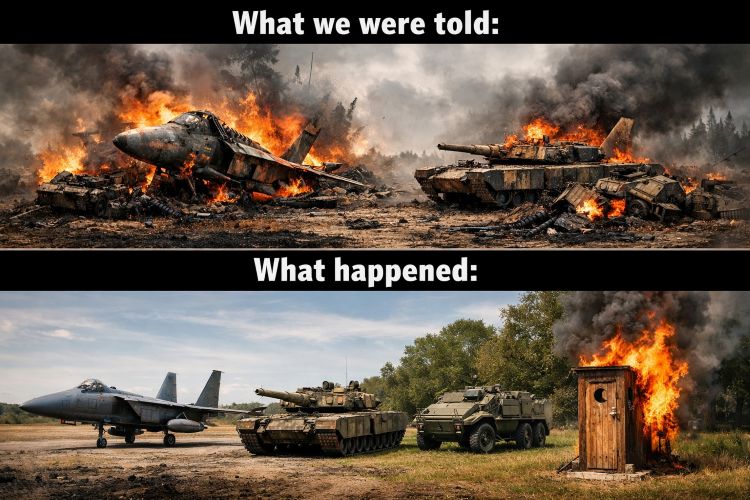
During the 2025 exchanges and recent flare-ups into 2026, social media platforms were inundated with deepfakes and fabricated imagery: videos purporting to show missiles slamming into downtown Tel Aviv, satellite photos of obliterated U.S. bases in the Gulf, wreckage of downed F-35s, and scenes of mass celebrations or panic that never occurred. Iranian state-affiliated outlets and pro-Iran accounts amplified content depicting apocalyptic damage to Israel.
Pro-Israel or western accounts countered with their own selective edits or outright fabrications minimizing Iranian resilience. Generative AI tools made these “shallowfakes” cheap, plentiful, and visually convincing enough to rack up millions of views before verification. Even AI chatbots queried by users seeking clarity sometimes confidently affirmed fake footage as real, prompting the Turing Centre to declare this the The First AI War in mid-2025.
This is not accidental.
Modern states – including their proxies and sympathetic networks – understand that in an attention economy, perception often shapes reality more than raw facts in order to support the narrative structure first and foremost. A viral video of a “successful” Iranian strike bolsters domestic morale and projects strength to allies in the “Axis of Resistance”. A narrative of precise, limited Israeli/U.S. operations reassures western populaces wary of another Middle East quagmire, and signals to adversaries that escalation will carry asymmetric costs.
These new bodyguards of lies serve multiple masters: regime survival in Tehran, deterrence and political unity in Jerusalem and Washington, and influence operations aimed at global south audiences skeptical of western power in principle, but deepening under missiles of words. Europe is largely flat-footed, yet perhaps most vulnerable.
The flashpoint also exposed older, more traditional forms of deception. Casualty figures are routinely massaged or invented. Damage assessments diverge wildly depending on the source. Israeli claims of “severe setbacks” to Iran’s nuclear program clashed with Iranian assertions of minimal impact and rapid recovery. Both sides engage in the time-honoured practice of “mowing the grass” not just militarily, but informationally, timing strikes and statements to fit preferred storylines.
When Iranian missiles cause limited but real damage in Israel, or when Israeli strikes hit civilian-adjacent areas in Iran, the framing shifted immediately. “Precision targeting” versus “barbaric aggression”, depends on the speaker.
The deeper revelation goes beyond any single belligerent.
The Iranian conflict demonstrates how modern war lies thrive in a petri dish of eroded institutional trust and fragmented media. Legacy outlets amplify official talking points with minimal scrutiny, especially when aligned with their manufactured editorial priors. Social platforms, despite moderation efforts, become vectors for state-linked influence campaigns. The speed of information flow outpaces verification, creating a permanent tule (TOO-lee) where even the most diligent observers struggle to separate signal from noise.
Lies are celebrated by each side, but they have profound implications.
First, they undermine, evens invert, deterrence: if adversaries cannot reliably assess capabilities or resolve because of pervasive disinformation, miscalculation risks rise. Few alive know – much less recall – razor-thin miscalculations such as The Soviet False Alarm Incident and Able Archer 83 and The B-59 Submarine Incident.
Second, they erode public consent for policy. Citizens fed a diet of competing fictions grow more cynical or polarized, making sustained strategic engagement more difficult for democracies.
Third, they favour actors willing to embrace ambiguity and narrative agility over those constrained by transparency or evidence-based discourse.
Brandolini’s Law enshrouds all three implications.
To be sure, the 2024–2026 Iran-Israel-U.S. exchanges are not the first conflict marked by propaganda – think Gulf of Tonkin, WMD (weapons of mass destruction) claims about Iraq, or the information war within the war in Ukraine. But they may represent a new benchmark of maturation. Generative AI lowers the barrier for plausible deniability and mass-scale deception. Precision weapons allow limited, “calibrated” strikes to be spun as either heroic restraint or reckless provocation. Proxy networks and deniable operations further blur lines of responsibility.
In short, there are many sprayers of excrement in the zone.
The splatter hits everyone.
This conflict reveals that the modern battlefield has transformed far beyond physical geography into the cognitive and informational domains. Victory is not only measured in destroyed facilities, neutralized commanders, or old-school McNameran body counts, but in the domination of the post-strike narrative. As long as states prioritize narrative control alongside kinetic effect – and as long as technology makes fabrication easier than ever – the “truth” of any flashpoint will remain contested, partial, and instrumental.
Readers of George Orwell’s 1984 might recall Victory Gin, Victory Cigarettes, and Victory Coffee, but readers today experience a barrage of Victory Narratives. Truth becomes collateral damage of the highest value: lies are “evidence” of winning.
Many know Orwell’s, “The Party told you to reject the evidence of your eyes and ears. It was their final, most essential command.”
But Orwell also stated that truth itself was deliberately, systematically, and serially rendered illegible, where “Everything faded away into a shadow-world in which, finally, even the date of the year had become uncertain.”
That lesson is sobering and impregnable: skepticism is essential, but blanket cynicism is paralytic.
Understanding modern war requires the dissection of missiles and strikes plus the layered deceptions that accompany them. This skill is far beyond an already-vulnerable public, having been fed attention pablum for decades. Worse, the scope, scale, and speed of deceptions mean few in the military, intelligence, policy and political spheres possess the skills necessary to see through the fog of their own creations and motivations laddered by the same actions and vulnerabilities on the other side.
The calculus of miscalculation becomes ouroboric.
The Iranian conflict exposes new vulnerabilities in air defences, nuclear programs, and regional power. More troubling, it lays bare the sophisticated design of contemporary war lies; a sophistication that eludes management, containment, and control.
Expect future conflicts to build upon rather than divest of this emerging template, with escalating stakes and indeterminate effects.
In 1984, The Ministry of Plenty (responsible for economic affairs, so think on that), “It was merely the substitution of one piece of nonsense for another.”
[1] Functional AI in military usage distinguishes functional action from the ubiquitous content creation that many readers use or are deeply aware. Functional AI systems are often classified as discriminative AI (classifying input), predictive AI (forecasting), or autonomous weapon systems (executing actions). Generative AI for Defence involves models (including LLMs) to generate novel content (text, code, or images) that mimic the statistical properties within training data. Here’s a great resource for the curious.
(Richard LeBlanc – BIG Media Ltd., 2026)
![18th Jun: GOAT Pandemonium Ge on all tempo (2025), 1hr 46m [TV-MA] (6/10)](https://occ-0-1403-999.1.nflxso.net/dnm/api/v6/0Qzqdxw-HG1AiOKLWWPsFOUDA2E/AAAABREKHQDTS_fedcGIvkhaREJUkcS3mPPSQTBA2tGh9QFnB3LHla62hZVJgIv4mN2InxbMr0sJohaLzMEVQr-dvZP2sTUNR1glfBeIWOH7m1j7BHC0Df6t3BBCsmyefocG3ixhLJCXseqsto88OCcIw0lTuLUSCWfxQ5bwuv5lQSFUqg.jpg?r=caf "18th Jun: GOAT Pandemonium Ge on all tempo (2025), 1hr 46m [TV-MA] (6/10)")