









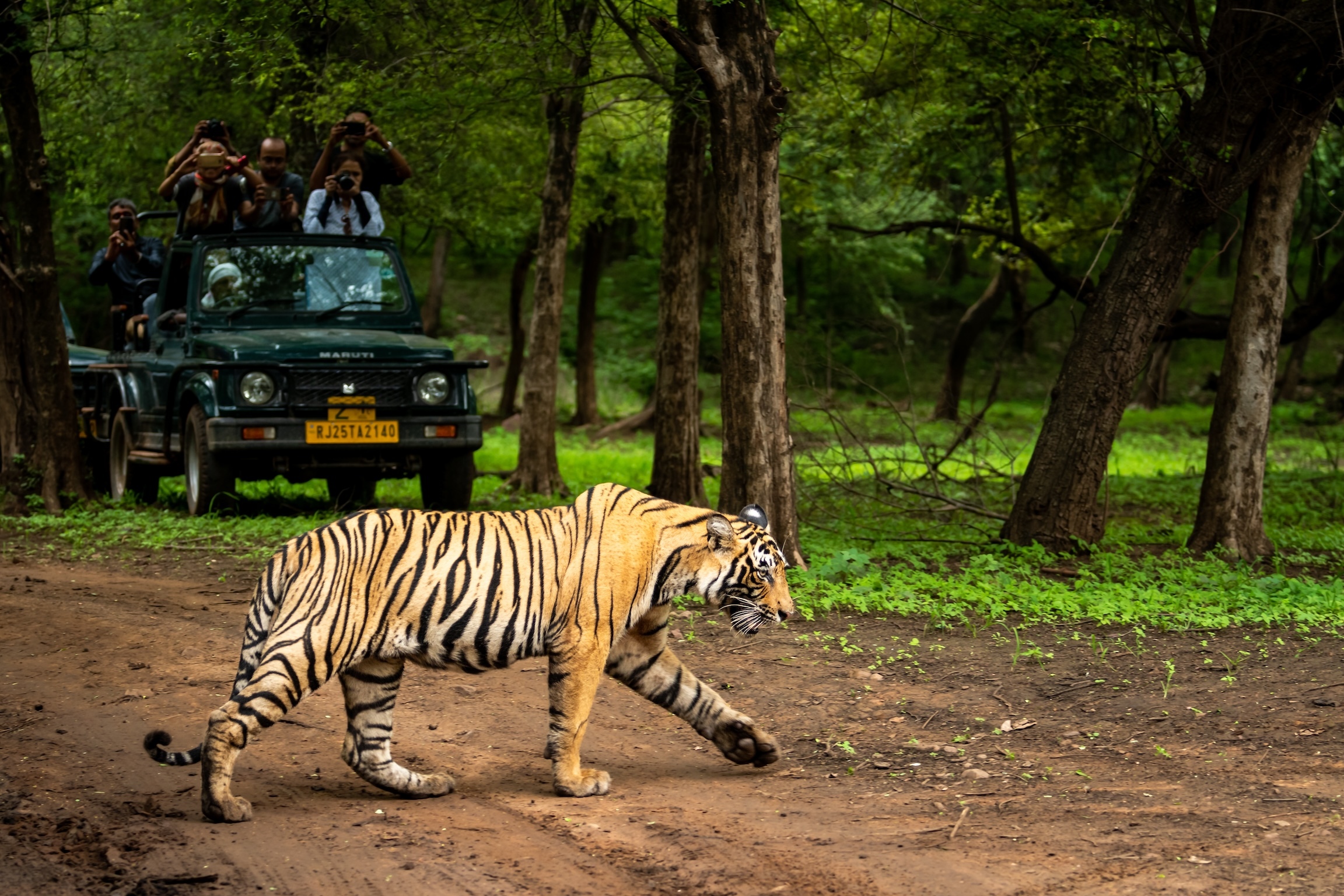
It’s understandable that, after quietly trundling along for what can be hours at a time, the long-awaited appearance of a resplendent tiger will make you want to reach for your smartphone. But if you’re on safari in India, you soon won’t be able to snap a photo of the creature yourself.
Back in November 2025, the country’s Supreme Court passed a ban on the use of mobile phones in tiger reserves across India, largely due to increasingly detrimental behaviour by tourists. The ban is expected to come into place from October this year, after the end of the monsoon season.
But, what does bad tourist behaviour actually refer to? Well, ‘in many ways, it is a classic case of a few people spoiling things for the majority,’ Managing Director of TransIndus Amrit Singh said to Wanderlust. ‘Park authorities had become concerned by the growing number of visitors distressing wildlife and placing themselves, guides and naturalists at risk, simply in pursuit of selfies or social media footage.’
And while it is a shame that the few have spoiled taking photos for the many, there are a couple of alarming instances that shed light on why this measure is necessary.
In February, reports from Ranthambhore National Park detailed a distressed tiger, surrounded by vehicles of visitors shouting and taking photos, struggling to retreat back to the jungle for refuge. Other instances have seen people dropping their phones and diving out of the safety of the vehicle to retrieve them. Unhinged.
Oh, and then there was when a child was accidentally booted out of a jeep in a mad rush to snap photos, which not only put their life at risk, but also that of the guide who jumped out to save them.
‘Safari jams’ have become quite a major problem, while nighttime safaris often lead to lots of flash photography, which upsets the animals. There are even concerns that unrestricted mobile communications could aid poaching activity through real-time location sharing.
What will the ramifications of mobile phone use be?
Tour operators have been given six months to implement the measures outlined in this ban, such as installing secure lockers for visitors to store their phones. Any visitor not complying with the rules could face a fine, and any park failing to enforce them could have its safari permit stripped.
It’s worth noting that photographers carrying digital and video equipment will still be able to do so, as long as their conduct in snapping photos is responsible.
India’s tiger population has doubled
It’s not all bad news – due to brilliant success with the revival and preservation of the country’s tiger population, numbers across India have effectively doubled. It’s the flourishing population which has contributed to a rise in tiger-spotting tourism.
Paired with the aim of limiting ‘safari jams’ and mobile phone usage, the legislation also plans to limit development in the areas surrounding nature reserves.
Did you see that the world’s top historical stays have been revealed by Wanderlust magazine?
Plus: This popular European holiday destination is setting out new rules to curb overtourism.
Stay in the loop: sign up to our free Travel newsletter for all the latest travel news and best stuff happening across the world.


