


![30th Jun: Shark Tale (2004), 1hr 30m [PG] – Streaming Again (6/10)](https://occ-0-8208-92.1.nflxso.net/dnm/api/v6/0Qzqdxw-HG1AiOKLWWPsFOUDA2E/AAAABdfzt3R9RjKOz4OlNCiExKyYSMy9ARcjChZDazUgEeIVEzyK4mc8iLpRV0_ojqqvnHXe6nztYK8jW2k6YpoqsenuhCHi2_xcsGsZ.jpg?r=fa2 "30th Jun: Shark Tale (2004), 1hr 30m [PG] – Streaming Again (6/10)")




Tove Ditlevsen was a Danish working-class poet, novelist and feminist icon. Her memoir The Copenhagen Trilogy was initially published in separate parts. Childhood and Youth came out in 1967 respectively; and Dependency (titled Gift in Danish, meaning both ‘marriage’ and ‘poison’) was published in 1971, just five years before the author’s death by suicide at the age of 58.
According to her Swedish Wikipedia page, Ditlevsen received a resurgence of interest in the 21st century through several theatre projects focusing on her life and work. The first English translation of her memoir in 2019 also contributed to international interest. In 2024, Swedish/Danish playwright Tom Silkeberg’s adaptation of The Copenhagen Trilogy was staged at Munich’s Residenztheater, to great acclaim.
At the end of March this year the same adaptation was directed at Malmö City Theatre by a long-term collaborator of Silkeberg’s – Serbian/Swedish director Anja Suša.
It is worth considering here multiple levels of reading of this complex text. Ditlevsen’s original is unusually compelling. I took a peek to familiarize myself before encountering the show, and I was immediately engulfed in its seductively simple yet addictive prose. Ditlevsen is both forensic and concise in portraying the social context of her early years, and on a personal level she is both brutally honest and unsentimental about the relative injustices of her harsh upbringing. The main theme of her emotional world seems to be a yearning for emotional connection rather than any material or ego needs. Ditlevsen repeatedly describes herself as ugly, awkward or at best maternal in relation to her alfa female friends whose exploits she unselfishly supports even at personal risk. There is an intriguing episode in Youth where she describes how she became involved with an amateur theatre group and then unexpectedly became a star of the comedy performance but, astonishingly, when she is offered a leading part in the company’s next piece she leaves the group in order to protect her friend’s wounded pride for being overlooked.
By necessity, Silkeberg’s adaptation is selective – it coasts and surfs along the book’s most notable peaks and troughs, and with significant dramaturgical deftness it fuses similar motifs into singular distilled entities. So Ditlevsen’s multiple conceited and ideologically suspect employers, colleagues and landladies are represented by a single Hitler-venerating one. Silkeberg’s text additionally makes the conceptual choice to frame the narrator’s first person singular – ‘I’ – as the main speaking character in this version who often addresses the other characters in the scene – ‘My Mother’, ‘My Husband’, ‘My Employer’ – in the second person singular as she narrates their interactions. This creates a degree of distancing from the actual lived experience – which is a gesture of increasing significance as we progress through Ditlevsen’s harrowing story of drug addiction. The latter is administered by her third husband who eventually turns out to be mentally ill himself. Silkeberg’s text creates a dreamlike prism through which the social realist narration of the original text is filtered and where only lightly refracted flashbacks and flashforwards from Ditlevsen’s life gradually assemble into an effect of weighty lyricism. It creates a kind of lump in your throat made up of a realization that this woman so desperate for human connection had been driven to suicide in her loneliness – and that this particular story, by the unique virtue of its being shared within the strange intimacy of theatre, gains a potential form of a belated wish-fulfillment.
Silkeberg does not pick the theatre incident as a relevant episode in his version though in retrospect it possibly could have been, just like Ditlevsen’s omitted commentaries on how the Danish working classes in the 1930s naively believed in Hitler’s capacity to save them might have produced a certain resonance today. But this version’s impeccable dramaturgical integrity is entirely contained in its honouring of the main character’s troubled interiority instead. Silkeberg overlays the adaptation with a series of extracts from newspapers because Ditlevsen famously also had an Agony Aunt column in which she dished out advice to troubled others and in which, according to Silkeberg’s programme note, well ahead of her time, she worked ‘performatively with herself as an instrument’ and even foreshadowed her own suicide.
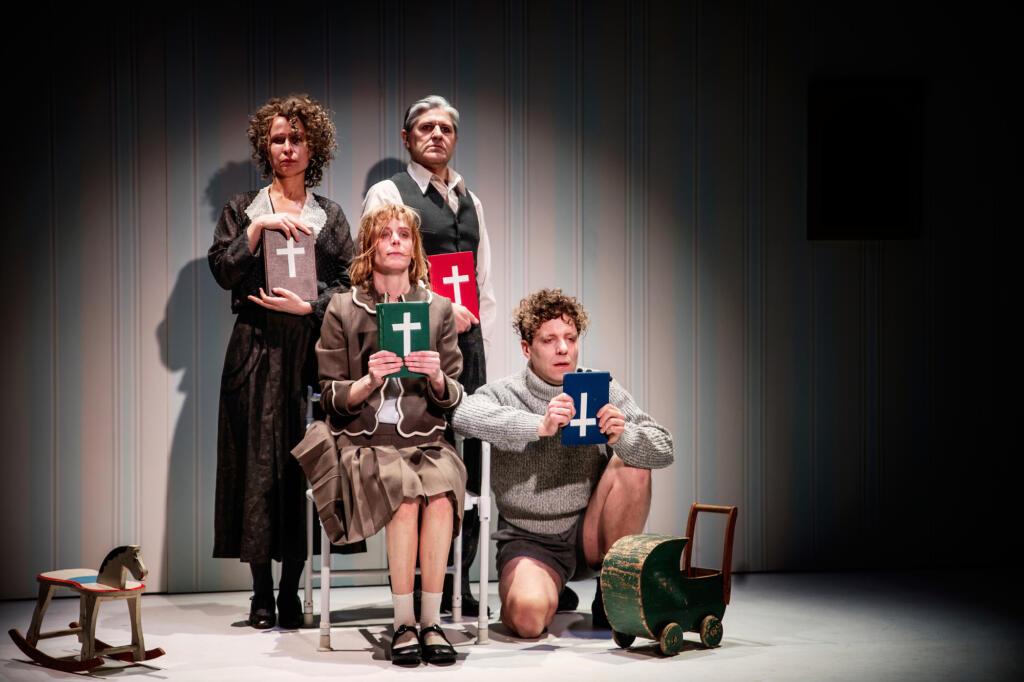
The Copenhagen Trilogy. Photo: Emmalisa Pauly
Anja Suša’s production finds an unexpected expression for this. At the risk of giving away spoilers – although right now we are about a week or so away from the closing of the current run so maybe there is a greater risk of never actually recording the ingenuity of the director’s intervention – Suša opts for a tactical counterpoint between what constitutes the first and the second half of the piece. Ditlevsen’s Childhood and Youth are visually presented in the style of an eccentric picturebook – a kind of Hans Christian Andersen fairytale on LSD. Helga Bursch’s set supports this impression in that it offers a shallow, almost two-dimensional framing for the often outrageous and occasionally colourful escapades of the young protagonist and her family. To signal that this is a thought-through choice, Suša punctuates the cartoonish first half with carefully placed quotes from Mark Fisher and Jacques Derrida about the relations between the past and the present and with evocative use of video projections designed by Stefan Stanišić.
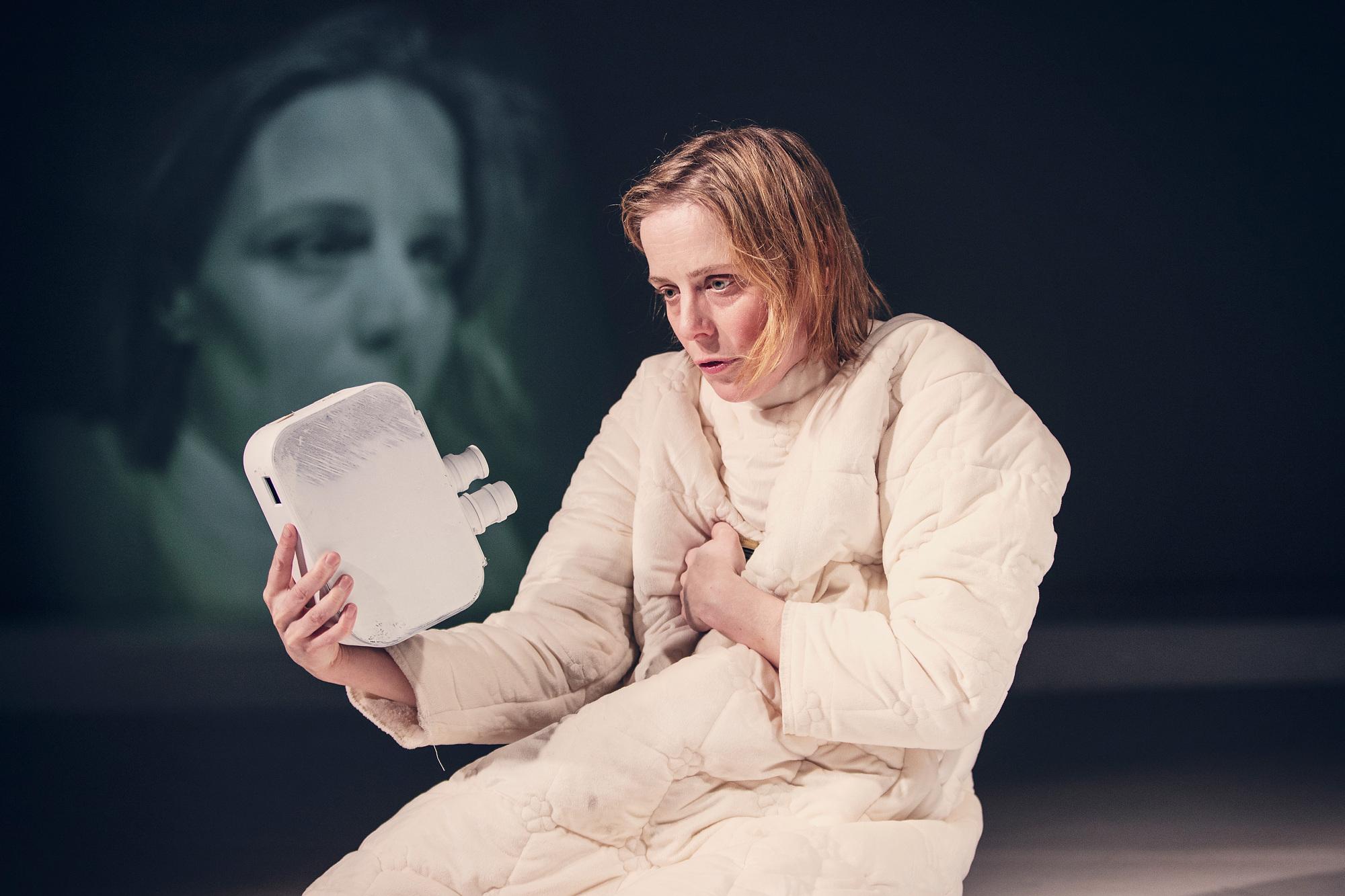
By contrast, the second half is all depth, emotional nuance, and earnestness. Appropriately Bursch’s set is expanded, clinically white, and eventually padded out in a way that suggests enforced safety. Suša’s parting shot – exceedingly effective in its simplicity – is one where the camera lens is turned onto the flesh and blood men in the audience, as if to ask what role they might continue to play in the fact that this sort of female suffering is not altogether consigned to history.
This post was written by the author in their personal capacity.The opinions expressed in this article are the author’s own and do not reflect the view of The Theatre Times, their staff or collaborators.
This post was written by Duška Radosavljević.
The views expressed here belong to the author and do not necessarily reflect our views and opinions.