







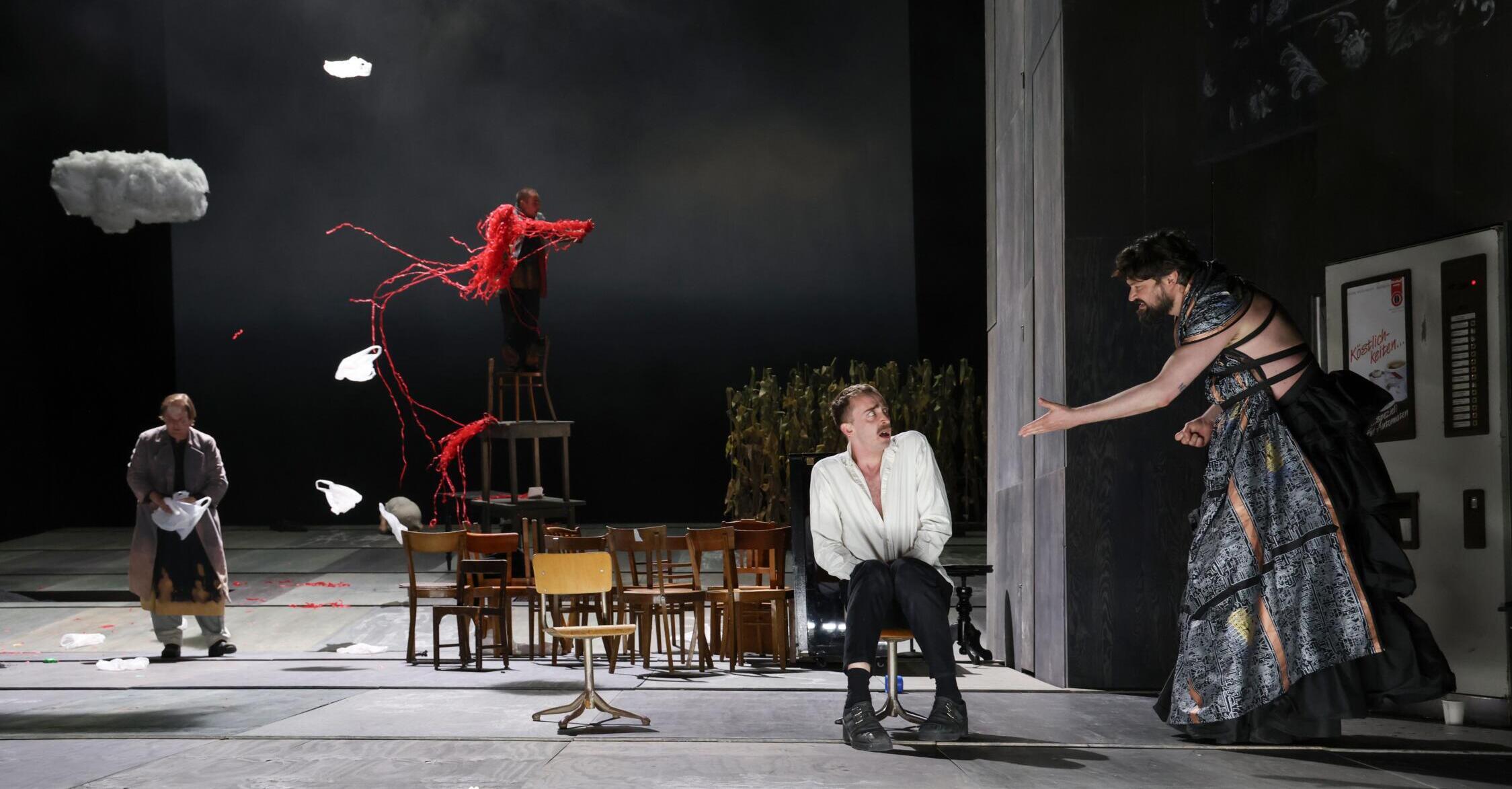
The stage, designed by Thomas Rupert, was vast and predominantly empty, the floor mainly even and sloping up at the very back. The walls were painted in shades of grey, as were the matching costumes designed by Anne Sophie Domenz. A good number of old-fashioned wooden chairs were used throughout the performance to different effects, as were a few more contemporary tables. With the help of fog and very white LED lamps, lightning designer Marc van Denesse created further atmospheric variations of gloom, in addition to the (lack of) colors of set and costumes. Much was made, at the start of the performance, of Francisco’s line “T’is bitter cold:” the watchmen helped themselves to coffee, hot chocolate and even hot soup from a coin-operated vending machine – its typical noises frightened the watchmen almost more than the apparition of the Ghost: a very witty moment of comic relief.
Director Alize Zandwijk throughout emphasized sadness and mourning, mainly Hamlet’s, but also that of other characters where it might not have been as immediately obvious as a character feature. This perspective was obvious from the beginning and was developed cogently and gently throughout.
The other major defining directorial decision was to cast male actors as Gertrude (Manolo Bertling) and Ophelia (Levin Hofmann). In line with Zandwijk’s overall gentle, careful perspective, Bertling and Hofmann conveyed the gender of their respective characters in a matter-of-fact manner, free from exaggeration and any attempt at being funny, even if unintentionally. Hofmann and Bertling differed in the ways they approached cross-gender acting. Hofmann may have been seeking to emulate the Renaissance practice of casting young men in the roles of women, seeking to play a young woman without seeking to hide his own gender. Bertling as Gertrude was taller and of more masculine build than most other actors of the production, and he had a full beard. His Gertrude was clearly a man wearing ill-fitting women’s clothes and not too comfortable with it either. The particular purpose of this casting choice, especially next to Hofmann’s Ophelia, escaped me. What was this meant to imply for Hamlet’s father and Claudius, and Hamlet himself, for that matter – if anything?
Several actors played several characters, which worked well, without the need to cut potentially important material because two characters played by the same actor cannot appear on the stage at the same time. In terms of casting, the role of the Player King, as well as that of one of the grave diggers and the Ghost of Hamlet’s father were given to a stalwart member of the Bremen company’s opera chorus, Wolfgang von Borries, who has also sung many smaller parts in opera. He sang excerpts from Robert Schumann’s Auf einer Burg, based on a poem by Joseph von Eichendorff, John Dowland’s Flow my tears, and Franz Schubert’s Der Doppelgänger (D 957, Nr. 13) based on a poem by Heinrich Heine.
Much of the text, rendered in the fresh translation / version by Angela Schanelek and Jürgen Gosch, created for Gosch’s 2001 production of Hamlet in Düsseldorf, was accompanied by live music by Matti Weber playing double bass, piano and a small section of woodwind instruments.
Hamlet, as portrayed by Emil Borgeest, would so much have preferred carrying on as a student rather than having to face real life at home – the phrase characterizing his state of mind was “Oh cursed spite, that ever I was born to set it right.” There were thus clear reasons for his procrastination, with several equally clear attempts on his part to forcefully push himself into action. Borgeest supported Hamlet’s words well with his body language, where his training in ballet and contemporary dance was obvious. He placed himself particularly well in relation to the surrounding space, which makes sense in view of his additional training and experience in stage and costume design. Ferdinand Lehmann was appropriately nasty as Claudius. Guido Gallmann as Horatio came across as more of a father-figure than a friend to Hamlet. He differentiated Horatio well from obtuse Rosencrantz. Martin Baum was suitably pedantic as Polonius, but not overbearingly so, and differentiated that role well from simple and well-meaning Marcellus. Ruben Sabel was a forthright Laertes, not too concerned, really, with Ophelia’s well-being and quite leisurely used to the advice his father likes to bestow on him. Alexander Swoboda as Guildenstern was a good match to Gallmann’s Rosencrantz, and a grave digger with funny dignity.
This post was written by the author in their personal capacity.The opinions expressed in this article are the author’s own and do not reflect the view of The Theatre Times, their staff or collaborators.