









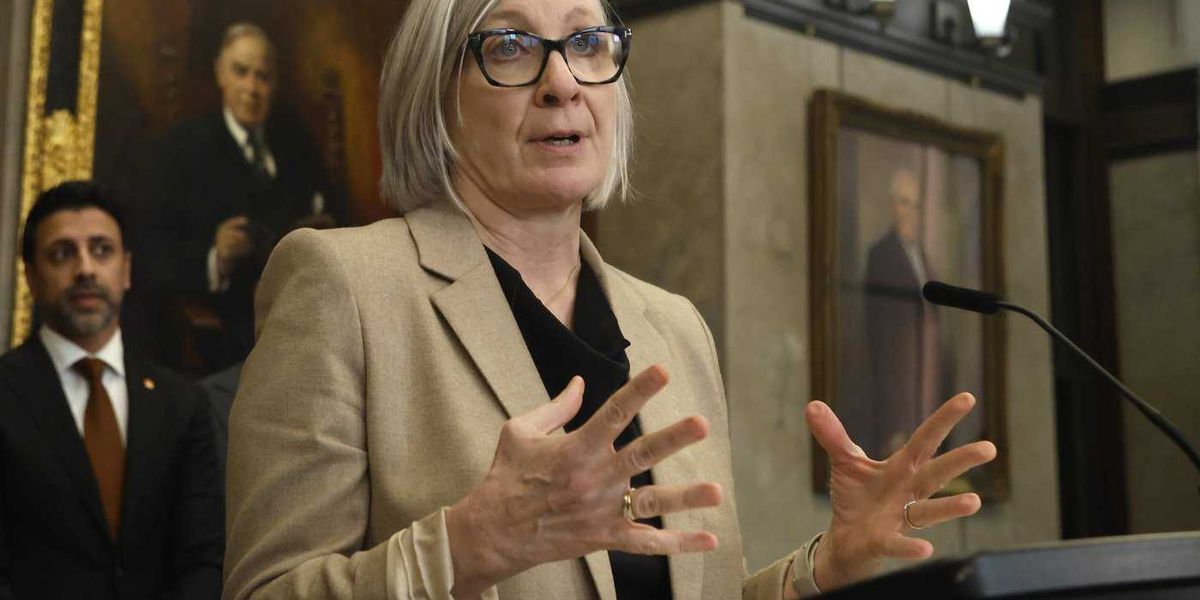
Federal Jobs Minister Patty Hajdu is looking for ways to turn down the temperature between unions and employers — particularly when labour acrimony threatens to disrupt critical industries.
Unions have seized on Ottawa’s review of federal labour laws to make the case for the right to strike and reaffirm their opposition to government intervention in bargaining.
Hajdu said in an interview on June 19 that the government will not interfere in the constitutional right to strike.
“The question is, when a strike is prolonged and there’s economic impact on other sectors of the economy or in critical industries … when should the government intervene? How should the government intervene?”
The federal Labour Code review, launched in mid-April, sought feedback from unions, employers and other stakeholders on issues like collective bargaining timelines, automation and health and safety protections.
Those consultations came after a fraught period for labour relations in Canada.
Recent years have been marked by high-profile strikes or lockouts at major Canadian ports and railways, critical service providers like Air Canada and national institutions like Canada Post.
Hajdu, like many labour ministers before her, has often said the best deals are struck at the table.
But in each of the aforementioned labour disputes, the federal government got involved by triggering Section 107 of the Labour Code. The controversial tool allows a labour minister to refer a dispute to the Canada Industrial Relations Board, which can declare an impasse to end the labour action and send the stuck parties to binding arbitration.
Section 107 was triggered eight times between June 2024 and August 2025 but was used only sparingly in the preceding 40 years, according to a Senate committee report published earlier this month.
Hajdu said the labour review heard a lot of opinions about Section 107. She said some unions want to see it eliminated from the labour code entirely, while others are “cautious” but want to see some tool made available to allow the minister to refer disputes for mediation.
Sen. David Wells of Newfoundland and Labrador said in a press conference unveiling the Senate labour report on June 11 that Section 107 is a “hammer” that ought to be used sparingly.
The recommendation from the Senate committee on transport and communications is to bring federal mediators into the bargaining process from the start when preventing a potential work stoppage in a sector like transportation is deemed to be in the national interest.
If talks still break down, the report says, cabinet should have the power to order binding arbitration to prohibit a strike or lockout.
Senators argued labour disruptions that regularly shut down large swaths of the economy hurt Canada’s reputation as a reliable trading partner at a time when the country is trying to diversify into new markets.
Bea Bruske, president of the Canadian Labour Congress, said the Senate report “gets it wrong.” She argued such a proposal would weaken workers’ rights in a period of economic uncertainty.
“We call on the Government of Canada to reject this report in its entirety and focus instead on strengthening collective bargaining and the right to strike and protecting fundamental rights for workers,” she said.
Hajdu said disruptions that stretch across the economy — such as rail strikes that leave farmers stuck with perishable crops they can’t ship — create “tricky situations” for labour ministers.
“You’re trying to balance, obviously, all of the rights that people have to strike with the short- and long-term economic impact,” she said.
“This government’s been clear we’re not going to — at all — touch a constitutional right to strike. The question is, what tools should be there for the minister of labour to foster industrial peace? And that’s what the consultations get at.”
One area where Hajdu said the recent review aligned with the Senate’s recommendations is on the need for earlier engagement with federal mediators when parties have a history of conflict.
She said she’s received positive feedback on federal mediation in general, which she said helps to avoid strikes or lockouts in 95 per cent of cases. Hajdu called it “the most important tool” at the government’s disposal.
Some stakeholders have pushed for a stronger industrial relations board, arguing the body needs the capacity to process disputes and grievances more quickly.
When grievances pile up at the board and haven’t been resolved by the time the next round of negotiations come up, discord between the parties can carry over, Hajdu said. Empowering the board to settle disputes could help to smooth out labour turbulence in Canada, she argued.
External forces in the economy are also increasingly feeding into labour negotiations.
Trade disruption from the United States and the rise of artificial intelligence are often playing out in the background of these talks, spurring anxiety on both sides of the negotiating table, Hajdu said.
She said she’s not sure those conversations have been well managed in some sectors.
“If you’re afraid of what the future looks like, it gets really hard to commit to long-term collective agreements … either on the employer side, who might be afraid of what their industry is going to look like in five years, or on the union side who might be afraid of what that means for their workforce,” Hajdu said.
“That, I think, is part of what we hope to be able to address through better relationship tools that help people have more frank, more open conversations earlier on.”
This report by The Canadian Press was first published June 27, 2026.
— with files from Daniel Johnson in Toronto
By Craig Lord and Sarah Ritchie | Copyright 2026, The Canadian Press. All rights reserved.