

![1st Sep: Cruel Intentions (1999), 1hr 37m [R] (6.4/10)](https://occ-0-1522-1001.1.nflxso.net/dnm/api/v6/0Qzqdxw-HG1AiOKLWWPsFOUDA2E/AAAABbPD2aumcglWxSTpccssOtPAoON3H-VHI6n8opYQCF-2hqx0tdo4TyB1-HZyTVIAvXIlhv7TP1Hztn0Nixe47keN-w1QME-T09__.jpg?r=4b2 "1st Sep: Cruel Intentions (1999), 1hr 37m [R] (6.4/10)")





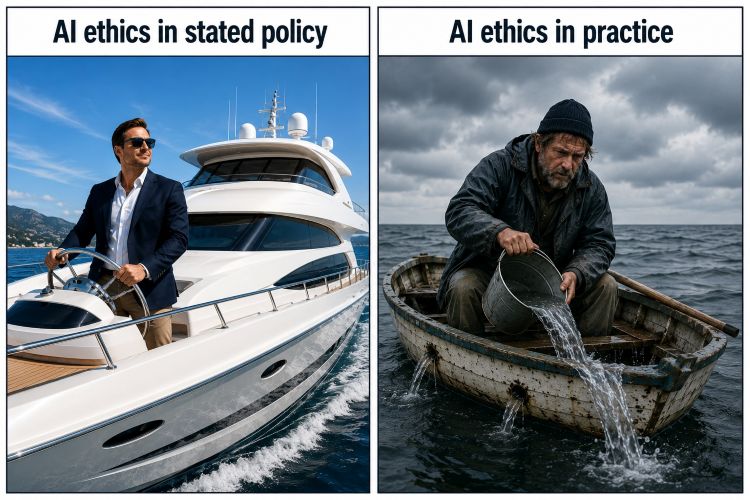
Artificial intelligence governance is often described in terms of principles. Fairness, accountability, transparency, and safety have become the dominant language through which organizations signal responsible deployment. These principles appear in policy frameworks, regulatory proposals, and corporate commitments across jurisdictions.
Yet the operational reality of AI deployment reveals a persistent and widening gap between declared ethics and executed decisions. The central issue is not the absence of ethical frameworks, but the conditions under which those frameworks are overridden in practice.
The European Union’s AI Act establishes one of the most comprehensive regulatory attempts to formalize ethical AI obligations, introducing requirements around risk classification, transparency, and accountability.[1]Similarly, the United States has pursued a voluntary commitment model, with leading AI developers agreeing to practices such as red-team testing, safety disclosures, and controlled deployment.[2]The Organization for Economic Co-operation and Development (OECD) AI principles, adopted by dozens of countries, reinforce the expectation that AI systems should be robust, fair, and accountable.[3]These frameworks suggest a growing global consensus on what ethical AI should look like.
However, consensus at the level of principle does not translate directly into consistent behaviour at the point of decision.
In operational environments, organizations face competing pressures that are not resolved through policy statements. Time constraints, competitive dynamics, cost considerations, and performance targets introduce tradeoffs that cannot be abstracted away. Ethical guidelines exist as a reference layer, but decisions occur within systems where speed, efficiency, and measurable outcomes dominate. The result is that ethical constraints are frequently interpreted, adjusted, or deferred rather than strictly enforced.
This divergence becomes visible when examining real-world deployments. One of the most widely cited examples remains the use of algorithmic risk assessment tools in the criminal justice system. An investigation by ProPublica found that the COMPAS algorithm, used to predict recidivism risk, exhibited significant racial bias in its outputs.[4]Despite being framed as a tool to improve objectivity, the system produced outcomes that disproportionately affected certain populations.
The issue was not unknown. Concerns about bias had been raised, yet the system remained in use because it satisfied other operational requirements, including efficiency and scalability.
The COMPAS case illustrates a recurring pattern. Ethical concerns are identified, documented, and acknowledged. However, when weighed against operational benefits, those concerns do not necessarily lead to system withdrawal or redesign. Instead, they are managed within acceptable risk thresholds, allowing deployment to continue. Ethics, in this context, becomes a variable within decision-making rather than a constraint that determines whether a decision can proceed.
A similar tension appears in hiring and employment systems. Amazon reportedly discontinued an internal AI recruiting tool after discovering that it systematically disadvantaged female candidates.[5]The system had been trained on historical hiring data, which reflected existing gender imbalances in the technology sector. While the issue was eventually addressed, the period during which the system operated highlights how ethical risks can emerge directly from data and model design choices. These risks are not hypothetical; they are embedded in the operational logic of machine learning systems.
In both cases, the ethical issue was not a lack of awareness. Organizations understood the potential for bias and had frameworks in place that acknowledged fairness as a requirement. The challenge was enforcement. Ethical principles did not function as hard constraints that prevented deployment. Instead, they existed alongside other priorities, creating a negotiation space in which tradeoffs were made.
This pattern extends beyond bias into broader questions of safety and misuse. The White House voluntary commitments emphasise the importance of red-teaming and controlled release to mitigate risks associated with advanced AI models.[6]These measures are designed to identify vulnerabilities before systems are widely deployed. However, they also introduce delays and costs that may conflict with competitive pressures. Firms operating in rapidly evolving markets face incentives to release capabilities quickly, even when full risk assessment is incomplete.
The National Institute of Standards and Technology (NIST) AI Risk Management Framework attempts to formalize risk identification and mitigation processes, providing a structured approach to managing AI-related harm.[7]Yet frameworks of this kind rely on organizational adoption and internal discipline. They do not enforce compliance at the point of execution. As a result, the effectiveness of such frameworks depends on whether organizations prioritise risk mitigation over other operational objectives in specific decision contexts.
Industry research reinforces this gap between intention and execution. McKinsey’s analysis of AI adoption highlights that while many organizations recognize the importance of responsible AI, relatively few have fully embedded governance processes into operational workflows.[8]This suggests that ethics is often treated as a parallel initiative rather than an integrated component of system design and deployment. When governance is not structurally embedded, it becomes vulnerable to being bypassed under pressure.
The Stanford AI Index Report further documents the increasing scale and complexity of AI systems, alongside growing concerns about their societal impact.[9]As models become more capable and more widely deployed, the consequences of ethical lapses increase correspondingly. At the same time, the concentration of advanced AI development within a small number of organizations introduces additional governance challenges, particularly around transparency and accountability.
The underlying mechanism driving these outcomes is structural rather than incidental. Ethical frameworks operate at the level of principle, while decisions occur at the level of execution. Between these layers lies a translation problem. Principles must be interpreted, operationalized, and enforced within specific contexts. Each step introduces discretion. Discretion, in turn, creates variability. It is within this variability that ethical commitments are diluted.
From a business perspective, this creates a fundamental question. Where does authority reside in AI-driven decision systems? If authority remains with human operators who interpret ethical guidelines, then outcomes will reflect the same variability and bias that those operators bring. If authority is delegated to automated systems, then the design of those systems becomes the critical factor in determining whether ethical principles are upheld.
Ultimately, the question is not whether ethical frameworks exist. The question is whether those frameworks operate at the point at which decisions are made. Until ethics is enforced at that level, it will remain contingent. And contingent ethics, by definition, does not hold under pressure.
References
[1] European Union. EU AI Act.
[2] The White House. Voluntary AI Commitments.
[3] OECD. AI Principles.
[4] ProPublica. Machine Bias Investigation.
[5] Reuters. Amazon scraps AI recruiting tool.
[6] The White House. Voluntary AI Commitments.
[7] NIST. AI Risk Management Framework.
[8] McKinsey. State of AI.
[9] Stanford HAI. AI Index Report.
(Mark Jennings-Bates – BIG Media Ltd., 2026)