






Iraqi theatre did not remain in Iraq. Over the past several decades, Iraqi playwrights, actors, directors, and artists have carried their theatre with them to new homes, including Canada. Written in Arabic, English, or across both languages, their work explores migration, memory, identity, belonging, and the complicated reality of beginning again in a new country.
Many of these plays begin where migration stories are supposed to end: once migrants have settled in a new country. Rather than celebrating settlement as a final destination, they examine what comes next. Language barriers, institutional demands, fractured identities, family separation, and the persistence of memory reveal that exile often survives migration itself. In Iraqi Canadian theatre, exile is not a temporary stage between departure and belonging. It is an ongoing experience that continues to shape everyday life.
On Representation, Experience, and Access
Before proceeding, it is important to clarify what I mean by Iraqi theatre in Canada. In this article, the term refers to theatrical works created by artists who were born and raised in Iraq and later settled in Canada as immigrants, refugees, or exiles. Their work is shaped by direct experience of Iraqi social, cultural, political, and linguistic life, as well as by migration and resettlement. This definition is not intended to diminish the contributions of artists of Iraqi heritage who were born and raised elsewhere. Their work forms an important part of the broader Iraqi diaspora. However, these are not identical histories. Artists raised in countries such as Canada, the United States, or the United Kingdom often possess greater familiarity with local institutions, professional networks, funding structures, language, and cultural norms than newly arrived migrants and refugees. As a result, they occupy different positions within the cultural landscape and may enjoy forms of access and visibility that are less available to recent arrivals. This imbalance can result in opportunities and resources being directed toward those with greater institutional access rather than toward artists whose work emerges directly from experiences of migration and displacement. In some cases, artists of Iraqi heritage who have not themselves experienced life in Iraq or migration from Iraq may nevertheless be positioned, promoted, or received as representative voices of Iraqi experience. Whereas their contributions remain valuable, such positioning can sometimes blur distinctions between inherited identity and lived experience, and may inadvertently contribute to the marginalization of artists whose work emerges from direct experiences of migration and displacement. Recognizing these differences does not establish a hierarchy of belonging; rather, it acknowledges that distinct histories, experiences, and forms of access shape how Iraqi identities are represented, understood, and given visibility within the diaspora. This distinction is particularly important because many of the artists discussed in this article not only represent Iraq but have themselves experienced the forms of displacement and resettlement that their work explores.
Exile Beyond Arrival
Yana Meerzon describes exile as an “odyssey,” suggesting that it does not end with arrival. It continues as a lived reality shaped by institutions, cultural expectations, and the constant negotiation of belonging. Many of the plays discussed here begin from a similar premise. Moving beyond the journey to Canada, these works explore what comes afterward.
For some Iraqi theatre artists, the challenges of exile extended beyond representation and became material realities that affected the continuation of their artistic careers. Artists who arrived in Canada often carried decades of experience as actors, directors, playwrights, and theatre-makers, yet many encountered barriers that complicated artistic continuity, including language, funding systems, professional networks, economic pressures, and the need to prioritize survival and family responsibilities. Some eventually reconnected with theatre communities in the Arab region and continued their artistic careers there. Others pursued different professions in Canada, while some experienced periods of isolation, frustration, depression, and disconnection from artistic practice. These experiences remind us that migration can transform not only where artists live, but also whether and how they are able to continue making theatre.
In Iraqi plays, exile is represented in different but interconnected ways. Sometimes it takes the form of institutional regulation and the pressure to become legible to the state; sometimes it emerges through the repeated demand to narrate trauma, through waiting and suspended time, or through fractured identities and uncertain belonging. The plays suggest that exile persists long after arrival, shaping everyday life in ways that are often subtle but deeply consequential.
The first example is Shallal in Toronto, a community theatre production written by Dakhil Al-Bahrani and Fullah Al-Orfali and performed by a combination of professional actors and volunteers from the Iraqi community. The play follows Shallal, an Iraqi immigrant whose inability to speak English shapes both his family relationships and his interactions with Canadian institutions. His struggle to pass an English-language benchmark examination becomes a struggle for dignity, authority, and recognition. Through humour and domestic conflict, the play reveals how immigrants are measured through linguistic competency and bureaucratic standards. Learning English is presented as important for navigating life in Canada; the play nevertheless questions the extent to which linguistic proficiency determines dignity, competence, and belonging. At times, Shallal resembles a familiar comic figure: the powerless patriarch or ridiculed peasant unable to adapt to modern life. Yet the play repeatedly complicates this image by emphasizing his loyalty, generosity, and moral principles. Such a portrayal directs attention away from personal deficiency and toward the institutional structures that produce exclusion.
The demand for recognition also appears through repeated performances of suffering. My play The Mug follows a refugee who is continually invited to universities, conferences, and cultural events to recount stories of war, displacement, and survival. Despite the sympathy and acclaim his testimony generates, little changes materially in his life. The work explores how trauma becomes a condition of visibility, recognition, and cultural currency, raising questions about the ways refugee stories circulate within cultural institutions. Yet the play also confronts its own paradox. Any attempt to critique the circulation of trauma must still represent trauma before an audience. The Mug leaves this contradiction unresolved, exposing the discomforting possibility that making suffering visible can itself become another form of extraction.
If The Mug examines the institutional circulation of refugee suffering, other works show how exile persists through mobility itself. Several Iraqi Canadian plays challenge the assumption that crossing borders necessarily produces freedom or belonging. In Mohammad Al-Jourani’s The Falafel War, the protagonist repeatedly changes identities, occupations, and social roles while fleeing threats that follow him across borders. Instead of liberating him, movement produces new forms of insecurity and surveillance. A similar dynamic emerges in my play The Widow. Samir, an Iraqi academic threatened by militias because of his liberal views, seeks safety in Canada only to discover new forms of erasure. Once respected and professionally established, he becomes largely anonymous within his new environment. His eventual return to Iraq and subsequent death reveal exile as a condition that operates across borders rather than between them. These works challenge celebratory narratives of migration by showing how displacement frequently survives relocation.
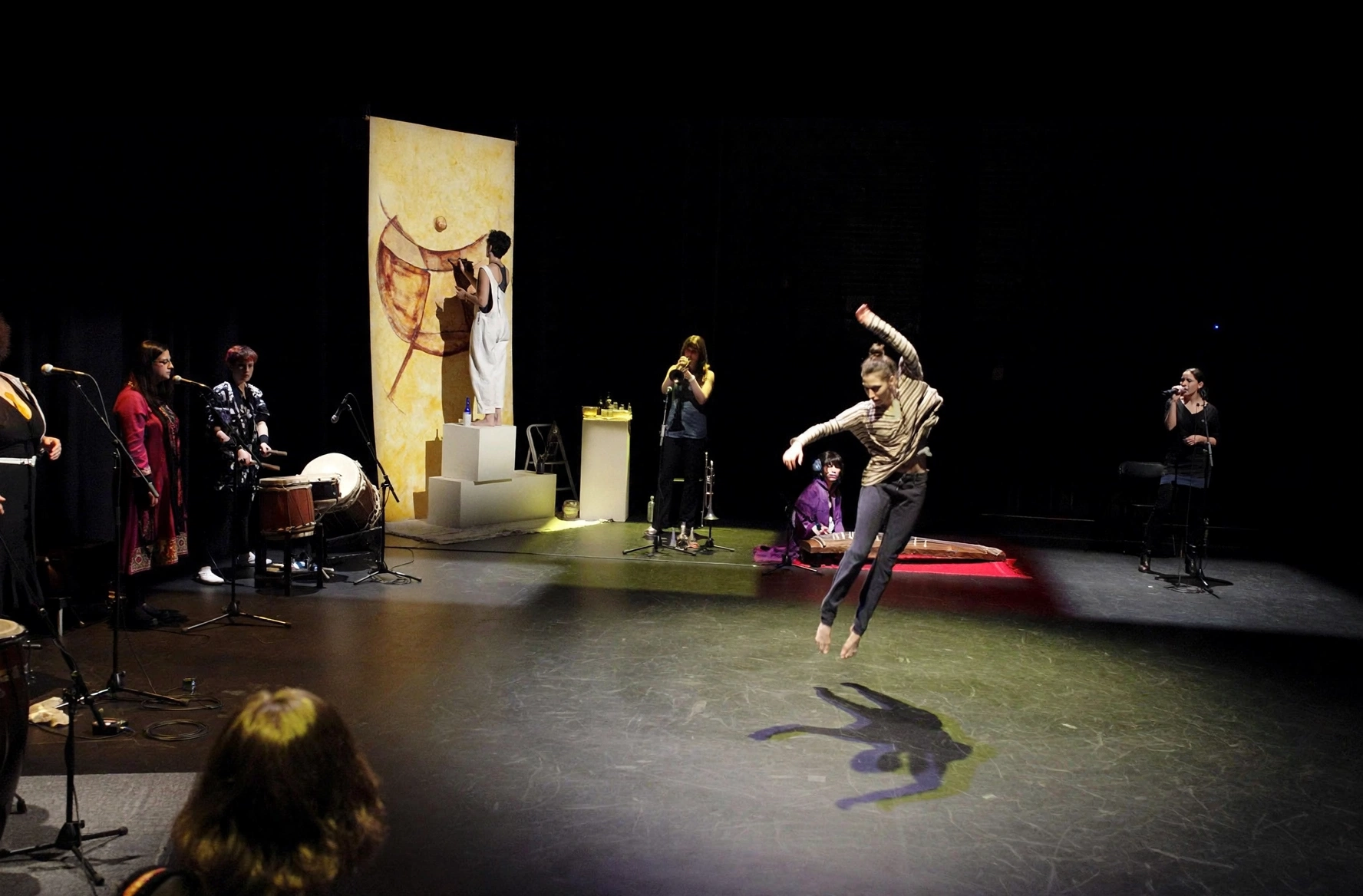
Questions of uncertainty and negotiation emerge in a different form in Jabbar Al-Janabi’s ANU, a large-scale multidisciplinary project based on improvisation, collaboration, and audience participation. Inspired by the Sumerian god Anu, the project rejects fixed scripts, stable hierarchies, and predetermined outcomes. Participants from different artistic and cultural backgrounds are deliberately displaced from familiar modes of expression. Musicians respond to dancers, visual artists become performers, and audiences influence the unfolding event. Exile appears here not through narrative content but through process itself. Identity remains unstable, communication is continually renegotiated, and meaning emerges through encounter rather than certainty. Unlike the other works discussed here, ANU stages exile through artistic practice rather than through character or plot. Participants are repeatedly asked to move beyond familiar artistic and cultural frameworks, adapt to new forms of communication, and collaborate across linguistic and disciplinary differences. In this sense, exile becomes less a subject of representation than a methodology, generating new forms of collective creativity through uncertainty, negotiation, and encounter. The project’s openness occasionally produces moments of opacity and unevenness, but these vulnerabilities are intrinsic to its artistic vision. ANU transforms exile into a model for coexistence, demonstrating how difference can be negotiated without being erased.
The relationship between cultural memory, artistic survival, and exile receives particularly rich treatment in King Gilgamesh and the Man of the Wild, created by Ahmed Moneka and Jesse LaVercombe. The play weaves together ancient Mesopotamian mythology and contemporary Toronto through the friendship of Ahmed, an exiled Iraqi artist, and Jesse, an American actor. Their relationship parallels that of Gilgamesh and Enkidu, allowing the ancient epic to resonate within contemporary experiences of migration, loss, fatherhood, and belonging. Music occupies a central structural role in the production. Described as “a play with music,” King Gilgamesh incorporates the live performance of Moneka Arabic Jazz, whose musicians accompany scenes, create soundscapes, and participate directly in storytelling. Songs, maqam-inflected jazz, musical improvisation, and audience participation become central vehicles for memory, friendship, artistic reinvention, and cultural transmission. Rather than transforming exile into a universal abstraction, the play continually grounds myth in the realities of war, migration, family separation, and artistic survival. Myth becomes a means of examining history rather than escaping it.
In sum, migration does not necessarily bring exile to an end. Whether through language, bureaucracy, trauma, memory, waiting, mobility, or cultural negotiation, exile continues to shape life long after arrival. What distinguishes Iraqi theatre in Canada is not simply its focus on displacement but its attention to what follows it. These plays move beyond stories of departure and settlement to examine the everyday realities of living between places, languages, and identities. In doing so, they reveal exile not as a temporary condition but as an enduring reality that shapes artistic practice, cultural production, and social life in contemporary Canada.
This post was written by the author in their personal capacity.The opinions expressed in this article are the author’s own and do not reflect the view of The Theatre Times, their staff or collaborators.
This post was written by Amir Al-Azraki.
The views expressed here belong to the author and do not necessarily reflect our views and opinions.