







I started my Edinburgh Fringe 2026 lying down. On a white bunk bed – a middle height one of a triple set – at a far end of what looked like a long and narrow rugged steel portacabin. It was the first few days of the festival with most acts still in preview, so the only shows I could get into were Darkfield’s audio theatre installations. This turned out to be an apt beginning to a festival in which theatre seemed to be asking audiences to surrender habitual ways of looking, listening and making sense of the world.
It’s no news that each Fringe tends to throw its own themes up to the surface. Very often this is a matter of collective unconscious spontaneously filtering through in among 3000+ random works of performance from all over the world; sometimes it’s a matter of artistic trends just amplifying each other at this global trade fair; and in some special cases it is just a case of coincidental reverberations experienced by each individual audience member on their way through.
Here is what I found having landed in Edinburgh in the first week of the festival.
Storytellers are back in theatre
It’s not entirely a new trend; in fact Kieran Hurley (https://www.theguardian.com/stage/2016/aug/05/heads-up-review-summerhall-edinburgh-kieran-hurley) and Christopher Brett Bailey had notable forays into desk-based storytelling accompanied by live music some ten years ago – and they both fall in the much longer lineage that goes back to Spalding Gray and beyond. But it seems like the trend is still growing and, as it happens, I am a fan. (In fact I have written a book about this aural turn and its links to technological developments.)
Let me be clear, I do not mean to diminish the value of any of these artists’ works by relating them to each other. On the contrary, I think it is deeply affirmative that they are all echoing each other across time even if they happen not to be aware of each other’s work. It is reassuring they are sharing similar impulses, issuing similar war-cries, standing connected to each other while seemingly alone. Maybe they would appreciate knowing that they are not working completely in isolation, that this is all a collective endeavour indeed, like they sometimes want to have us believe.
Notably however, this storytelling trend took an extraordinary breadth of forms at this year’s Fringe, from autobiography and clowining to folk theatre, immersive performance and adaptation of classics.
Take US-based Nadia P. Manzoor – a British Pakistani performer telling a family story with a difference, featuring hip hop, porn and pythons. Whether her story is autobiography or autofiction, Manzoor’s performance, comic timing and character embodiment are impeccable. As she contemplates her own motherhood and evolving relationship with her daughter, she unpicks the ways in which she herself has been parented or conditioned by family tradition to build relationships in life. It is a bittersweet story well worth eighty minutes of your time whether you are into popular culture, comedy, women’s lives or genuinely original transcultural storytelling.

Flyer for Nadia P. Manzoor’s Jerk Off, (c) no credit
Over at Traverse One, Bryony Kimmings approaches the genre of a folk story from a completely different angle – as a self-styled blend of auto-fiction and comedy drama – a form she has been developing for over fifteen years. The winning formula in Kimmings’ take on storytelling is her propensity towards tongue-in-cheek, auto-ironic satire. But she is a woman in her forties living dangerously close to a bog and a modern day coven, and life experience is, as one might discover, the magic that makes art possible. What in turn makes life possible is, at least in this case, a newly-found sense of community.
Back to back with it, at the studio-sized Traverse Two, Malaika Kegode’s intriguing new folk gig theatre play innovates by aiming to leave you dissatisfied. Weaving together a mysterious backstory concerning a disappearance of a young musician ten years ago, a legendary village recluse with a secret, and a present day mother-daughter relationship drama, Badgers is constructed as a thrilling parable that asks who has a right to tell whose story, and whether the audience is even entitled to the narrative closure it has learnt to expect over the centuries. This is a political question, of course, rightly motivated by decolonial agendas, although as such it remains prudently implicit. Instead the piece seeks a reframed, personally implicated viewing by casting us, the audience, collectively into the role of the female protagonist and letting us process the subsequent discoveries in our own time.
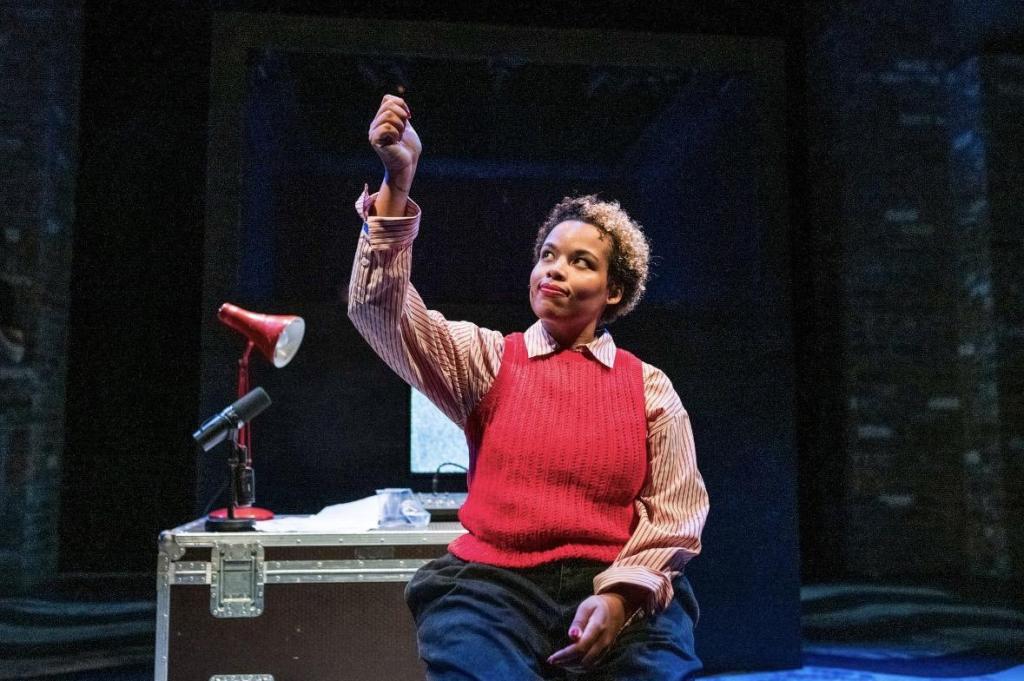
Malaika Kegode in Badgers, (c) Paul Blakemore
Many productions displaced spectators from passive observation to imaginative participation by stripping theatre to the act of telling. Male storytellers, particularly those in the Gray-Hurley-Brett Bailey tradition, dispensed with the mise-en-scene completely in favour of a single desk on stage from which they speak into a microphone or mix a musical accompaniment.
Like Brett Bailey, Sam Ward goes for cinema-inspired narrative in his piece As Far as We Know at Summerhall whose motifs include a chain-smoking detective, an absurd receptionist, deserts, caves and mysterious garden occurrences surrounding a woman’s anxiety-driven quest for answers. Like Brett-Bailey, Ward delivers the narrative at breakneck speed and also uses music as an atmospheric and dramaturgical tool – once or twice ingeniously so. Unlike Brett-Bailey, Ward is interestingly reflexive about his apparent obsession with the screen – one of his sections explores exclusively a kind of textual puppetry by projection. Ward’s piece also brings about a conclusion that this is in its core a writerly project, although the writer in this case seems to have been shaped by comics and TV as much as radio prose.
Further down the line with this trend, Sam Rees’s Gameplay at Pleasance Dome positions itself not only as a piece of storytelling theatre but as access-led performance, in which initial audio-description seamlessly evolves into the storytelling. There is nothing that happens on stage here for which the sense of sight is crucial, and yet this is not a radio play by virtue of the fact that collective imagination feels important. This, after all, is an end of the world story.
Rees is accompanied live by musician AJ Turner with whom he happens to share the concern that we live on borrowed time. And this collaboration can therefore be perceived as an act of hope – one that is presumably shared by all the rest of us who are there because we are seeking solace and meaning and survival through art. When it comes to these things, Gameplay is a piece that deliberately underpromises, but certainly overdelivers.
Its metatheatrical dimension combined with the emphasis on ‘seeing with your ears’ also brings to mind the work of Tim Crouch, though Rees is a kind of writer more explicitly drawn to literary attention to detail than formal invention.
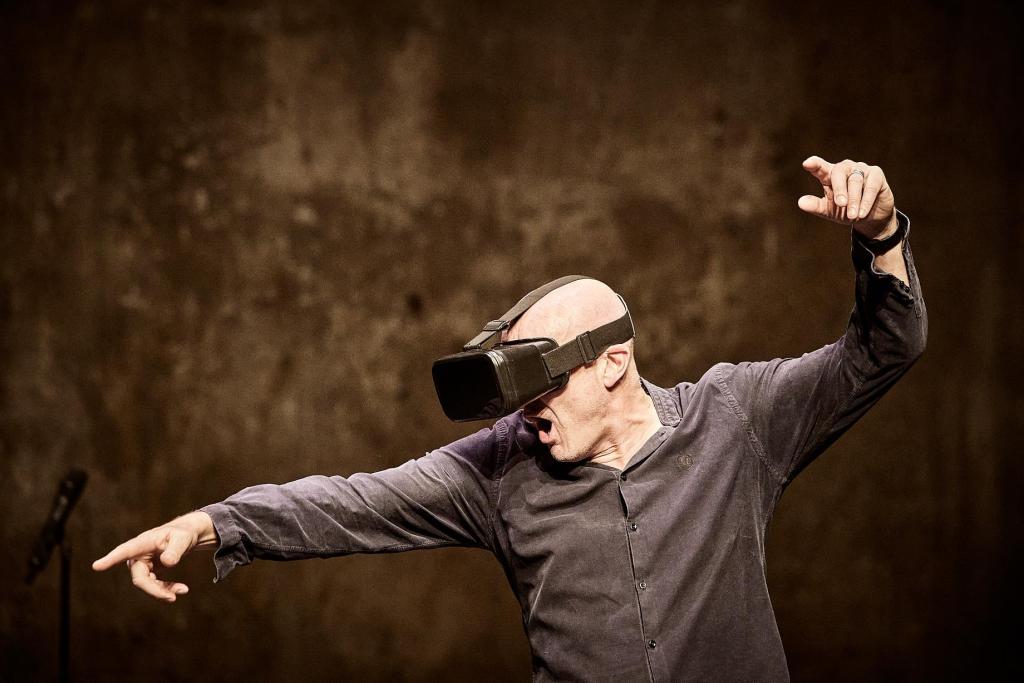
Tim Crouch in TRUTH’S A DOG MUST TO KENNEL, (c) Christophe Raynaud de Lage
Tim Crouch’s Truth’s a Dog Must to Kennel – the very piece that explicitly requests ‘seeing with your ears’ was shown at Shedinburgh this year for a brief run, exactly four years after its premiere at the Lyceum during the Fringe 2022. In it, Crouch’s Fool alternates between a stand-up routine commenting lightly on the hypocrisies of our here and now and a moment-by-moment account of a live performance of King Lear supposedly watched through his empty VR headset.
Though Darkfield’s work is perhaps the purest expression of this tendency towards ‘tell rather than show’ – and their telling is also enhanced by sound, olfactory and haptic effects – I found it lacking in the kind of imaginative play that Crouch’s own work and influence on others delivers.
The main defining feature of Darkfield’s aural dramaturgy is that they aim to completely remove the sense of physical sight. Their use of binaural sound achieves a certain sense of three-dimensional spatiality. The audience additionally listens to the tightly choreographed audio drama within a carefully designed physical space that allows for an ambiguity around what is real to be heightened. When you hear a voice whispering into your ear, coming from over your left shoulder, you might instinctively turn around in the way you wouldn’t if you were listening in the safety of your own home. This creates scope for surprises and visceral reactions conjured up by sound manipulation alone. But the ultimate aim of such work seems to be to confound rather than emancipate – even, and especially when, we are explicitly placed in the shoes, or rather the box, of Schrödinger’s cat.

Darkfield’s Coma, (c) Duška Radosavljevic
Collective Imagination, Deliberation and Truth
While storytelling tends to require imaginative audience participation for purposes of completing the author’s mental picture, some other cases of live performance at this year’s festival resorted to more adventurous forms of audience participation.
At the Edinburgh International Festival, Belgian Toneelhuis/ Olimpique Dramatique reimagined Chekhov’s Seagull through Flemish Sign Language. Thematising courage (artistic and romantic), this production discreetly teaches the audience a whole set of its own theatre conventions about how it treats text, language, sign language, stage directions, simultaneous captions and the proverbial gunshots of Chekhov’s play. They perform for two and a half hours without a break. Then the final act flips all of the established conventions on their head. And we are encouraged -and, as it happens, enabled – to watch this final act without any captioning but only through sign language alone. On the part of the audience, it makes the time invested feel like a worthwhile accomplishment – if they dared to stay till the end, that is. Which they really ought to.

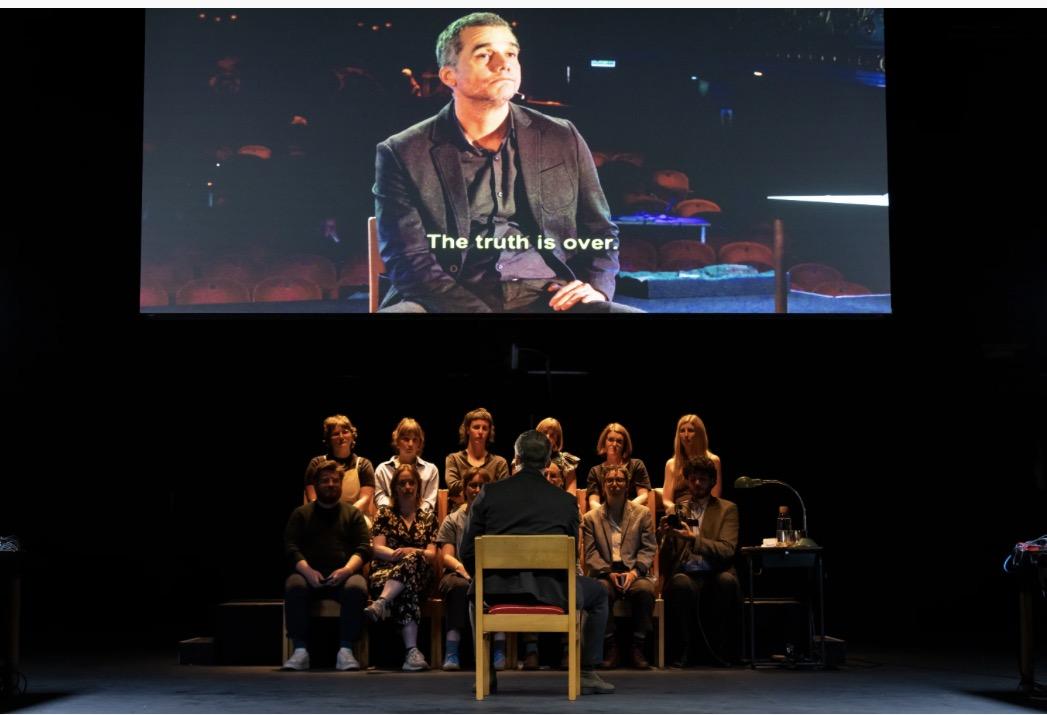
Wagner Moura and the audience jury in A Trial, after An Enemy of the People, (c) Jess Shurte
Over at the Lyceum, in A Trial, a co-authored adaptation of Ibsen’s An Enemy of the People, Brazilian director Christiane Jatahy, writer Lucas Paraizo and actor Wagner Moura have transferred the action to the Brazilian countryside, but all of the play’s key issues are up for deliberation with the local audience. As part of the Edinburgh International Festival, sections are played in English and a local actor is hired to lead the jury of eleven audience members selected by ballot at the start of the performance.
While Ibsen’s play centres on Dr Thomas Stockmann’s attempt to expose contaminated waterworks, an effort blocked by his brother, the town’s mayor, in the name of economic interest, this adaptation opens after Stockmann has already been publicly “cancelled”, in order to imagine the fair trial he never received. It may seem rather obvious at first how the audience vote will go and so the two and a half hours of considering the evidence may eventually feel a little too drawn out. But, as it happens, the magic of this theatre production reveals that indeed not everyone is of the same opinion.
Truth be told the deliberation in this adaptation is frustratingly limited to just eleven audience members and to whatever happens between them backstage in a short interval before the finale, but the unexpected takeaway is that the trial will keep playing itself out in your mind or conversations on the way home.
Inspired, I asked ChatGPT to find me another specimen in the Fringe that involves audience deliberation. Revealingly, several relevant offerings confirmed that democracy and improv have a lot in common.
Described as an improvised comedy show where the audience bring in their cases against companions for a court of comedians to adjudicate, This is Your Trial sounded like a potential nightmare, but it was one of the few shows I could make, I was curious, and the queue seemed long enough to warrant a safe space.
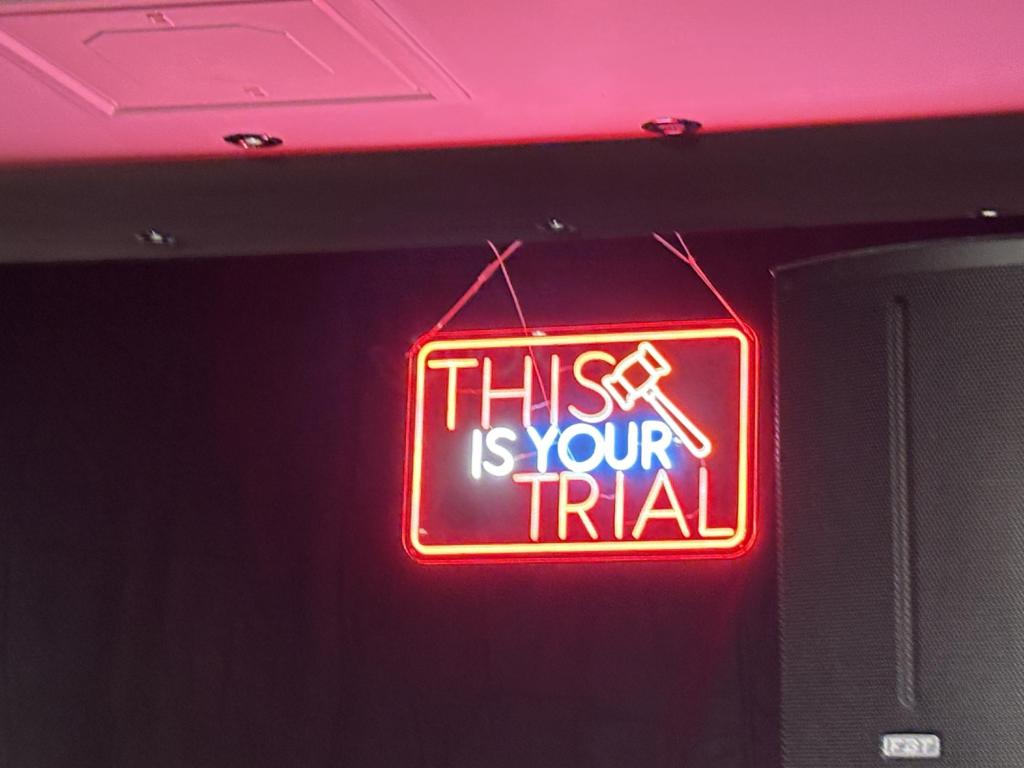
This is Your Trial, (c) Duška Radosavljevic
Three or four grievance cases can be fitted comfortably into such an hour. And the quality of the proceedings was in fact excellent. Articulate, playful, quick-witted and skillfully tied together — enough to raise the roof of the inauspicious venue. Final verdict: worth a go with good company.
Although this was a rather small and imperfect sample, it left me thinking about deliberative processes, the arbitrary nature of their outcomes, and the way in which the art of rhetoric could still shape individual judgment. But how much capacity does theatre still have left to resist the supreme rhetorical skill of artificial intelligence? And with what specific skills practice?
This brought back the contribution of Tim Crouch’s Fool in his reminder that truth itself is always partial. Nothing is what it purports to be in the world around him, and no one, except the Fool, seems to see the truth. He concludes he mustn’t speak truth to power in order to survive but he also knows that not telling the truth inevitably leads to tragedy – the annihilation of everything he himself stands for. Surely that kind of paradox is at the core of theatre itself as seen in the emblematic comedy and tragedy mask intertwined together.
Questions of truth’s absolute instability similarly surfaced elsewhere in the festival, although in strikingly different ways.
While Kegode’s Badgers touched on it via the question of story ownership, Isabella Jovanova Heaver opts for a disenfranchisement from any personal relationship to truth. Her piece Racists, Recessions, Revolutions begins with what appears to be genuine autobiographical confession before it gradually evolves into its fabricated counterpart. The Macedonian 2016 fake news episode turns out to be only an engaging overture to a more nihilistic story about exploiting Britain’s own swing to the right for one’s personal economic gain.
This kind of ideological nihilism could indeed be seen as an ultimate expression of neoliberal capitalism and technofascism, yet many artists still opted for rewarding the audiences emotionally even in the absence of objective certainty. And here new writing by young writers at the Traverse particularly excelled.
Eilidh Loan’s second play, Cathy, inspired by her bereaved grandmother, filled Traverse One auditorium to the brim. Though it opens with a funeral mass, the play featuring TV star Elaine C Smith had the audience laughing from the word ‘go’ at every carefully crafted line of dialogue. I was not part of the target audience but could not help marvelling at this show’s excellent efficiency. Functioning both as a full-length work and as a seventy-minute one-act play et at a thrift store, both incredibly rich and economical, Cathy was excellent value for limited time and money during the Fringe – a true Scottish hit in every way.
Another homegrown play, Water Colour by Milly Sweeney, at Traverse Two, offers a tender meditation about the potential of salvation through connection between strangers. On stage we are told two stories in parallel, with the highs and lows of the two character journeys creating perfectly symmetrical arcs to each other. While this is satisfying in one way, in another it makes for a kind of story that has a predictable ending. Sweeney’s writerly skill is in convincing us this is not a problem. On the contrary she somehow makes it a virtue. While for the most part this is a play about the mysterious and terrible workings of mental illness the author eventually elevates it into a medicinal modern-day fairytale.

Catriona Faint and Lara McDonnell in For Dolores (c) Pat Redmo
Irish playwright Eve O’Connor has a similar talent. In her play For Dolores everything is quite unlikely but somehow still convincingly shown to be possible. This piece opens with two women bristling at each other as if they are at the end of a marriage, only for us to eventually discover they are at the beginning of something rather beautiful. Much of it is down to skilful story crafting, although the full effect is the work of the performers Catriona Faint and Lara McDonnell too. There is little else that can be said without spoiling the thrilling experience of seeing this show.
American Jenny Lyn Bader’s Mrs Stern Wanders the Prussian State Library continues the theme of deepening human connection and amity at Traverse Two. Rooting the drama in Hannah Arendt’s nascent ideas on love, charity and moral imagination as well as some factual research from the philosopher’s life, Bader imagines the finer detail of an encounter between a prison guard and Arendt as a political prisoner in the early days of Nazi Germany. A potent dramatic twist is provided by a sudden moral dilemma that arrives rather late in the play. I would have been curious to see the characters walk that fine line for longer, but in retrospect this intellectual thriller still remains one of the more distinctive pieces I will have seen this August.
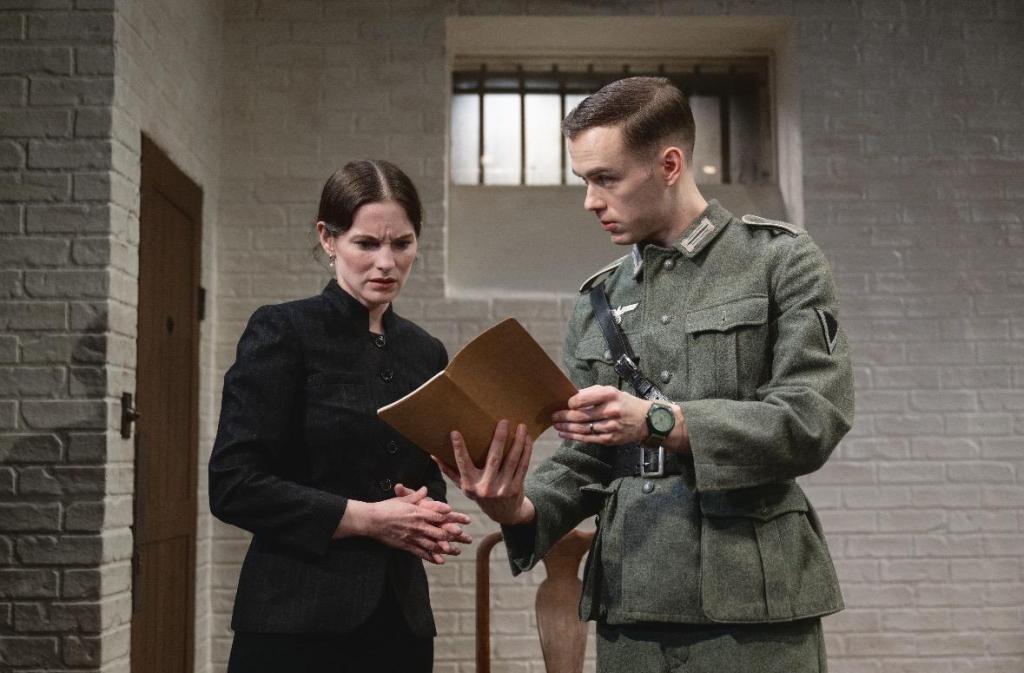
Ella Dershowitz as Hannah and Brett Temple as Karl in Mrs Stern Wanders the Prussian State Library, (c) Valerie Terranova
Comedy as Dramaturgy
While storytelling seemed ubiquitous, comedy was all-encompassing at this year’s Fringe. Yet this comedy offering functioned as a conscious dramaturgical trend rather than routine escapism or distraction. Clowning, absurdity, satire and play repeatedly became ways of approaching questions that might otherwise have been unbearable, and some of the festival’s funniest shows were also among the most politically and formally ambitious. Across the board comedy emerged as the means by which artists approached democratic anxiety, migration, conspiracy and identity.
In the spirit of their chosen theme of political leadership, Sh!t Theatre’s Rebecca Biscuit and Louise Mothersole begin their performance at Zoo Southside with a public vote: would the audience like an academic treatise on historiography or the performers rollerskating naked?

Rebecca Biscuit and Louise Mothersole in Sh!t Theatre’s Evta Too, (c) Ali Wright
Their sequel to Tim Rice and Andrew Lloyd Webber’s Evita is an angry, witty, anti-capitalist, musically virtuosic punk theatre show. Additionally, there is so much genuine research that goes into their work – including trips around the globe, interviews, archives, letter-writing, action research and ethnography – that frankly I’m surprised they don’t already have a string of PhDs. Evita Too is also a tongue-in-cheek study of populism, and the most perfect form of feminist activism I have ever seen: changing the world while letting men think you’re just doing your own shit.
That women are capable of reinventing clowning into a more sophisticated theatre language is also evident in the work of three-time Fringe First winners from New York, Xhloe and Natasha. Their singular brand of fast and furious physical storytelling, rooted in rural America, subtly picks at their society’s long unhealed wounds. In their fourth show Bigfoot Ripped My Dog in Half I Saw It, now at Summerhall, they explore the ways rumours spread and conspiracy theories evolve by centring on two teenagers whose attempt to cover up a traffic accident they caused spirals out of control.
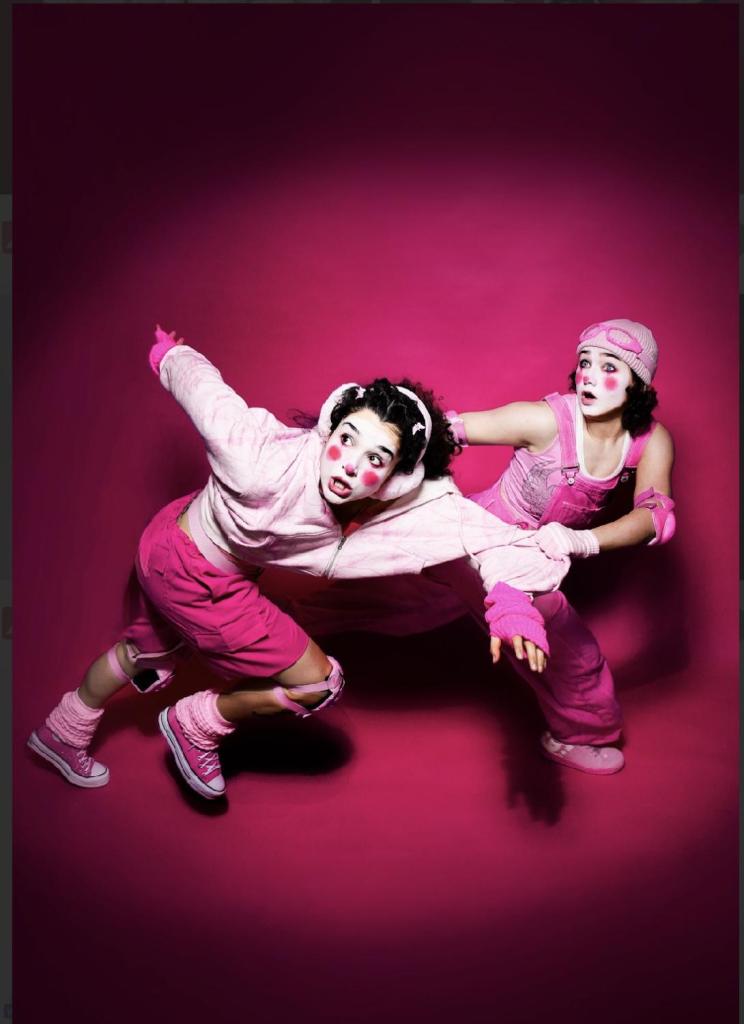
Xhloe Rice and Natasha Roland in Bigfoot Ripped My Dog in Half I Saw It, (c) Morgan McDowell
In other corners of Summerhall, Iranian clown/performance artist Sohrab Haghverdi drinks his own urine as part of an elaborate plan to obtain a US ‘genius visa’, while Australian clown Connor Dariol, also known as Conk, sings the same song for an hour.
The former is also an eccentric, tightly controlled balancing act between clowning, Rumi-inspired meditations on bodily fluids and an angry tirade against identity politics. His unique capability for excruciating tenacity pushes Haghverdi’s Foriegner (sic.) to the edge between funny and uncomfortable. And sometimes just enough beyond the edge to keep it stringently provocative rather than just vacuously entertaining.

Sohrab Haghverdi in Foriegner, (c) Ashley Smith
The latter – Man Sings the Same Song Over and Over Again for an Hour – seemingly opts for the vacuously entertaining instead. But by being exactly what it says on the tin, this show grows in its significance and the audience’s estimation the further it goes. The song that Conk sings is a secret but extremely well chosen in order to allow for multiple layers to be stripped in each rendition, without losing any of its entertainment value. There is a surprising element of pathos in it too, though Conk will not have you dwell on it for too long. Rather he will have you sing along, maybe even play along and, why not, dance along too. It’s a kind of mayhem you can only get at the Fringe.
*
I ended my week at Edinburgh Fringe 2026 staring at the sun. There was one spectacle this August freely available to much of the globe – and as a genuine natural phenomenon rather than a human creation of any kind – the solar eclipse.
It was my second in 25 years, both witnessed in Edinburgh’s Meadows, both times with some trepidation about potential permanent eye damage. Yet I could not have imagined a better place to be for this occasion. In a festival city of such singular beauty this too was a collective act: passers-by cheerfully sharing eclipse glasses for a few seconds at a time, gasping ‘amazing!’ before moving on with drinks in their bags, or just sharing picnic blankets, conversation and laughter in the evening sun.
Would it have been better – or safer – to have simply imagined it instead? I do not know. But what this Edinburgh has taught me is that theatre has a remarkable capacity to recalibrate our senses – or even conjure one through another. Hearing with our eyes, as in the Flemish Seagull, is a skill that theatre can teach in two and a half hours if necessary. Seeing with our ears is not unrelated to Hamlet’s seeing in his ‘mind’s eye’. The same goes for our sense of humour, our sense of justice and our sense of wonder – all summoned by the shared here and now of theatre. Perhaps that is humankind’s closest equivalent to a natural phenomenon: theatre’s enduring capacity to enable strangers to encounter the world together.

Sunrise over the Royal Mile, (c) Duška Radosavljevic
This post was written by the author in their personal capacity.The opinions expressed in this article are the author’s own and do not reflect the view of The Theatre Times, their staff or collaborators.
This post was written by Duška Radosavljević.
The views expressed here belong to the author and do not necessarily reflect our views and opinions.