





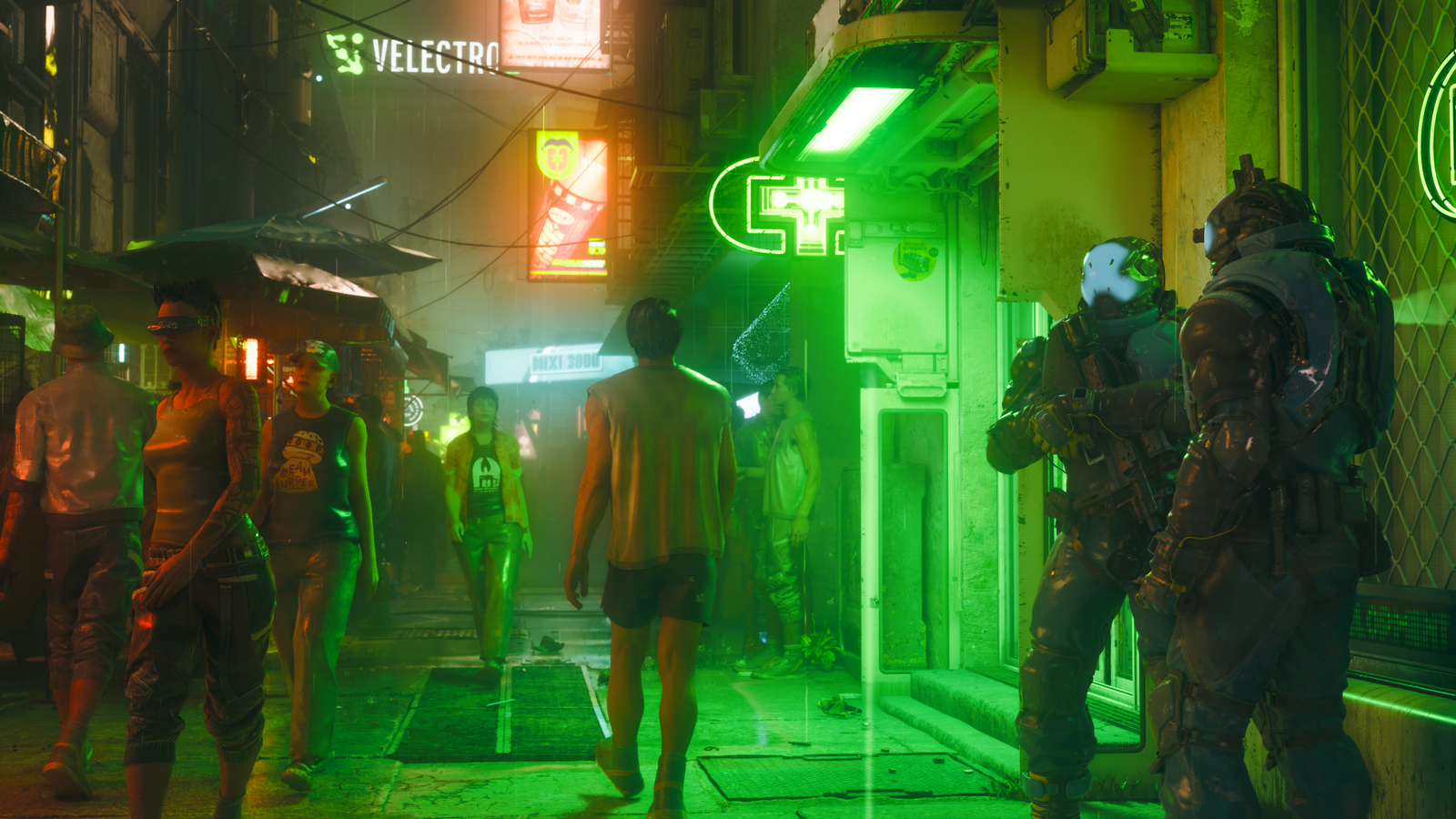
It’s pretty weird that vents in video games always open into immaculate stainless steel tunnels. That’s not the case in No Law. The vents in No Law are downright disgusting, full of cockroaches and cobwebs. It’s a subtle design choice, but one of many that makes No Law the most exciting game I previewed at Gamescom 2026.
No Law, an immersive sim from Neon Giant, aims to completely reimagine the cyberpunk genre as we know it, at least based on an hour of hands-off gameplay I was shown behind closed doors at Gamescom 2026. Neon Giant’s previous game, the 2021 isometric co-op shooter The Ascent, featured a pretty nuts-and-bolts cyberpunk setting: a vertical city trapped in eternal night, drenched as much in neon as it is in perpetual downpour. No Law offers a more refreshing twist.
No Law is reinventing cyberpunk as we know it
For starters, No Law lets you see — make sure you’re sitting down — the sun. Yes, sunlight! In a cyberpunk game! Its setting, the fictional city of Port Desire, is what Neon Giant considers a sort of Mediterranean cyberpunk. Your Akiras, Cyberpunk 2077s, and Ghostrunners are often set in places that riff on Tokyo or Los Angeles. Why never Old World Europe? Port Desire’s winding alleys and bustling piazzas could be Menton, Sanremo, or any other jewel of the Riviera, except overlaid with the neon signs and strip club advertisements you’ve come to recognize from the genre.
Port Desire is also an incredibly green city, which gives the whole thing a more “one with nature” vibe than you typically see in cyberpunk media. In the fiction of No Law, the city is overrun by aggressive plantlife. Workers have to spend each night using chemicals to clear the growth, else it’ll take over the city. You can, apparently, find parts of town that have been completely given over to the plants, though I didn’t see any in my demo. (A representative for the studio described it as “Studio Ghibli meets Judge Dredd.”)
Neon Giant is so committed to creating a sense of place that it named every single street and put all of those names on dedicated street signs, numbering every single building too. If you’d like, during missions, you can let a waypoint direct you exactly where you need to go. Or you can try to uncover information (either from files or from NPCs) to learn where you need to go, finding those locations based on your understanding of Port Desire’s road network. Additionally, every single NPC has their own home tied to a specific address, which they return to when, say, no longer on shift or no longer interested in getting hammered in the public square.
That last aspect seems innocuous but is quietly the most exciting part of No Law, teasing the sheer breadth of possible outcomes. You play as a fixer named Grey Harker. Burly. Ex-military. The type of blank-slate tough character who serves as a canvas for “doing whatever you want.” Now let’s say that means you kill the owner of a local bodega, where you’d typically buy health-restoring sodas, status-inflicting alcohol, or, for the hell of it, eggs. That bodega will summarily be closed for the rest of the game.
But let’s say you, a good person, have no intention of killing said bodega owner. Later on, you go on a mission, and get cornered in a courtyard by some thugs. The bodega owner happens to live in the apartment on the third floor. It’s night time. They’re home. You throw a careless grenade at the thugs, miss, and it sails through the bodega owner’s window. That too would shut down the bodega for the rest of your playthrough — without you even realizing it.
In this, Neon Giant appears to have captured the spirit of golden-age immersive sims like Dishonored and Deus Ex: Human Revolution. The studio created a whole bunch of interactive systems. Then they let the game rip.
Get Polygon’s Wishlister newsletter
A weekly cheat sheet to what you’ll eventually love to play. No buying, no
commitment — just saving for later.
Sign up free
Free. Unsubscribe anytime.
I saw this play out in real-time toward the end of the demo, where the developer played through the same mission twice to illustrate how you can take various approaches to completing objectives. This particular mission tasked Grey with finding an informant named Flink, with nothing more than an address to go off. The building, though, was surrounded by gang members looking to pick a fight. Grey had to rely on other immersive sim navigational tools — stealthily jumping fences, climbing through windows, or crawling through vents (!!!). At one point, in poking his head through a window, Grey spotted a drunk man passed out on his bed, dozens of empty liquor bottles lining the shelves. The man was so drunk he left his door open. Conveniently that’s exactly where the mission solution was.
Intriguingly, you get XP simply for completing your task, but don’t get any bonuses for how you complete the task. You won’t get extra XP for sneaking, for successfully unlocking safes, or even for landing headshots. In this, No Law solves for the longtime problem where immersive sims naturally bias toward rewarding stealthy play.
The second playthrough was set during nighttime — and, yes, befitting the genre, it was pouring outside. Though I didn’t get to feel it for myself, the shooting looked more like the shooting from a typical FPS than a typical immersive sim or RPG. (In other words: not Fallout.) At one point, Grey tossed a grenade. It suspended an enemy in midair, then exploded after a few seconds — an example of really cool tech whose functionality seems to slot naturally into No Law’s world of unpredictable interlocking systems.
With the enemies defeated, Grey was able to walk right into the apartment. Everything on the shelves had fallen to the ground. The force from the grenade had rattled the walls, knocking all of the bottles out of place. Apparently, in testing the game ahead of its Gamescom build, the developers had no clue that interaction would happen. They wrote the rules. No Law broke them in ways they never could’ve never expected.
No Law will be released in 2027 for PlayStation 5, Windows PC, and Xbox Series X.