![4th Sep: News of the World (2021), 1hr 58m [PG-13] – Streaming Again (6.4/10)](https://occ-0-1403-1001.1.nflxso.net/dnm/api/v6/0Qzqdxw-HG1AiOKLWWPsFOUDA2E/AAAABbve_Vtu9j0UR8JjAqRTbCRxyafLVam8h9cdgbMsmWIh8GHCGn8Jeo8gFs3wCkG36IEy16Zt3j_pelqLLNJL2hKNUIl-r4ncLcLU.jpg?r=52f "4th Sep: News of the World (2021), 1hr 58m [PG-13] – Streaming Again (6.4/10)")







Theater Poetenpack was founded in 1998 by Andreas Hueck, who has continued as its artistic manager to this day. The theatre is part of the scene of privately owned, independent or free theatres in Germany, as compared with the theatres owned by a combination of public funders, such as the federal state (Landestheater), municipality (Stadttheater) and central state (Staatstheater). Theater Poetenpack has its headquarters, and since 2020 a permanent venue, in Potsdam, and receives some external funding from public sources, having to rely to a large extent on the income from ticket sales. In terms of programming, the company presents work from the classical and modern to contemporary canon, with declared special emphasis on the low-budget, makeshift nature of their sets and costumes, characteristic of the packs of touring actors of past ages, and the poetic nature of the language spoken in the theatre. Those emphases are reflected in the company’s name: pack of poets. Over the summers, they present a selection of their repertory open air, in the Potsdam-based gardens of Sanssouci Castle, and in the gardens of the Möllenvogtei in Magdeburg.
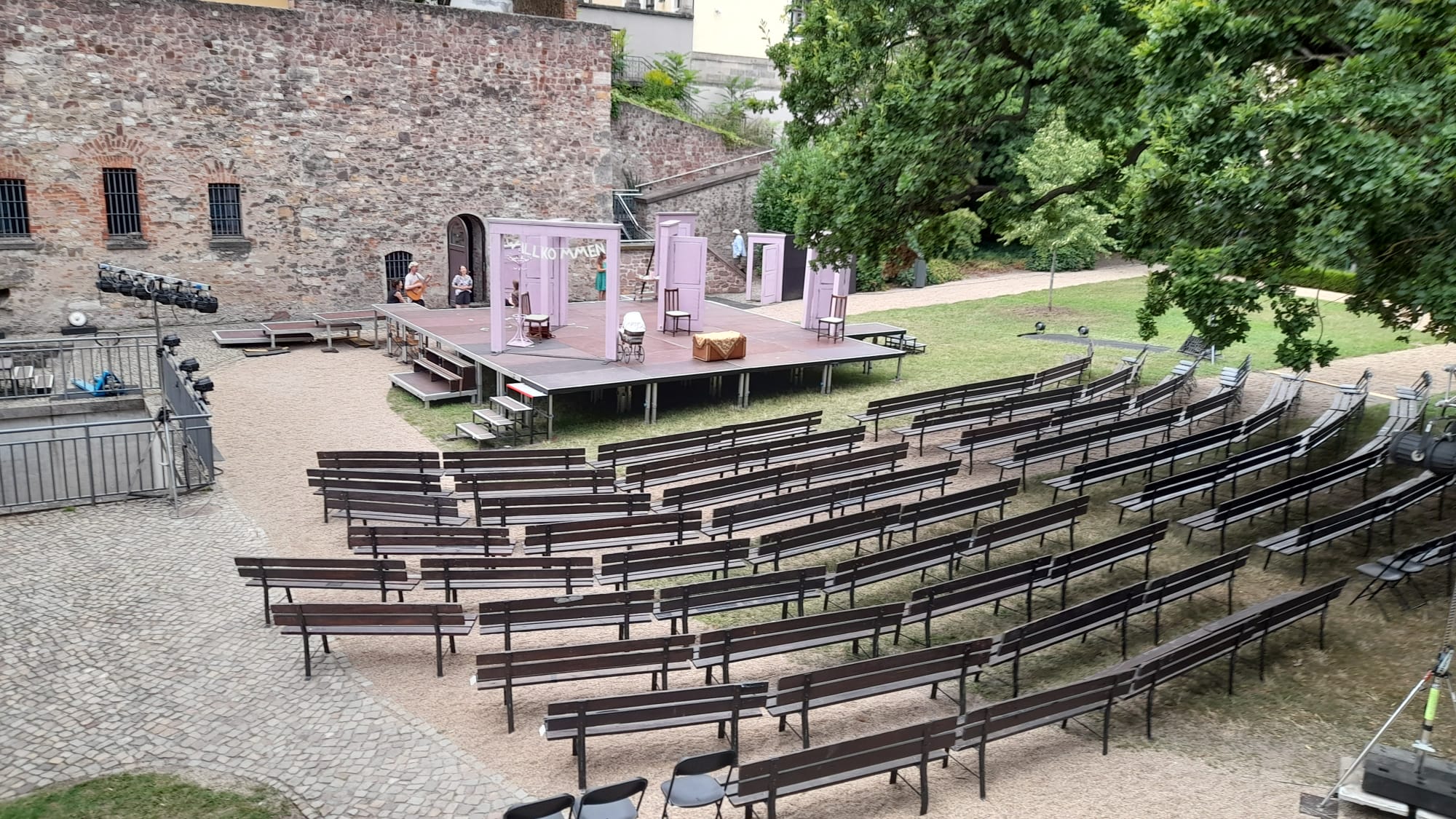
In this space in Magdeburg, enclosed by the walls of the Vogtei, some 200 seats were arranged on benches in front of a stage created as a raised level of rostra, with adjustable legs to suit the uneven grounds in creating an even playing area. The set for The Cherry Orchard consisted of a number of door frames, some with, some without doors, which were shifted by the actors during scene changes, characteristically in the same well-choreographed and unhurried way that the action of the play was presented.
Hueck, who directed the production of The Cherry Orchard, and his team and cast managed to create a performance of two hours 40 minutes (including 30-minute interval) that maintained a fine balance between keeping up the interest in the characters and events while capturing vividly the play’s variations on the theme of inability or unwillingness (or both) of even only appearing to be doing something.
In productions where a major star performer is cast as Ranevskaya, as an obvious audience magnet, this character inevitably moves even more center stage than justified by her position in the plot. Theater Poetenpack may have its internal stars, but that does not matter in terms of presentation or reception: Gundi-Anna Schick as Ranevskaya had the very advantage of hers not being a star name in the German theatre scene. She was on equal footing with the rest of the cast, and the centrality of her character resulted from what both the production and her acting made of that character. Schick presented a multi-faceted woman, stuck in her habits and traditions, ever-shifting between almost and never realizing the problematic nature of her life decisions. Schick played Ranevskaya as melodramatically theatrical in one moment and uttering deep, genuinely felt insights in the next moment, sitting oddly next to each other because they were so diametrically opposed to almost rule each other out. This Ranevskaya, her whims, her moods, and her utterances, became the pivot around which all the other characters and the plot moved, in smaller or larger circles, agreeing, disagreeing, arguing, laughing. And often despairing, because they could not understand her ways, a feeling aggravated when they vaguely sensed, or crudely realized, the frightening extent to which Ranevskaya’s behavior represented a mirror of their own shortcomings. The production made full use of this specific line of interaction, which secured sufficient drive and energy to sustain the slow and word-rich development of the plot.
Alexandra Maria Johannknecht made clear, as Anya, the kind of youthful exuberance Ranevskaya would have radiated in younger years. Her Anya had her own repertory of words and expressions, but, in significant moments, Ranevskaya’s patterns of speaking and behaving shone through. Ranevskaya was like Anya once, and there was a good chance Anya would turn into the woman Ranevskaya was now. Johannknecht was particularly impressive in the moments of Anya’s outbursts of optimism for her own future. The emphasis on the importance of working struck me first and foremost with Anya and reminded me of how central working is also for many of the characters in The Three Sisters. Teo Vadersen played Gayev as a particularly sad, lost old man – it was very moving how he conveyed to the audience that behind his superficial happiness at securing the job in the bank, he was fighting back tears of despair at what he perceived to be proof of his ultimate failure in life.
Stefan Wilde played Lopakhin as a man who was not at all comfortable among Ranevskaya’s family – he never was and he ultimately never would be. The ways this Lopakhin dressed was out of place in the estate environment, and he may have felt this vaguely, but would not have known how to improve. When Gayev dropped a casual comment (which hit even harder because it was dropped so casually!) on cheap aftershave, Wilde here captured very well the inner events for Lopakhin: hearing Gayev’s words, wondering whether the comment was directed at him, a little frown (I have bought and used aftershave specifically for this event, I don’t usually use it, it was quite expensive I thought), the frown deepening, with the remark bringing back all he and his family suffered at the hands of the family owning the estate – and finally shrugging it off on the basis of his full awareness of his strong and their weak financial position. In Wilde’s performance, Lopakhin’s utter frustration at Ranevskaya’s inability / unwillingness to take up his suggestions for saving the estate became palpable, vocally and through his appropriate use of rolling eyes and overall body responses. What Lopakhin did not realize was that Ranevskaya’s restrictions were mirrored, in reverse, by his own inability of proposing to Varya. There are differences of class that nothing can bridge, not even love or money! Wilde, finally, showed us that Lopakhin did change in the course of the play: he accepted that nothing he said or did would change the incomprehensible behavior of Ranevskaya and her family. Together with that insight, he accepted his financial power and proceeded to act not on the basis of a subservient sense of obligation, but based on what that money would be able to buy for him.
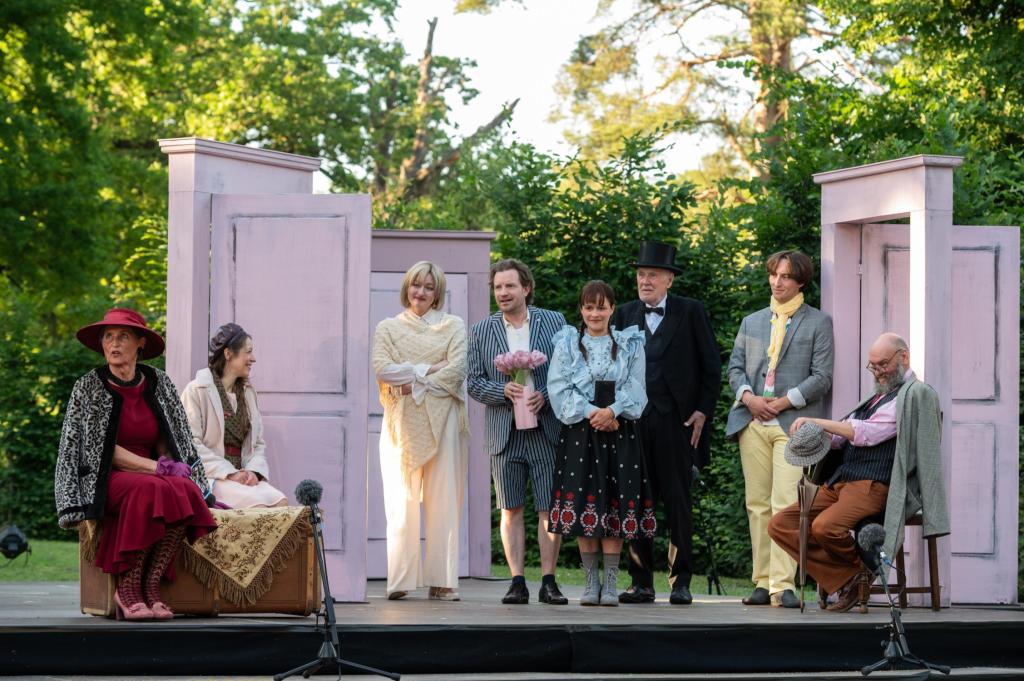
Gundi-Anna Schick (Ranevskaya), Alexandra Maria Johannknecht (Anya), Mirja Henking (Charlotta), Stefan Wilde (Lopakhin), Marie Luise Stahl (Varya), Willi Händler (Firs), Max Knoll (Yasha), Teo Vadersen (Gayev). Photo credits: Marcus Lieberenz.
Marie Luise Stahl was a very feisty Varya, outspoken, blunt, witty, going far beyond social expectations in what she said, and in the way she behaved, especially in the final encounter with Lopakhin, where, in a moment that was both funny and poignant, she ended up, briefly, in the position of kneeling in front of Lopakhin, as if she were about to propose to him.
In the production’s true ensemble spirit and nature, there was no immediate differentiation of major and minor characters and roles. Each had her or his full life history and identity. Eneko Sanz was Trofimov, the eternal student, vaguely critical of everyone and everything, including himself – fully aware that he had never actually done anything meaningful in his life and never would, and seeking to justify his existence away from a judgement framework based on such meaningful achievements, whatever they may be. Sanz’s emphasis on self-irony added a further dimension to this character not always taken for granted. The other hierarchically subordinate characters, the servants with their own hierarchy, the governess, the young servant and the old servant, complemented the cosmos of the estate. Mirja Henking as Charlotta was yet another outsider, her background unknown, not belonging anywhere, really; she was dressed in floating, white garments, and when not in the actual scenes with the family, she was seen ambling and floating about with the musician, Arne Assmann, in the background, at times singing a few songs created for the production, including a piece reminiscent of Brecht/Weill. Max Kroll was convincing as Yasha, the young servant not hesitating for a moment to repeatedly ask Ranesvskaya for money, while Willi Händler was moving as the old servant, Firs, stuck in his ways just as much as every other character was in theirs.
This post was written by the author in their personal capacity.The opinions expressed in this article are the author’s own and do not reflect the view of The Theatre Times, their staff or collaborators.