




![1st Oct: Adili Idola Celebrity Roast: Reza Arap (2026), 2hr 24m [TV-MA] (6/10)](https://occ-0-2433-2430.1.nflxso.net/dnm/api/v6/0Qzqdxw-HG1AiOKLWWPsFOUDA2E/AAAABRHoDCfBlCHNGrzz-VIem8xAlsIcBp5NuIhAl6NxbIhDds6gEfxxZ91WoYgxpSbtU69JoKpRV01lDcRIBvkmt5AlSmT1MEF5YgZAiLQRVWGHfDqWEcofsx2nK2xSOhc_1TcoREIc9E7il3JL7yvPlo7FOH77cjtRM_6KToGE9xc84Q.jpg?r=944 "1st Oct: Adili Idola Celebrity Roast: Reza Arap (2026), 2hr 24m [TV-MA] (6/10)")




Immediately upon entering World War II, America faced the problem of its messages being intercepted by Germany, Italy, and Japan. As such, the American military needed to develop a code that couldn’t easily be broken. Early in 1942, Los Angeles civil engineer Philip Johnston proposed a solution. Having spent much of his youth on a Navajo reservation, and being one of the few non-Navajo people on Earth who understood the Navajo language, Johnston suggested the military recruit Navajos and use their language to communicate vital war information.
The strategy worked, and the code talkers, as they were called, were instrumental in many American victories, including the Battle of Iwo Jima. U.S. Major Howard Connor even said, “Were it not for the Navajos, the Marines would never have taken Iwo Jima.”
Despite their indispensable, patriotic effort during WWII, I did not learn of the code talkers from any history class. Instead, I learned about them on The X-Files, during a three-part story that represents a high point for the series’ mythology.
As with every other season of The X-Files, the show’s second season concluded with a cliffhanger that wouldn’t be resolved until the next season began. On May 19, 1995, the episode “Anasazi” concluded season 2. Then, season three kicked off with “The Blessing Way” and “Paper Clip,” the latter of which aired 31 years ago this week.
The X-Files turned real history into an alien conspiracy
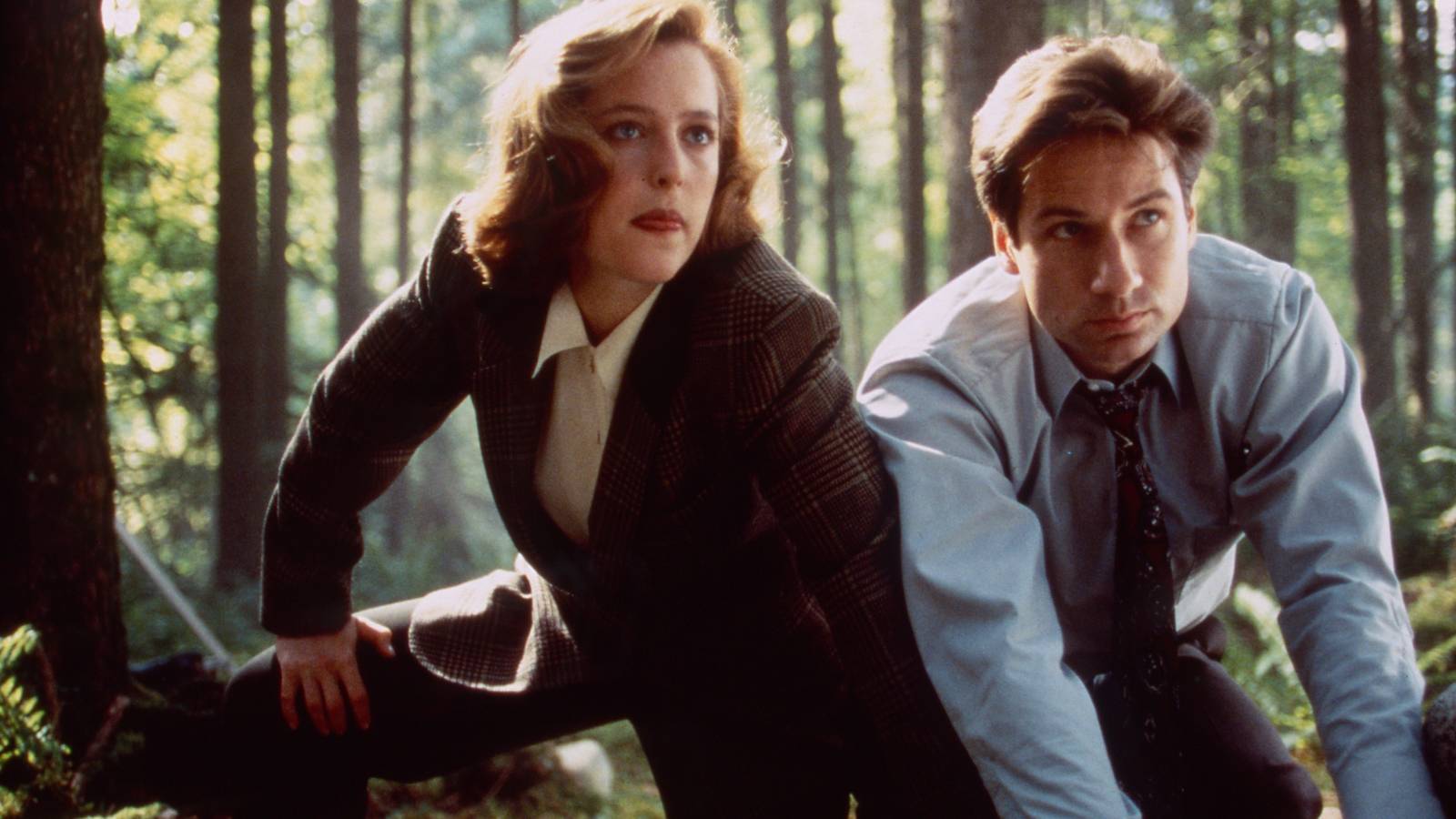
“Anasazi” begins with two separate threads that would eventually be woven together throughout the course of the three-part story. First, a teenage boy discovers a UFO on a Navajo reservation and finds a long-dead, alien-like body inside. Separately, a hacker infiltrates the Department of Defense’s UFO files and gives a tape of the information to Agent Mulder (David Duchovny). At first, Mulder can’t make any sense of its contents, but Agent Scully (Gillian Anderson) suggests the language may be Navajo. She is eventually referred to Albert Hosteen (Floyd “Red Crow” Westerman), an elderly Navajo man who served as a code talker during WWII.
Meanwhile, the Cigarette Smoking Man (William B. Davis) is determined to retrieve the tape and he turns to his old associate, Mulder’s father (Peter Donat), to convince his son to turn the tape over. However, when Mulder meets with his father, his father is killed. Eventually, Scully brings Mulder to New Mexico to meet Hosteen, who leads Mulder to the UFO site. Inside what turns out to be a railroad car, Mulder sees dozens of dead bodies that appear to be aliens. Suddenly, soldiers in the employ of the Cigarette Smoking Man blow up the boxcar and it appears as though Mulder is dead. That’s how The X-Files season 2 ended.

When season 3 debuted with “The Blessing Way,” we find out that Mulder is alive and being nursed back to health by Hosteen. Scully, meanwhile, returns to FBI headquarters and is warned that her life is in danger, as it is believed that she has possession of the tape. She doesn’t, nor can she find the tape where Mulder stashed it. Scully’s sister (Melinda McGraw) is then murdered at Scully’s apartment, as she is mistaken for Scully. At the same time, FBI Assistant Director Walter Skinner (Mitch Pileggi) reveals he has the tape, which he has held onto for safekeeping.
The trilogy concludes with “Paper Clip,” which sees Mulder and Scully head to a mining facility in West Virginia to find proof to back up the files. There they find thousands of paper files, Mulder sees a UFO up close, and in a dark tunnel, Scully encounters what appears to be dozens of aliens. The episode also concludes with one of the most epic owns in X-Files history when Skinner turns the digital tape over to the Cigarette Smoking Man in order to get Mulder and Scully reinstated into the FBI (they’d both been fired for their off-the-book activities in these episodes). But despite the Smoking Man’s successful retrieval of the tape, Skinner lets him know that Hosteen has committed the files to memory and has already shared their contents with 20 other Navajo who will go public if Mulder and Scully are harmed.
The show’s mythology never felt this satisfying again

All three of these episodes were written by The X-Files creator Chris Carter, and part of what’s great about them was the fusion of real-world history with the X-Files’ mythology. The code talkers bring in something really interesting from World War II, and Floyd “Red Crow” Westerman’s Albert Hosteen is an intriguing character far different from the evil old G-men who usually populated the show. “Paper Clip” was also named for the real-life “Operation Paper Clip,” which saw Nazi scientists work for the US government after World War II to advance American science and weaponry (this history gets woven into the story, too). By tying these real-world elements into the X-Files’ fiction, it made the grandiosity of show seem all the more plausible.
These episodes also cemented Assistant Director Skinner as an ally of Mulder and Scully, which had been in question during much of season 2 (his debut season). After this, Mulder and Scully often turned to him when they needed a trusted ally.

Together, these three episodes were as good as The X-Files ever got, at least in its central mythology story about aliens and the government plot to conceal their existence. In time, most die-hard X-Files fans come to realize that the standalone episodes are the best of the series, in large part because the mythology story never comes to a satisfying conclusion. This three-parter, however, was deeply satisfying and felt like a big, X-Files movie before there ever was such a thing. In several ways, it’s even better than both X-Files movies. The life-and-death stakes and direct connections to series lore make this a standout story, especially when compared to the movies, which had to be more standalone to appeal to a mass audience.
Future X-Files mythology episodes would never be quite this exciting again. For one thing, having killed off Mulder’s dad and Scully’s sister in the same story, there were simply fewer family members to be threatened in the future (though it would still happen). The lore of the series would also continue to be piled on top of itself, with little resolution along the way. And while these three episodes didn’t solve everything, it came during a point in the series where you still felt like this was all building towards something and eventually we would have all the answers. In contrast, just a couple of seasons later, the lore had become increasingly convoluted and it became clear that answering these questions wasn’t nearly as important to the writers as posing them to begin with.
Don’t get me wrong. There are definitely high points after this trilogy, and I’m not saying The X-Files “jumped the shark” after this. I’m just saying that these three episodes represent the high point of X-Files mythology — for better and for worse.
The X-Files is available to stream on Pluto TV, Hulu, and Disney Plus.