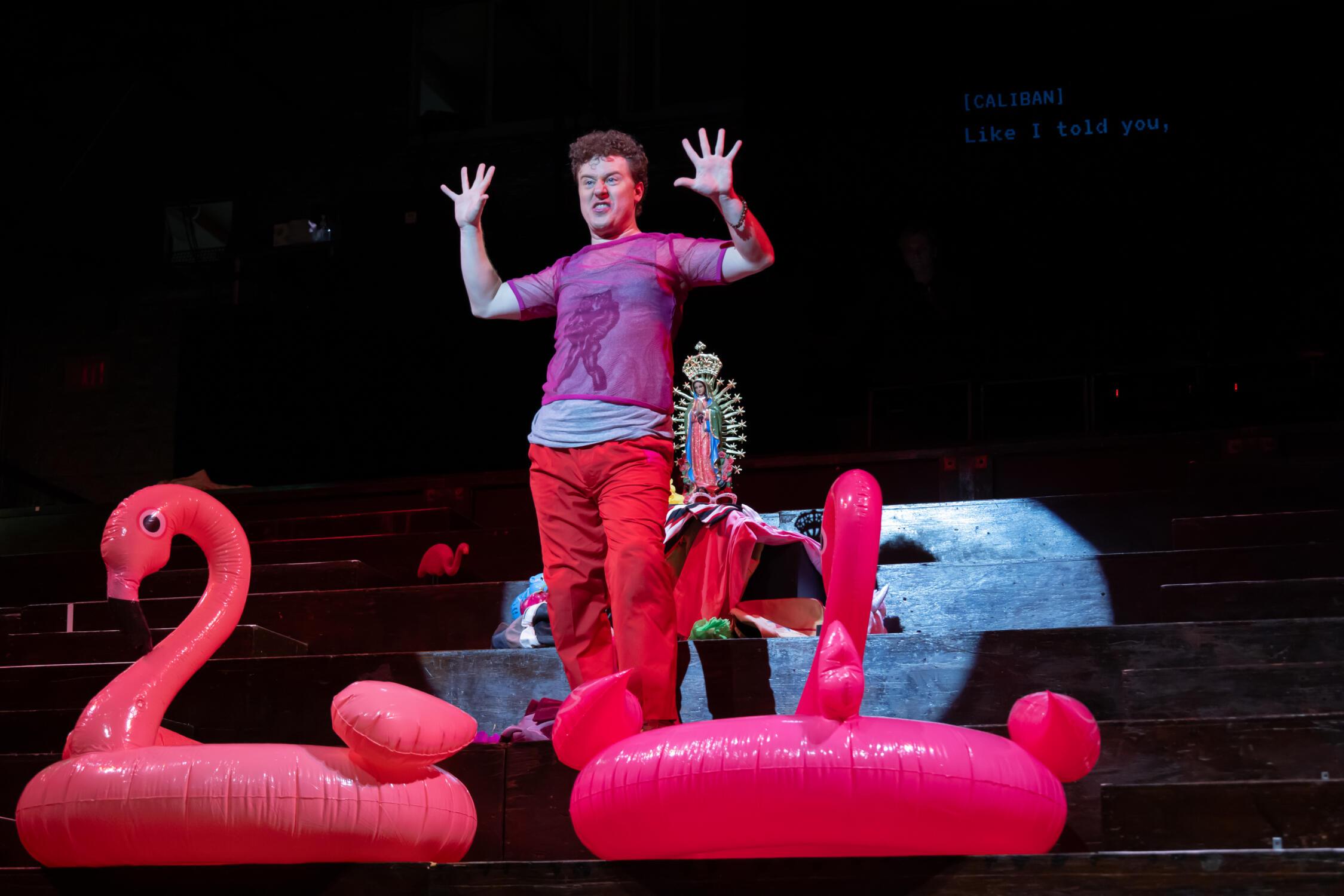





Koh Choon Eiow in approaching theatre’s Ghostopia. Photo by Hsu Ping.
(Read the second part of the interview here.)
Outside the bright, modern meeting room on the 10th floor of the Taipei Performing Arts Center, Koh Choon Eiow (高俊耀) was sunk in an oddly-placed armchair with his eyes ajar. The Malaysia-born theatre veteran could hardly pass as your genial neighborhood uncle; there’s something in his posture that gives away his decades of artistic dedication. Reminding me of a chameleon almost—steady, but always charged with precise action, as if observing the world from two independent directions. When I approached him, he immediately greeted me with a sagacious readiness, “We can start early and catch the 3 p.m. show together.”
Koh Choon Eiow is an outlier in Taiwan’s performing arts scene. Born and raised in Sungai Petani, Malaysia, Koh grew up in a local Chinese restaurant. He found an early footing in Kuala Lumpur’s theatre scene during and after his years at the Malaysian Institute of Art. He directed, playwrighted, and performed, all the while juggling a day job at a TV production company. Yet it was not until his relocation to Taiwan in 2004 that his career seemed to take off. His first breakthroughs were The Seven Silences: Anger (2008), an implosive collage of vignettes depicting marginalized individuals in lower-class Hong Kong, and Chronology on Death (2011), a physical two-hander ridiculing Malaysia’s disputed corpse-snatching incidents. The former won the inaugural Taipei Fringe Festival’s biggest prize, the Rising Star Award, while the latter went on an international journey, touring to Macao, Shanghai, Penang, Singapore, and Kuala Lumpur in the following years.
Like most theatre artists, Koh has a multi-hyphenated career attached to his ever-expanding CV—though his may be more extensive than most. He often acted throughout the 2010s. He was the ferocious husband in Hung Hung’s The Valkyrie (2014), as well as the alcoholic journalist lost between the real and the fiction in Out of Heaven (2013). Besides his self-initiated projects, he often works as a playwright with wide-ranging collaborators, including old-school leftist artists, contemporary puppetry troupes and traditional theatre practitioners, such as those of Yueju (Cantonese Opera) and Nanguan (Nanyin). He is also a prolific and eloquent essayist, contributing regularly for PAR, a performing arts magazine issued by Taiwan’s National Theatre, and program pamphlets for his own shows.
Koh might be an outlier, a maverick even, yet he is certainly not a lone wolf. In 2005, at a theatre workshop that focused on bodily training and Grotowski’s methodology, he began a life-long collaboration with Cheng Yin-chen (鄭尹真), a then-aspiring versatile Taiwanese actress. In 2014, they co-founded approaching theatre (窮劇場), a “little” theatre company whose Chinese name, at first sight, is reminiscent of Poor Theatre. Though the character “qiong [窮]” translates colloquially as “poor”, they were actually inspired by its classical roots. In Wang Zhihuan’s famous 8th-century poem “Climbing Stork Tower” (登鸛雀樓), the character is used as a verb meaning ‘to exhaust the limits’ of one’s vision. By deliberately rendering it as “approaching,” the company implies a persistent pursuit—a perpetual act of reaching toward elusive artistic truths. For Koh and Cheng, the search expands beyond bodily training; they are interested in “exploring the social history and aesthetic culture that’s observed within one’s body, as they seek to discover the forms and conditions of human existence.”
Since its inception, approaching theatre’s productions have received wide recognition from critics and theatre-goers alike. Since The Seven Silences: Anger, approaching theatre has won several Program of the Year awards at Guling Street Avant-garde Theatre, a major fringe hub in Taipei. Their productions are invited to a wide range of festivals, including Taipei Arts Festival, Macao Arts Festival, and Cross-Strait Little Theatre Festival. Yet in recent years, the acclaim for their artistic mastery seems to go beyond diehard aficionados. In 2023, approaching theatre’s Apostating Time (感謝公主) won the Taishin Arts Award, the most prominent arts award in Taiwan given by a private foundation. Following that success, Ghostopia (暗夜.腹語.鬼托邦) clinched both Best Playwright and Best Actress in a Play from the 2025 Taipei Theatre Awards, the first major theatre prize initiated by government agencies with ambition beyond theatre’s inner circle.
The modest duo might not foreground their starry achievements, yet Ghostopia, performed solely by Koh and Cheng, does feel like a magnum opus decades in the making. The story begins as a half-serious parody of Hong Kong exorcist flicks, as the exorcist treads deeper into the ghost’s past, the audience is drawn back from a modern Taipei ruin into the 1950s Malayan jungle, where A-Muei, a Malayan Chinese woman, was caught between an English colonizer and a local communist guerrilla in the paranoid post-war New Village.
The auteur signature are all present: a play unfolding between narration and self-aware dialogues; a double act constantly switching characters, languages, and theatre traditions; physicality and musicality taking focus over psychological realism; a design not completely stripped-down but definitely uninterested in historical verisimilitude; and the bodily schizophrenia behind the infatuating facades of colonialism and capitalism on Asia’s Pacific front. Critic Jen-Hao “Walter” Hsu described the play as “both hilarious and incisive, witty and poignant.” Indeed, the doubling, whether of actors or characters, often paints Koh’s pieces in an ambivalent tone, complemented with his tendency to close his piece with an ambiguous, lingering gesture. In this case, “I am a man without shadows.”
Seemingly different from his signature ambiguity, Koh’s demeanor struck a note of razor-sharp straightforwardness. He never attempts to conceal his perplexity at ill-conceived questions, and he can always connect dots to form a bigger picture in mere seconds. With his latest work, a staged reading of a Korean play, set to open the next day at the Taiwan International Play Reading Festivals, I, a part-time dramaturg who on occasions worked with Taiwan’s Prologue Center for New Plays, met with the restless artist right after his dress rehearsal. I talked with Koh about border-crossing collaborations, musicality in language, and his thoughts on emerging artists.
Our conversation has been edited for clarity and length, and incorporates materials from the talkbacks of the Festival.


approaching theatre’s Apostating Time, written by Koh Choon Eiow. Photo by Lin Yu-Quan.
Chen: Hi Director Koh, I know you came right after the dress rehearsal—thank you for meeting with me! First, it’s hard to avoid identities these days. You once said that you feel like having two bodies or two souls: one in Taiwan, the other in Malaysia. It reminds me of the Buddhist story “the conscious corpse” that you incorporated into Ghostopia, where two ghosts replaced a traveler’s body parts with a corpse’s. In the English-speaking world, artists often use a compound word in front to indicate their current artistic base; for example, I might self-describe as a New York-based Taiwanese artist. How would you locate your identity in relation to that English-speaking framing?
Koh: As an artist, the priority nowadays seems to be positioning yourself. The kind of positioning I am referring to is like being put in a drawer. We have to categorize ourselves, inviting people to view us through that single frame. My past experience was not like this. I’m used to the reverse way: I show you my work, you feel it, and you decide to put it into this or that drawer. Now you show people the drawer first, and they view you through this drawer. I don’t know if it’s because the audience is used to this mode of perception; whether to see a show or not is fully dependent on a preceding frame.
Chen: A Woman from Afar (먼 데서 오는 여자), written by Korean playwright Pai Sam-shik (배삼식), opens tomorrow. How do you feel? And with your various transnational collaborations, what do you find different or interesting this time?
Koh: This is a reading, so the director’s vision is not our priority; it’s more about presenting the playwright’s voice as written. In fact, we didn’t meet with the playwright until yesterday’s press conference. We were quite focused on the play itself, but it was not my first time working with Korean artists. My first encounter was back in 2013, when I worked with Assignment Theatre (差事劇團) on Out of Heaven. In the show, I performed with a Korean actor. I obviously didn’t understand Korean, so in rehearsals, I had to figure out how to receive his breath and return that energy back. Later, in 2017, I worked on Wang Mo-lin’s The North Defectors. Yin-cheng and I were playing doubles against two Korean artists, who both have a background in activism. Through them, we could see how Korean society is highly polarized by unfair distribution of wealth; a strong antagonism exists between laborers and capitalists. We’ve picked up these cultural subtleties in the past so approaching this play doesn’t feel entirely unfamiliar.
Chen: You are known for your attention to voice and body, so I am curious: what are the differences in bodily texture between Korean and Taiwanese actors? And how do you approach the Korean play with a Taiwanese cast?
Koh: The Korean language is quite different; the intonation has more curves in comparison to Mandarin; the force within hits quite differently as well. In May, there was a Pansori performance here in Taipei, and they say Pansori’s very core is han, a sense of deep, collective resentment that connects to the history of colonization and post-colonial turmoil. The collective state of trauma probably influenced the Korean language and the Korean identity—if we can naively speak of a distinct, homogeneous “national” character—which is quite different from, say, the broadly-defined Han Chinese.
By coincidence, I was reading Mater 2–10 from Hwang Sok-yong (황석영) before I knew I was going to stage the reading. The novel chronicled a railway worker family across three generations. The story revolves around how each generation resists capitalist oppression under different circumstances, from Japanese colonization, the Korean War, to rapid industrialization. And you can find similar experiences across Asia. Colonization in the first half of the 20th century, followed by war, independence, then a sudden leap from agricultural society to immense wealth—but during the progress, what was sacrificed and what was exchanged was left unheard and unseen. We saw these impressive numbers, but what happened to the people behind these numbers?
So back to the reading, of course in general, we can say that yes, Korean actors are more expressive whereas Taiwanese actors are more restrained, but it’s clear to me that we’re not trying to replicate or impersonate the Korean acting style. Each nation has its own modes of expression and modes of emotion that could not be simply learned by impersonation under a short amount of time. Therefore we worked with our actors’ bodies.
In rehearsals, we share our experiences and observations of Korean society. We discussed societal issues, the Cold War experience, the activist movements mentioned in the play, and the suppressed history of laborers or the colonized. There are commonalities underneath. Throughout the 20th century, of course the direction and actualities were different, but around the 1960s and 1970s, whether Taiwan or Malaysia or the Four Asian Tigers, we shared this forwarding vision of progress towards a developed nation, a better civilization. Yet under the glamorous surface, there was oppression and suppression. With these common grounds, we asked ourselves constantly, how we can approach the play in Mandarin Chinese?
For similar reasons, we’re also not trying to impersonate the stereotypical elders on stage. People have this misconception that elders should sound slow or rough on stage, but I don’t think that’s necessary. The play spans across 50 years of the characters’ lives; we spent most of our time dealing with how to interpret the characters’ different stages through their voice texture. Moreover, sometimes they are imagining, so how can we differentiate between the real and the fictional through texture for the audience? At which moment the texture in their voice shifts, allowing the flow of time to carry the audience forward? Through these minute differences, I hope we could lead the audience through the footsteps of history.
Chen: I want to pivot to your relationship with reading now that you brought up Hwang Sok-yong’s novel. It’s hard not to notice how well-read you are. In interviews or writings, you were always sharing what you’ve read. I assume reading is a big part of your artistic inspiration; could you share your literary influence with us? Is there anything in your upbringing that you kept returning to?
Koh: Reading is undoubtedly an important part of my life. I grew up in a small town, so at a certain point, reading inevitably exposed me to a bigger world and opened up a sense of aspiration. You will be curious about what the outside world is like. You will be curious about how others live their lives. Reading has been a habit of mine since elementary school or middle school, and when I was studying theatre in Kuala Lumpur, the things I’ve read over the years naturally became a database to return to. When I am researching a play, I naturally connect it with what I have already encountered.
I don’t really remember what I read as a kid. There were children’s books and comics for sure. I tried Chiung Yao, but I never really got into her romances; I probably read most extensively on Jin Yong and Gu Long’s wuxia novels during my adolescent years. During that time, I also followed serials in the newspaper. I followed Japanese crime fiction in newspapers in a way similar to how we’d follow soap operas on television. I read Murakami Haruki’s Norwegian Wood as a newspaper serial as well. I don’t remember much else before college; adolescence can be quite a confusing period.
Chen: Speaking of literature, you published two play anthologies in the last decade. Because these plays grow out of performance, bodily presence plays a heavy role between the lines; that is to say, it’s hard to separate the text from the performance. There seems to be a specific rhythm and cadence to how the lines should be delivered, and I believe the pattern naturally comes from the rehearsal process and the specific time and space where you and your creative partners figured the play out. So, I wonder how you imagine others staging your published plays?
Koh: I am quite curious as well. I truly hope some theatre friends out there will be interested in staging my plays. You were right about how the plays were crafted, but if we trace far back, for example, all the way through Western theatre history, Shakespeare, or say traditional theatre, those plays were written in a way that is also close to the actors. Look at the famous Dan Jingju actors, such as Mei Lan-fang. The repertoire was crafted specifically for them, but the plays still lived on, allowing entirely different actors to step into the characters. Written plays always have that potentiality. So it’s hard to tell. Sometimes you have to take a step back and look across a larger timeline to see if a work ferments. I wouldn’t say that just because I cared about the actors’ bodily presence or musicality in language, the plays can’t or shouldn’t be played by someone else. I don’t think we should jump to that conclusion.
This post was written by the author in their personal capacity.The opinions expressed in this article are the author’s own and do not reflect the view of The Theatre Times, their staff or collaborators.