

![2nd Mar: The Actor Awards Presented by SAG-AFTRA (2026), 2hr 34m [TV-MA] (6/10)](https://occ-0-503-2705.1.nflxso.net/dnm/api/v6/Qs00mKCpRvrkl3HZAN5KwEL1kpE/AAAABfiTIwiwzYhVD6qtE-IX0TgN3Sb-DUxivMLEhSICDwfU9dOqP-gijKNraYHec9rIdFldmENkgvOhOhGxsnGzbnBtfDefXeteHjBwvmBnduGjRWy8GV6bFV8mnico21oBYeJTmdkBgQiJJwo7oIXVGomx979vylXDmPW4eczzNcGSb5h0H8dr8LEROIT_FKcheHnUiqdo2zjb0t4JuGBY6yKn855pqTykvj3bjxQZ.jpg?r=c05 "2nd Mar: The Actor Awards Presented by SAG-AFTRA (2026), 2hr 34m [TV-MA] (6/10)")






Pokémon Pokopia poses a tempting question: What if we could just start again? Tear down our decaying infrastructure, shutter the factories pumping pollutants into our atmosphere, and rebuild a habitable planet for all creatures living on it? It’s a powerful fantasy, one that’s helped transform games like Minecraft from toy boxes to digital institutions. Maybe, Pokopia asks, it’s more fun to build a functional world than to destroy a dying one.
Developed by Omega Force, Pokémon Pokopia is a blocky life sim that applies the universal language of Pokémon to the creative joys of Koei Tecmo’s Dragon Quest Builders series. That doesn’t just mean throwing all the monsters you love into a charming town-building sandbox, but pairing the ethos of the Pokémon series with a genre that perhaps better suits its good-natured environmentalist messaging. If you can find the patience for its litany of tedious chores and slowpoke pacing, Pokémon Pokopia serves as an earnest reminder to nurture our world and all the little things in it.
Pokopia wraps dystopian fiction in a cute disguise. In its opening moments, a lone Ditto wakes up to discover an unfamiliar world. All the humans have vanished, and the empty world is a sea of dead grass and ruined buildings. After taking the form of its missing trainer, Ditto meets a Tangrowth who tasks the little blob with restoring Pokémon habitats so that critters, and hopefully the missing humans, will return. It would all be a little unsettling if it wasn’t brimming with bright colors and Pokémon charm.
From there, the life sim loops of the game unravel themselves very, very slowly over the course of a 30-hour story (if you’re speeding through it) that gives some structure to the sandbox main attraction. You’ll build homes, decorate the world to your heart’s content with more collectible items than I can count, craft like there’s no tomorrow, cook meals, and even learn how to establish a whole bartering system eventually. Progress is doled out in fulfilling requests for certain monsters, and also in gaining HM-like moves that let you water the ground, grow grass, smash through blocks, and more. Pokopia goes surprisingly deep, but learning how to do everything is a long, tedious process where the wordy dialogue tutorials flow like rivers even 20 hours deep.
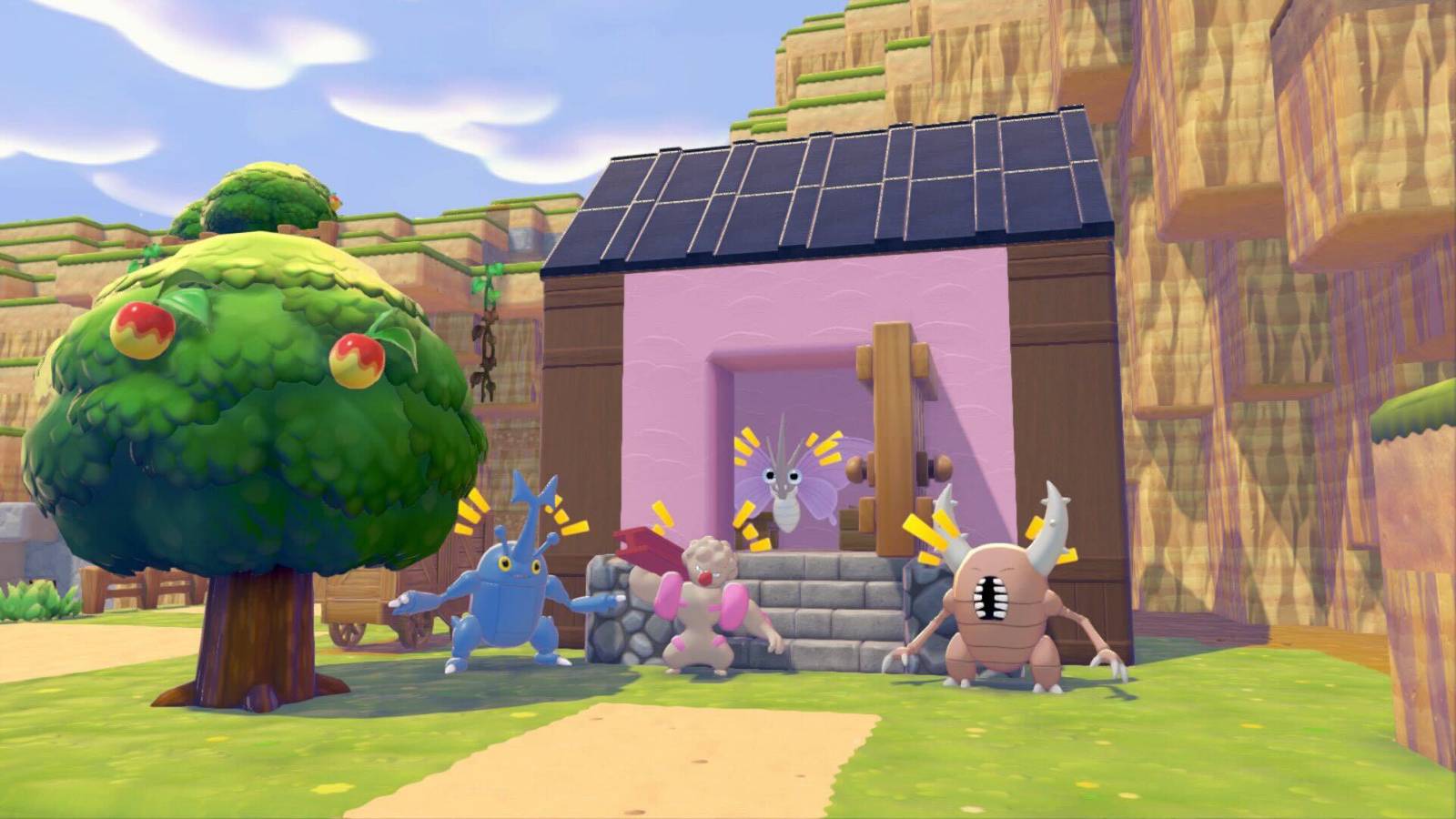
What’s more instantly gratifying, at least, is Pokopia’s puzzle-like spin on the series’ traditional “catch ‘em all” concept. To summon a monster to live in your world, you need to figure out the habitat it wants to live in. Some will only pop out when four patches of tall grass are placed together. Others have more complex needs, like requiring a full picnic basket spread across crafted tables and chairs or a proper stage for a singing bird. You are collecting homes as much as you are collecting Pokémon, and that significantly changes your relationship to monsters you’ve caught hundreds of times.
You’re not a trainer in Pokopia, even if you’re imitating one. There are no battles. Your grass-type Pokémon only use their type-specific powers to make flowers and vegetables grow faster, not vine whip other monsters silly. There are no gyms or any remnants of the old world as we’ve always known it to exist in the RPGs. Those things are in literal disrepair. The maps, built from Minecraft-like blocks, are dotted with familiar Kanto landmarks like a beached S.S. Anne that’s begging to be reclaimed and renovated. Scattered lore logs make references to the gym leaders of yesteryear, but they’re gone too. The world is a blank slate. So, what are you going to do with it?
That open-ended question gives you a lot of space to play around and discover your own answer. Maybe you’ll want to recreate the towns you know and love by constructing rows of housing on neatly arranged streets. Maybe you’ll want to kick that human vision to the curb entirely and build natural habitats out of good old grass and lumber. Will you string up messy powerlines to operate machines that require electricity, or reject industry altogether? You’ll make every decision block by block.
All of this play happens against an environmentalist backdrop that shouldn’t come as a surprise to anyone who has played a Pokémon game. The RPGs are filled with freak climate disasters and light commentary on urbanization. The story of the missing humans here, which can be uncovered through lore pick-ups, touches on similar themes. There’s a palpable anxiety about the health of the planet and fears that it’s too far gone to save, but Pokopia never deals in doomerism. Instead, players are given a space to do something constructive with those feelings. Repopulating a dead planet by paying close attention to what every tiny Bonsly needs becomes a small act of digital catharsis. Maybe it’s never too late to turn things around if we’re willing to put the work in.
There is a tension between Pokopia as a sandbox life sim and a story-driven game.
Patience is a requirement to get to that feeling, and it’s not always earned by a game that forgoes a lot of handy conveniences. If you want to assign monsters to a task — say, rebuilding a dilapidated Poké Center, you have to find them wandering out in the world, command them to follow you, and then trek over to the task you want them to do. Sometimes that means you’re at the mercy of fiddly Pokémon AI, as you wait for a Squirtle to realize that you want it to spit water on some gunk so you can clean it up. That minor inconvenience gets a little more time-consuming due to the fact that the world is split into separate biomes (a central grassy area, rocky mountains full of ore-rich mines, a seaside town). If you need a monster that specializes in building in an area, you may need to march them from one area to the next just to put them on the job.
There is a tension between Pokopia as a sandbox life sim and a story-driven game with very intentional progression. If you’re coming to it just to casually play an hour every other day, you’ll find that it will take you weeks — if not months — of consistent playtime just to gain the ability to make paper, smelt ingots, or even just traverse the world efficiently. There is always a built-in progression to a sandbox game, but there’s usually a sense that everything you’ll need is available to you from the jump. The puzzle is in figuring out how to go from crafting shovels to making skyscrapers. Pokopia’s story, filled with quests built to introduce systems one at a time, cuts into that sense of discovery by withholding information from you until it decides it’s time to learn.

While frustrating, that slow pace is a deliberate choice. Pokopia doesn’t want you to blast through everything it has to offer in one sitting. It makes you wait by putting timers on your building projects — some take 15 minutes to erect, others can take a whole day. You’re meant to log in, play a bit, put as many pans on the stove as you can, and log out. It takes too long to get to the point where you can really start automating mass ingot production, but Pokopia is comfortable giving you gradual gains.
There’s something honest in that decision, even if it’s bound to turn some players away. An ecosystem isn’t something you clean up in a day. It takes time and care. The slow early hours of Pokopia spent repairing potholes in brick walkways and watering every square of withered grass are worth it over time. You have to invest in progress.

Somewhere near the 30-hour mark, where the late game’s grindy requests began to wear me down, I traveled back to the starting field where my adventure began. I had been decorating it gradually over the course of my playtime — a leaf hut here, a lawn ornament there — but it had been a while since I stopped to actually look at how far the area had come. Close to a dozen Pokémon were happily out and about, living their little lives in peace. Some were playing tag with a new friend. Others were sunbathing by the pond next to their favorite Arcanine doll. Over on a park bench I’d placed at random, a Goomy and Magikarp napped together.
For a moment, I forgot that I was playing a very mechanical life sim where monsters can feel more like tools than animals. (In some ways, Pokopia just trades one kind of labor for another.) I felt like I had actually created a comforting home for some friendly Pokémon. Not a place built by humans who capture critters for sport, but a world shaped around them.
Pokémon Pokopia will be released March 5 on Nintendo Switch 2. The game was reviewed on Nintendo Switch 2 using a prerelease download code provided by Nintendo. You can find additional information about Polygon’s ethics policy here.