





![30th Sep: The Naked Gun (2025), 1hr 25m [PG-13] (6.15/10)](https://occ-0-7328-1001.1.nflxso.net/dnm/api/v6/0Qzqdxw-HG1AiOKLWWPsFOUDA2E/AAAABW5sXI6Ii_BeXH09ixe9sqWp5MyaXXivY4jvu9zUjIKnKyrZZiwnDQzCfY6eGsjJf0H1MU9v3DwcZmB-EH04CTj9ROKyBATqUSLIDl2qp2zwUu7Fq-QZsfHdL6JzZhTmeWEgASqXp7-sF1-zXvCq7SOo5KhU296wE8FbPUTb-kqodw.jpg?r=c3a "30th Sep: The Naked Gun (2025), 1hr 25m [PG-13] (6.15/10)")





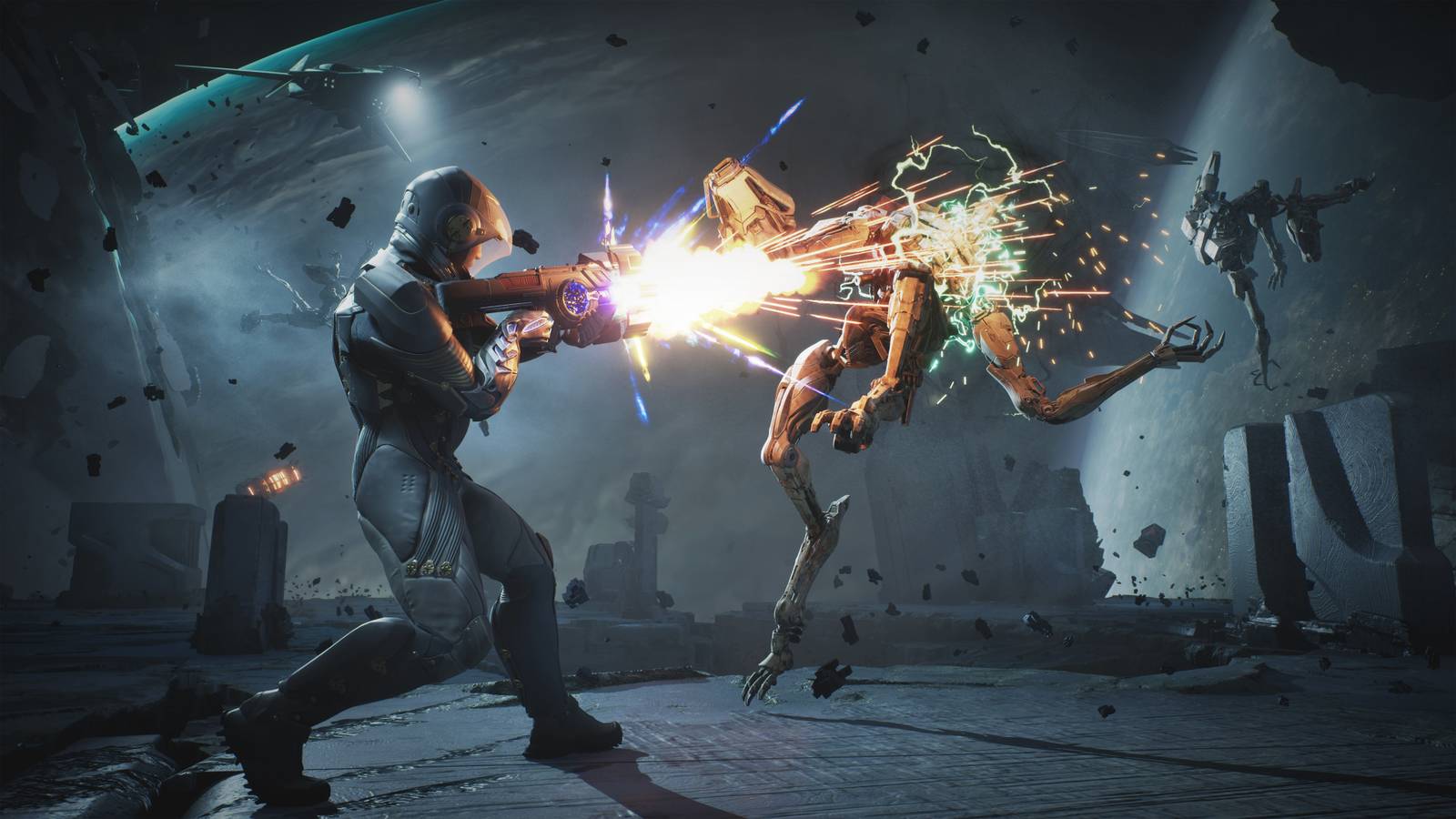
So, I recently played this new video game. It’s a space-faring action-RPG set centuries in the future. The action is cover-based, and from what I’ve seen, largely takes place in derelict alien structures. In missions, I’m accompanied by two party members, whom I can give orders to in battle through the use of a time-pausing ability wheel. (Those abilities, by the way, operate on cooldowns.) The dialogue options I choose can build affinity with my party members, and tip my morality one way or another on a red-and-blue scale. I’ve got a cool spaceship. Hey did I mention space?
If this sounds like I’m about to tell you I played Mass Effect 5, I’m so sorry, this is not that game. It’s Exodus, the debut from Archetype Entertainment planned for an April 7, 2027 release on PlayStation 5, Windows PC, and Xbox Series X.
The comparison between Exodus and Mass Effect is a natural one; members of the Archetype team worked on the original Mass Effect trilogy (and also share a collective pedigree that includes other totemic games like Halo 4 and The Last of Us). You can see that DNA in any screenshot, concept art, or gameplay trailer. But despite the superficial similarities, Exodus is carving out its own corner in the genre of space-faring action RPGs set centuries in the future.
Exodus is so much more than a Mass Effect replacement
Exodus is unique in its space thanks to what narrative director Drew Karpyshyn described as a north star in development: a canon rooted entirely in relativistic physics. The one ironclad rule? No faster-than-light travel. But the game sends you to various star systems, meaning characters experience the life-altering effects of time dilation through what Archetype refers to as “Exodus missions.”
“It’s a major life event. It’s a major narrative choice. So not every mission in the game is going to be something where you experience time dilation,” Karpyshyn said in an interview at a preview event for the game in Austin, Texas, ahead of its release date announcement at Gamescom 2026. “A lot of the game is knowing you’re about to make an Exodus mission and preparing for it, getting everything in place because you know you’re gonna be gone for, you know, potentially years? Decades? Who knows?”
Exodus is technically set 40,000 years in the future, but its fiction begins closer to our IRL time, when humans decamp a decaying Earth for the Centauri Cluster, a string of star systems with a high density of habitable worlds. Thanks to the rules of time dilation, some ark ships arrive thousands of years before others. The humans who arrived first messed with their genomes to the point where they’re no longer recognizably human, and adopted the Celestial moniker. They also applied this technology to animals from Earth, granting them human-level consciousness and dubbing them Awakened. (This is why one of your companions is an octopus with Big Feelings.)
It’s a rice canon that’s been explored in various forms of media in the years between the game’s reveal and its release: a tabletop game, a duology of novels by the British sci-fi legend Peter F. Hamilton, a string of short stories by other British sci-fi legend Adrian Tchaikovsky. Though the setting itself has already been richly explored, the people who live in-universe in Exodus are still very much shrouded in mystery. Without the benefits of faster-than-light communication, information can take years to travel between the stars. It’s one thing Karpyshyn notes as helping Exodus distinguish itself from other modern sci-fi universes.
“One is obviously the time dilation. It puts sort of a different spin on the choices. It affects the way the universe is built, the way societies are built. There’s not as much connection between different systems. You kind of know they’re out there, but you don’t know a lot about them,” Karpyshyn said.


So how does all of that heady philosophizing actually distinguish Exodus from its forebears on a moment-to-moment level? Not that much, to be honest, at least according to two hours of hands-on gameplay. But this is far from a bad thing. The Mass Effect games are some of the best video games ever made (yes, even Andromeda) but have been on ice for about a decade, thanks to a wide range of factors beyond its creators’ control. Being hailed as the second coming is not a bad thing, seeing as what I played more than holds up to the comparison.
In Exodus, you play as Jun Aslan, a Traveler — a human who braves crossing the deep space between star systems. Due to the effects of time dilation, Travelers sacrifice any chance at a personal life.

“When a traveler goes on a mission, they typically have a destination that they know how far away it is. So, you know, maybe it’s five light years away. It’s gonna take you five light years — five years to get there and five years to come back. Right?” Karpyshyn explained. “Again, five years for everyone else, [but] because you’re traveling very close to the speed of light, it might only seem like a few days for you. So you kind of have this idea of what you intend for it to be. Now, maybe something goes wrong, maybe you end up getting off track. Maybe on that mission you then have to go somewhere else.”
Those detours can compound, and soon enough, you could be away from your home base for 10, 20, even 100 years. The same is true for your six companions too, affecting not just your storyline but theirs. You don’t need Karpyshyn to confirm this, but he did so anyway: You won’t be able to see every permutation of the story in a single Exodus playthrough.

Jun is part of a “dynasty” of Travelers based on the human stronghold world of Lidon. (In the full release, you’ll be able to choose between a female or male Jun, but my demo only featured the male version of the character.) But his brother, Gideon, exiles Jun, and seizes control of Lidon. My gameplay demo opened, as all things should, with a heist. Jun gathers his crew to broach an orbital station named Khonshu located above Lidon. Khonshu is home to the Kay, a species of Awakened frogs who have been enslaved (by Gideon, go figure) and subjugated to intense scientific experiments. Your goal is to figure out what’s going on, and maybe save some people (frogs?) along the way.
That largely plays out like a traditional, if incredibly polished, third-person shooter. You duck behind cover to dodge enemy fire, and can use six weapons to fire back: the Piercer (a burst-fire rifle), the Repeater (an automatic rifle), the Shredder (a shotgun, basically), the Sharpshooter (a sniper rifle), the Bomber (a grenade launcher), and the Specter (a…my notes describe this as “charge-y thingy”?). If you run out of ammo, you can craft more on the fly, based on how many resources you’ve scrounged from chests and defeated enemies, but the default clip sizes mean that needn’t happen too often. You can also modify weapons and tweak their stats, and boost your own powers through extensive skill trees.

The shooting is tight, the movement is fast and fluid, and the combat toolkit is further accentuated by a suite of non-weapon attacks. You can, for instance, direct the mech-wearing Elise to fire off a barrage of rockets or the fellow Traveler Suliman to cloak himself and stab an unsuspecting enemy in the back for critical damage. Jun himself also has powers akin to a Uranic human — a human who has some elevated Celestial DNA but is still a human nonetheless. These allow him to manipulate livestone, a neurally inductive silicate that serves as a common building material throughout the Centauri Cluster. One ability, Erupt, allows you to explode the ground underneath an enemy. Lance lets you throw a lance at targeted weak spots. Partway through exploring Khonshu, I stumbled upon a Celestial shrine and unlocked the Petrify ability, which allowed me to lock enemies in place.
Many of these powers help with traversal in Exodus too. Exploring Khonshu, I used Erupt to shatter walls of livestone, revealing new passageways. I used Petrifry to freeze a pair of moving platforms, allowing me to cross a wide chasm. Just this one level was peppered with environmental puzzles and branching pathways like this, which led to a variety of discoveries: new loot, a Celestial shrine that granted a skill point, some talking frogs whom I was tasked with rescuing.
Get Polygon’s Wishlister newsletter
A weekly cheat sheet to what you’ll eventually love to play. No buying, no
commitment — just saving for later.
Sign up free
Free. Unsubscribe anytime.
The last stretch of my demo took place in a section of Khonshu that had its walls blown apart, opening to the vacuum of space. Typically, games set in a vacuum forget that sound doesn’t travel. But a completely silent action video game would feel…boring, unnatural. Exodus works around this by going all on Hans Zimmer-esque soundscapes. Whenever you cast an ability in space, an orchestral whooooom plays in the background.
At the end of the outer-space segment, I stumbled upon a robot who had convinced itself it was a human. This robot also held onto a key that unlocked the Very Obvious Boss Room Door. I was given two options: pay the robot human money, which would boost my Paladin (blue) morality meter, or take it by force, which would have increased my Immortal (red) morality meter. Depending on your choices in these situations, your companions will gain or lose affinity with you. And yes, there is romance (though Karpyshyn said you cannot romance Salt, the octopus). I went with the Paladin option, since this was a preview build and my bank account didn’t matter. With the boss key in hand, I entered a chamber that pitted me against an inconsolably pissed-off Awakened bear. The ensuing fight forced me to use every weapon and ability in my toolkit to survive.

If you’ve read up to this point, you might be thinking, “Cool, they made Mass Effect again.” Maybe they did. Maybe they didn’t. The similarities are unmistakable, unavoidable even, but I personally think there’s enough innovation here on a narrative level to distinguish it from that which came before. (Read the books if you don’t believe me!) Though with the future of Mass Effect more dubious than ever, would anyone really push back against a second coming?
“Obviously I have a lot of love for Mass Effect. I worked on it. We love that fans love Mass Effect,” Karpyshyn said. “We definitely are glad to […] have that as our legacy, but we also wanna make sure we’re creating a new experience. We’re just trying to make the best game we can. If we, at some point, get put into that pantheon of beloved games that people love and talk about for years to come, I mean, that’s the goal, right?”
Archetype Entertainment provided Polygon’s flight and hotel for purposes of attending this preview. Read more about Polygon’s travel and ethics policy here.

