





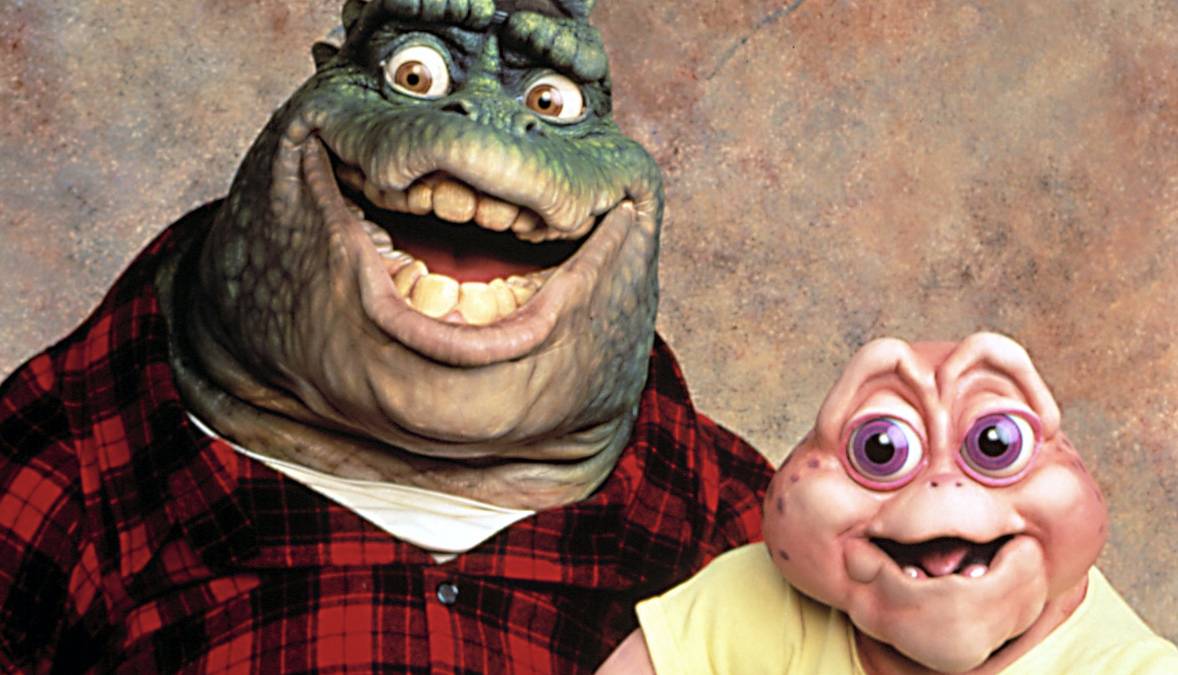
Along with Steve Urkel’s high-pitched confession “Did I do that?” and Joey Tribiani’s surprisingly suave come-on “How you doin’?,” one of the most recognizable sitcom catchphrases of the ‘90s was, “Not the mama!” The ABC sitcom Dinosaurs, about a Megalosaurus family living 60 million years ago, imagined a prehistoric era when dinosaurs began to settle down, get married, have children, and live in houses.
The show starred Stuart Pankin as the voice of Earl Sinclair, a dim-witted, temperamental tree-pusher with a wife, Fran (Jessica Walter), and two teenage children, Robbie (Jason Willinger) and Charlene (Sally Struthers). Finally there was the Baby (Kevin Clash), an adorable-yet-violent newborn who loved to inflict pain on his father while shouting, “Not the mama!”
That catchphrase, as well as Dinosaurs’ notoriously dark series finale — which concludes with the family’s imminent extinction — are what people remember most about Dinosaurs, but there was much, much more to the show.
Dinosaurs began as a project by Jim Henson, but in the very early stages of its development, he passed away. Despite this, the show’s production continued on, with Henson collaborator Kirk Thatcher stepping in to design the dinosaurs, while sitcom veterans Michael Jacobs and Bob Young shaped the family dynamics.
The main characters were played by performers in rubber dinosaur suits, with animatronic dinosaur heads controlled by puppeteers via radio signals. Using technology developed for the early 1990s Teenage Mutant Ninja Turtles films, Dinosaurs was one of the most unique and technologically complicated sitcoms ever made. It was also a modest success that ran for a respectable 65 episodes spanning four seasons.
For those who grew up watching ABC’s family-friendly TGIF block of shows, Dinosaurs still holds a special place in their hearts, which is why, for the show’s 35th anniversary, Polygon caught up with Thatcher for a chat about his earliest conversations about Dinosaurs with Jim Henson, designing the Sinclairs, and what he was thinking when he wrote that legendary finale.
Polygon: To get started, I was hoping to ask how much of this project Jim Henson lived to see.
Kirk Thatcher: I did two rounds of designs with Jim Henson. The idea was something that he thought up, and he and I were brainstorming. At that point, they were just black and white sketches, and I’d done the first round. Then I met with him on a Friday where I showed him the second round of designs and we talked about it and we had lunch and shot the breeze. Then, shockingly and obviously tragically, he passed away four days later.
We wanted to show that treating the Earth like it’s your toilet or ashtray is not the best way to live your life.
That’s where it started. The whole idea we were kicking around was to do a sitcom about dinosaurs along the lines of All in the Family, where the dad is set in the ways and he thinks dinosaurs are going to rule forever. Also we wanted to show that treating the Earth like it’s your toilet or ashtray is not the best way to live your life.
How did the project continue on after he’d passed?
At the time, Disney was going to buy the Muppets. I wasn’t privy to how this came about within the Disney/ABC/Muppet deal, but I know we were pitching ideas after Jim had passed, and this was one of them. I don’t even know how it got to Michael Jacobs and Bob Young.
It was fast-tracked, though. Jim died in May of 1990, and we were on the air less than a year later. I went off to London for four months to supervise the build. This took over the whole Creature Shop in London.


What informed your designs for the Sinclair family?
Anytime I approached a puppet design or a character design that was going to be a physical creature — not CGI or animation — it was the practicality of it. It had to move. It had to have eyelids and lips and things that would work for a dialog-heavy sitcom. The tricky part was, everyone knows what a dinosaur looks like, so it was about mutating it enough that you could have articulate dialogue, which the Henson Creature Shop had gotten down really well with the Ninja Turtles. But the Turtles had semi-froggy, flat, human faces, whereas these guys ran the gamut from Earl’s friend Roy (a goofy-looking T. rex) to the Baby, who was more like a human baby, but with some baby bird influences.
Charlene’s more like a hippo.
Practicality was half of it, but the other half was personality. Michael Frith [former Executive Vice President and Creative Director for Jim Henson Productions] was an amazing mentor to me. He was a guy who designed things that looked abstract, but you could tell their personality through the shapes. I was thinking about that here, and that’s what Jim Henson said he liked about my drawings. But these weren’t abstract Muppets. These were going to have scaly skin and glass eyes and all that.
The Baby was based on a bird?
Yeah, I had just gotten birds two years earlier, and one of them was a Moluccan cockatoo. Their feathers are a light pink, and when you get them when they’re babies, they’re literally pink blobs with giant purple eyes. They don’t have any feathers, just pin feathers, and they look like porcupines. So I designed him to look like a big fat baby bird without pin feathers, because we weren’t feathering our dinosaurs. That’s where his look came about.
There wasn’t any real adherence to any particular species of dinosaur. Robbie’s just kind of a made up lizard thing with frills that look like a mohawk, and Charlene’s more like a hippo.


How did the designs change over time?
The female characters had hair, which I thought was funny. Charlene had a Paula Abdul kind of hairstyle because she was like a little material girl, and mom had a ’50s mom hairdo. But Brian Henson didn’t buy it. He said, “You’ve got to give them horns or ceratopsian protuberances.” So we did a reset on that.
The other thing was Ethyl [voiced by Florence Stanley], Earl’s mother-in-law. She was originally a pterodactyl hanging upside down in the closet. We all thought it was funny, but then Michael was like, “You can’t do anything with her.” He said it became like a Laugh-In gag. So I redid her as this lizard that had melted into an electric wheelchair, which we thought was pretty funny.
Our show was notorious for taking strong political stances.
One change from the original drawing was Earl, as he originally had more of a stuck-out jaw. He was basically a riff on my brother, who was a contractor and a guy who knows more than you do about most things. I gave him that chin forward kind of look, but still an overweight dad. Michael said, “Oh no, he looks like a bully.” And we’re like, “Well, yeah, he’s an Archie Bunker-type. He’s kind of a loudmouth.” But Michael said, “You’ve got to shave down that chin.” So he shaved it down and Earl ended up looking more frog-like.
We knew that the family had to be walk-around characters, but just for scale, the Baby was going to be a puppet. Earl’s boss, B.P. Richfield [voiced by TV icon and The Jeffersons star Sherman Hemsley], was always going to be a big, giant puppet too. Him and the Baby were the designs that changed the least along the way.
Did you expect the Baby to be such a hit character?
No. I knew he was going to be adorable and funny, but so much of that is the performance by Kevin Clash. Also Kevin O’Boyle sculpted him. All those Muppet characters or Henson characters have many fathers. Kevin [Clash] is at least 50% of it, and the rest of us provided the other 50%. And there’s obviously the writing too.
You wrote the famous series finale. How did that idea come about?
I would write episode ideas and pitch them to the room. For this, the basic idea was: They pave over this parking lot, which is the breeding ground for these beetles. Each year, these beetles come and they breed and then they eat this kudzu-like plant that kind of takes everything over. So then the plant becomes a problem. Then they spray the plants, and that was going to make all the herbivores sick — it was going to be sort of a domino-effect story.
About that same time, we were told that we were not getting picked up, so the room kind of took it and ran with it. The story became that they start a nuclear winter.
For me, it was great. I was there for their creation and I got to help finish the show.
But it was originally going to be a normal episode where everything was fixed by the end?
Yeah, but I don’t recall what the happy end was because right after I pitched it, we got that call.
Was there ever any pushback from the network on this?
No. Our show was notorious for taking strong political stances. I won an Environmental Media Award for some episode [“Changing Nature”]. We also did “Nuts to War” and the happy plant episode [“A New Leaf”]. I remember the John Birch Society said we were the most seditious show on television, which we wore as a badge of honor.
It’s funny. Now, when 40-year-olds come up to me and talk about the finale, they’re like, “I was so sad as a kid. You devastated me.” And I’m like, “Well, do you recycle?”