



![24th Sep: How to Lose a Guy in 10 Days (2003), 1hr 56m [PG-13] – Streaming Again (6.25/10)](https://occ-0-912-92.1.nflxso.net/dnm/api/v6/0Qzqdxw-HG1AiOKLWWPsFOUDA2E/AAAABbH8KPVROm87H6EegbosGOkaO3EdY5SscBPwN2Aonewa6eTCpyes-glvbdPAwAtxnMyLkaNHsg6eovK0dArNA-vJXibhmjPk_kgO.jpg?r=388 "24th Sep: How to Lose a Guy in 10 Days (2003), 1hr 56m [PG-13] – Streaming Again (6.25/10)")



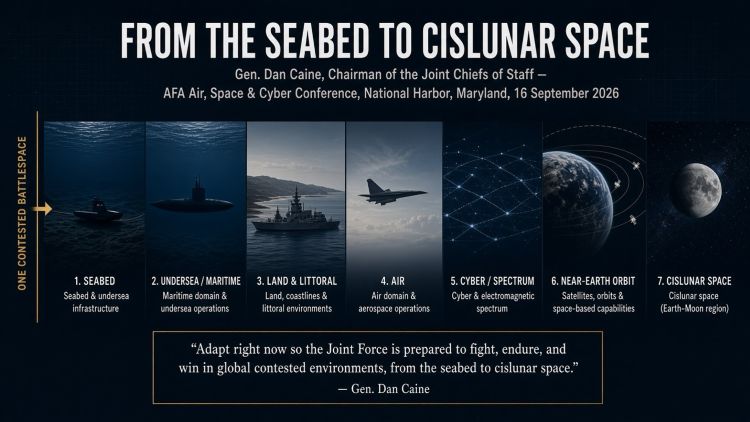
Figure 1: Graphic c/o Grok.
Last week’s statement by General Dan Caine, Chairman of the United States Joint Chiefs of Staff, that “today’s modern battlefield operates from the seabed to cislunar space,” was the first in a series of noteworthy announcements at the Air & Space Forces Association’s 2026 Air, Space & Cyber Conference. His comments at the National Harbor, Maryland, event last week called into question almost 70 years of international negotiations on the nonproliferation of weapons in space.
This begs the question of whether the U.S. has broken any international treaties on space weapons.
Caine’s full speech, recorded as part of the September 17 Air & Space Forces Association post, “Full Keynote: CJCS Gen. Dan Caine | 2026 Air, Space & Cyber Conference”, is available on YouTube.
Caine was not the only one talking about space weapons in Maryland.
The September 14 Washington Post story “U.S. has deployed first space-based weapon, Air Force secretary says,” quoted Air Force Secretary Troy Meink as saying that the United States “now has on-orbit space control weapons capable of defending the joint force (of U.S. and allied communications and Earth imaging satellites) against hostile adversary action.”
Space Force Chief of Space Operations General Douglas Schiess was quoted as saying that U.S.-controlled “guardians” are currently deployed to “operate on-orbit weapons that can defend the joint force against space-enabled attacks.”
In essence, the U.S. had admitted to deploying “weapons in space.”
Short history of space law – the UN treaty era
Caine’s comments come on the heels of almost 70 years of discussions on the nonproliferation of weapons in space.
Those discussions originally began at the United Nations.
The main forum was the UN Committee on the Peaceful Uses of Outer Space (COPUOS), created as an ad-hoc body in 1958 and made permanent in 1959. Its legal subcommittee negotiated the core treaties, and the UN Office for Outer Space Affairs (UNOOSA) serves as secretariat. It maintains the UN register of space objects, an international record managed by UNOOSA to keep tabs on space objects and the nation states responsible for them.
The 1966 Treaty on Principles Governing the Activities of States in the Exploration and Use of Outer Space, including the Moon and Other Celestial Bodies, commonly known as the “Outer Space Treaty”, is generally considered to be both the foundation of current international space law and the height of UN success at crafting treaties.
It came into force on October 10, 1967. As of late 2025, it had 118 nations signed on to the treaty, including all major space-faring states and the U.S.
Core principles of the Outer Space Treaty include:
- Article I, which allows for the exploration and use of outer space for the benefit of all countries; freedom of access, and scientific investigation.
-
- It defines space as not restricted to states capable of launching satellites into orbit, or a domain where science can be copyrighted and restricted.
- Article II, which states that “Outer space, including the moon and other celestial bodies, is not subject to national appropriation by claim of sovereignty, by means of use or occupation, or by any other means.”
-
- While Article I says space is for everyone, Article II says no one may turn it into national or personal territory.
- Article III, which notes that, “States Parties to the Treaty shall carry on activities in the exploration and use of outer space, including the moon and other celestial bodies, in accordance with international law, including the Charter of the United Nations, in the interest of maintaining international peace and security and promoting international co-operation and understanding.”
-
- This article is a reminder that the treaty stands on existing concepts of international law.
- Article IV, which states that, “States Parties to the Treaty undertake not to place in orbit around the Earth any objects carrying nuclear weapons or any other kinds of weapons of mass destruction, install such weapons on celestial bodies, or station such weapons in outer space in any other manner.”
-
- It bans nuclear, chemical or biological weapons and “weapons of mass destruction,” from being placed, installed or stationed in space.
-
- It allows for the deployment and use of the following:
-
-
- Military satellites for reconnaissance, missile warning, communications, navigation, and targeting.
- Conventional anti-satellite weapons, whether ground, air, or satellite-based.
- On-orbit “space control” systems that are not generally considered to be weapons of mass destruction (WMD).
- Ballistic missiles that transit space on a suborbital arc and re-enter, rather than entering orbit or being stationed there.
- Nuclear reactors used as power sources, as distinct from nuclear weapons.
-
-
- The second paragraph of Article IV is separate and stricter on the Moon and other celestial bodies: those bodies shall be used exclusively for peaceful purposes. No military bases, weapons testing, or deployed military systems are allowed on the Moon or on any of the planets in the solar system.
- Article VI, which states that, “States Parties to the Treaty shall bear international responsibility for national activities in outer space, including the Moon and other celestial bodies, whether such activities are carried on by governmental agencies or by non-governmental entities, and for assuring that national activities are carried out in conformity with the provisions set forth in the present Treaty. The activities of non-governmental entities in outer space… shall require authorization and continuing supervision by the appropriate State Party to the Treaty.”
-
- The sentence tasks the state with ensuring that all of national activity, even private-sector activities, must comply with treaty provisions.
Of course, the Outer Space Treaty has other provisions, but under Article IV, weapons are permitted in space. And under Article VI, national governments are responsible for their activities in space and must stand behind those activities.
To a large extent, this is what General Caine and his colleagues were doing at 2026 Air, Space & Cyber Conference. They were announcing and taking responsibility for what their national government was doing in space.
Weapons permitted in space under the treaty include:
-
- “Conventional anti-satellite weapons,” launched from the ground, either by airborne aircraft and fighter jets, or from another satellite.
-
- Current ballistic missile systems, carrying nuclear warheads that transit space on a suborbital arc to re-enter the atmosphere and attack surface targets.
On the other hand, no military bases, weapons testing, or deployed military systems are allowed on the Moon, or in most of “cislunar space”, extending from Earth’s surface to and including the Moon’s orbit and surface, under Article IV of the Outer Space Treaty.
This would suggest that not all of the satellite weapons described by General Caine are technically legal, depending on where they are located.
As for the United Nations, it never managed to equal the success of its Outer Space Treaty. The follow-up, 1979 Moon Treaty was only ratified by 17 nations, none of which can launch humans into space, and is generally considered to be a failure.
Later progress defining international space laws have mostly been “guidelines” lacking the force of international law or are simple national legislation such as the U.S. Commercial Space Launch Competitiveness Act of 2015, which legalized space mining for U.S.-based companies.
As for why that happened after such a promising start to international space agreements, that is a topic for Part 2 of this series.
(Chuck Black – BIG Media Ltd., 2026)