






There was a moment in 2020 where it felt like we’d never get to see our friends again. As the COVID-19 pandemic worsened, weeks of social isolation turned into months with no end in sight. Anxiety mounted as people feared that an unprecedented moment was going to become the new normal. The developers at House House, the studio behind Untitled Goose Game, were facing those same fears during the lockdown era. Rather than being paralyzed by it, they put that energy into a video game that would capture the experience of getting lost in nature with a group of friends. The result was Big Walk.
Set to launch on PlayStation 5 and Windows PC later this year, Big Walk is the kind of multiplayer game that people were desperate for in 2020. It’s a chill co-op experience where players wander a big, beautiful world and solve little puzzles strewn about it. It’s nothing like Animal Crossing: New Horizons, the go-to hang-out game of the COVID era, but it looks like it’s out to capture that same energy and combine it with House House’s particular brand of comedy.
Ahead of its release, Polygon assembled a crew and jumped into the world of Big Walk with its creators in-game to act as tour guides. We found a lovely co-op game teeming with smart puzzles designed with teamwork in mind. Even if it doesn’t make the same impact it may have had it launched in 2020, there’s a good-natured adventure here that reminds us that hanging out with your friends in digital space can still be a delight — with the right game.
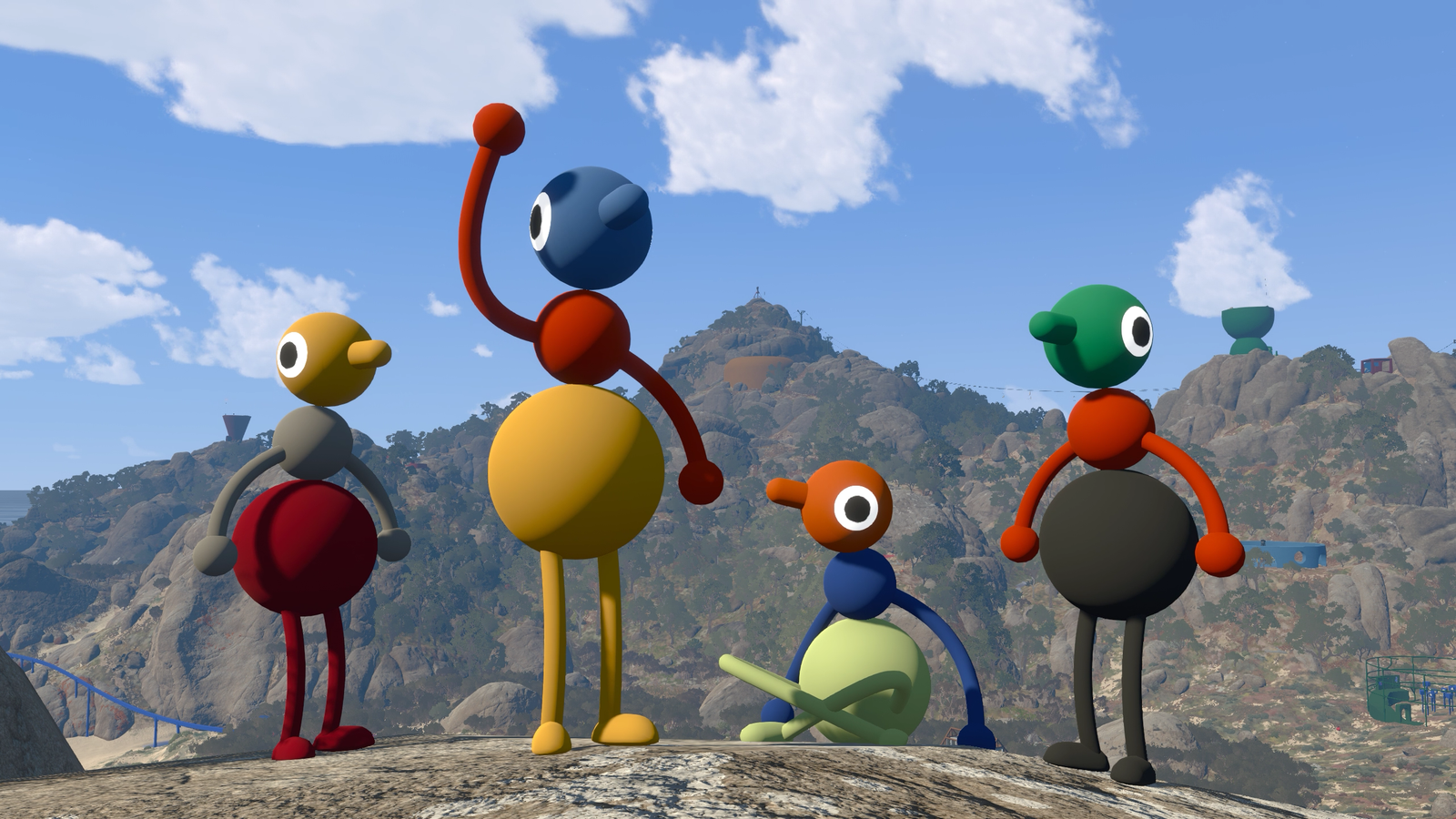
The hour-long journey began when my colleagues and I all assembled into a small tutorial hub. We were greeted by the game’s developers, who appeared as two of the game’s spherical player characters. (House House says the creatures don’t have an official name; the developers want players to build that language for themselves.) After learning the basics of how to move, pick up objects, use proximity chat, and annoy one another by clanging cowbells, we walked out into the game’s sprawling open world. The developers didn’t say (they weren’t sure!) exactly how big it is, but they joked about it being “San Andreas-sized.”
Rather than providing any direction, the devs told us to simply explore the world any way we liked. Big Walk appears to be very open-ended. It’s less of a structured game and more of a hang-out space dotted with interconnected puzzles — the type you discover when you’re not looking for them. The first thing that caught our eye was a building in a field below us that was glowing in the night sky. We decided to head there, following the lead of those of us who had picked up glowing balls, while we waited for the game’s day-night cycle to give us some light. We found a little customization station there, which let us paint one another’s body segments.
As the sun came up, we all agreed to hike up a hill and see where it took us. We found our first puzzle there. Some sort of gourd was sitting in a tightly wound vice grip that we couldn’t open. With some collective sleuthing, we discovered four buttons on some pillars surrounding it. Clicking them randomly didn’t appear to have an effect, so we started talking. What if we hit them all at once? With a little coordination and shouting over proximity chat, we did just that and unlocked the gourd. What did it do? We had no idea, but we quickly decided that it was both our child and God, and carried it around with pride. That personal storytelling is exactly what House House is hoping to spark by telling players very little.
More gourds tied to co-op puzzles greeted us the more we explored. When we found one hanging on a scaffolding, we all picked each other up to form a giant tower that could reach it. Another was locked in a chest that would only stay open when someone on a very far-off platform held down a button. The group split into two teams to make sure no one got lost during the trek. A more complicated puzzle locked two of us in a room full of symbols. Those players had to call out what shapes they saw, while the people on the outside found cards bearing those symbols and hung them on pegs in the right order to unlock a gourd. Each puzzle we found was completely different, testing our coordination skills in new ways.
We finally figured out why we were carrying around a bunch of gourds when we found a machine where we could slot them all into cases. That gave us an uncut key that we could slot into a machine. Rather than unlocking anything, the device cut a bit off the key. What now? Someone noticed what looked like an arrow on the top of the device, so we followed it. Sure enough, we found another cutting device, then another, then another. It turned out that we weren’t just finding random collectibles, but rather were in the middle of a cleverly hidden quest line that played like a spread-out escape room puzzle.
That idea should give Big Walk enough secret structure for players in need of direction, but it’s also just a relaxing place to hang out. At one point, we found a little structure surrounded by speakers that pumped out laid-back music. We assumed it must be a puzzle and started looking for clues. Eventually, I found some chairs and asked my buds to just take a seat with me for a bit. At that point, the devs confirmed that we had simply found one of the world’s chillout spots. No secrets to be found, just good times.

If Big Walk can deliver an inviting virtual space that’s just fun to hang out in even when you’re not working towards anything, it could be a special kind of co-op game. It’s bound to be lumped into the newly formed “friendslop” label used to describe games like Peak, but its focus on relaxation over puzzling makes it feel like a different kind of experience altogether.
I actually missed the best example of that in action. Toward the end of the demo, my woefully old PC rebooted. (By no fault of the game; it just does that sometimes.) I texted my colleagues to apologize and say that I was rushing back in so we could continue. In response, they sent me a bunch of screenshots of them picking up my corpse and carrying it around. They were having more fun using my body for prop comedy than they were solving puzzles.