

![5th Sep: Security (2017), 1hr 31m [R] – Streaming Again (5.9/10)](https://occ-0-76-92.1.nflxso.net/dnm/api/v6/0Qzqdxw-HG1AiOKLWWPsFOUDA2E/AAAABbmuSVtIurglG467SFs5NV_hG0e-gXD2vA5JpOuUuaBPU_7GSW3XLjNHpy0Gpzdaeag1lzItCKzsT2EHjTWRHdzJrg68j3SERxiT.jpg?r=9de "5th Sep: Security (2017), 1hr 31m [R] – Streaming Again (5.9/10)")


The Toronto SummerWorks Review: Blood Brothers makes Shakespeare’s brotherhood physical, intimate and dangerous
By Ross
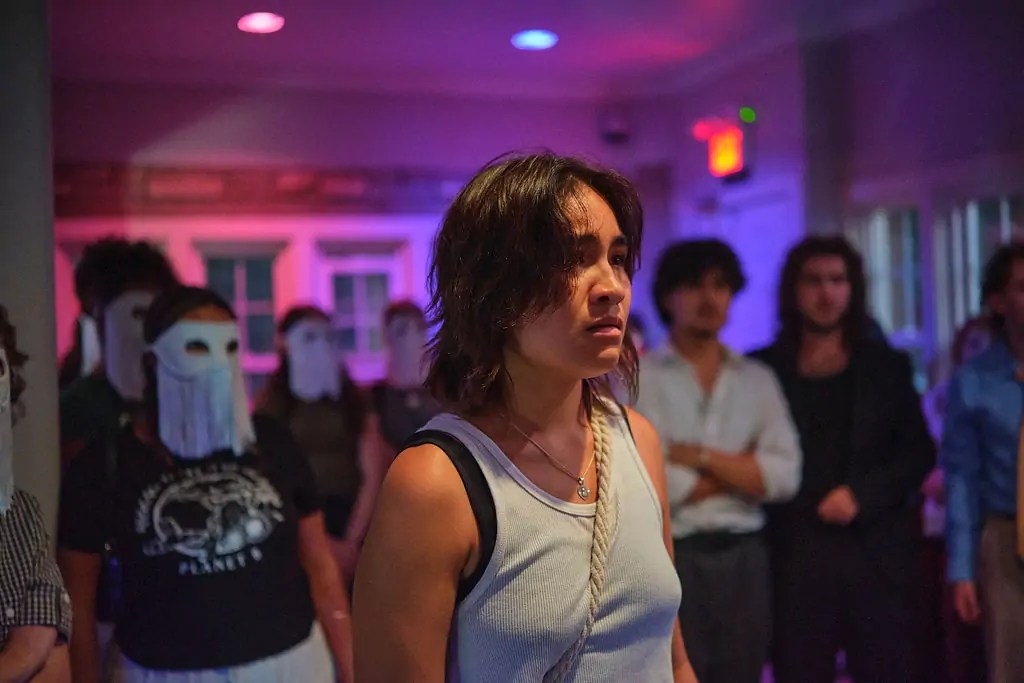
I have rarely felt quite so physically aware of my own body in a theatre as I did standing on the steps of an actual fraternity house, waiting to enter Blood Brothers, an immersive theatrical experience co-created by Brianna Russell and Catie Thorne for SummerWorks in association with Outside the March. Before we even crossed the threshold, we were given a very clear warning about the disturbing situations we might encounter inside. It was a smart sensory set-up, one that left me nervous and intrigued all at the same time. Then we were masked in white and released to wander the two floors of the Delta Upsilon fraternity house.
A few young frat and wanna-be frat “bros” were already moving through the cluttered college world created by Amanda Michele’s sharply defined set and props, talking, posturing, and testing one another. The aggression was immediate, with these young men projecting a cocky arrogance, desperately trying to prove something to each other and perhaps to themselves. They belong here; this stance seems to tell all those around them, reinforcing the idea that they are part of the pack and together they are invincible. It’s a tense framing, highlighting that the need for acceptance is one of the most important currents running through Blood Brothers, and that we should be on high alert while we are in their house.
As a gay white male, I know something about the oppression that can follow when you do not fit comfortably inside certain expectations of masculinity. The atmosphere inside this house is thick with it. It reeks of stale beer and spilled liquor, but it is the smell of all that macho posturing that triggers something startlingly close to a high school response. It’s that old feeling of vulnerable exposure when you know you are not living up to somebody else’s rules on what it means to be a man, and I found myself sitting cornered in a room, watching and internalizing the action surrounding me. I was becoming increasingly conscious of the tension in my muscles as threatening guy energy snaked through the hallways and ran up and down the stairs. I do not think I have ever been in such close proximity to this kind of swearing, bullying, and pressuring one another to adhere to a culture they have adopted as their own. And I hope never to find myself in this situation for real.
That physical anxiety was overwhelming and intentional; that gives the adaptation of Shakespeare’s Julius Caesar its charge. This is a fraternity where the language of brotherhood becomes the language of Shakespeare’s political conspiracy. Julius Caesar is obsessed with what men owe one another, what honour means, what loyalty requires, and how a group of men can convince themselves that violence is justified for the sake of a larger cause. We know the dangers that can grow inside spaces built around privilege, misogyny, and unquestioned loyalty. We read about it every day in the newspaper, and here in Blood Brothers, the fraternity becomes a world where masculinity, violence, and power are constantly negotiating their place.

“To be a brother, you have to be a man” is repeated as a kind of governing principle, particularly for those young men working desperately to become part of the group. Jonah Paroyan gives Julian the magnetic charisma expected of the fraternity’s handsome leader, with Evangeline Dailisan’s costumes helping establish the visual confidence of these young men as they perform the identities they have chosen for themselves. Paroyan makes the desire of these young men to follow him feel almost as natural as the danger surrounding him. The cousin of the Caesar brothers, Cinna, seems particularly desperate to be accepted, and Seung Eun Cha captures the aching vulnerability beneath his determination to belong. The reasons for the others are less clearly defined, but Cinna’s desire to become part of something bigger than himself is unmistakable and unsettling. These young men are willing to be humiliated and tested for the privilege of belonging.
When the gong is hit, the illegal hazing games begin. The tasks are built around degradation and ridicule, with facts and pledges needing to be recited exactly, or dignity is stripped away. The ritual turns brotherhood into a contract, one that demands obedience before it offers protection. That becomes especially troubling as the story moves toward the consequences of what eventually happens in the house, and the question of whether they will protect one another. “We are all honourable men, are we not?” they demand from one another as we watch with horror how the production wisely transforms Shakespeare’s questions about honour and collective responsibility into the language of fraternity culture. Boro Milošević’s Brutus and Nick Cikoja’s Cassius give the central conflict a physical and emotional force, making the fraternity’s competing ideas of loyalty and responsibility feel increasingly dangerous. The line “Can’t be Brutus’s fault, or it’s all our fault” establishes a pretend unity that depends upon shared complicity. They admit they have been getting away with “murder” for centuries, doing the same thing over and over again and walking away unstained, convinced they are still destined for something greater.
That need for acknowledgement hangs over the action. Marc Antony’s plan to save them all is a complication in that ideal, and Kalon Young makes Marc fascinating as someone already thinking about how the story will be told once the damage is done. When Marc declares, “I see potential in this room,” his desire to remain on the visible right side of history is both telling and unsettling. The two women who find themselves inside this world introduce a moral conflict into the fraternity’s carefully constructed loyalty. Portia, played impressively by Auguste Kociuba, shines as a voice of truth and reason, particularly in her willingness to stand her ground. Heather Thomas brings Calpurnia into the difficult position of deciding whether to help the “bros” find their way through the situation unharmed, even though it is her boyfriend they are discussing. Blame is delivered like an anvil being struck down by a complicit judge somewhere in another room. Calpurnia stands silently by while Portia refuses to surrender her position. We know the pattern they are confronting because privilege and race so often determine who is punished and who escapes consequence.

The female characters have their own background story, one that becomes clear if you follow them upstairs into one of the bedrooms. I might have missed that material entirely if I had not followed them, which speaks to one of the pleasures and complications of the production’s immersive structure. Blood Brothers asks its audience to choose where to stand, whom to follow, and what to watch, and the experience changes according to those decisions. We move from bedrooms to hallways and party spaces, following the noise and movement wherever it takes us. Sometimes the most important thing happening is happening somewhere else, but the production does a good job of making sure the audience is continually drawn toward the central action, largely through the sound of arguments that erupt loudly and fiercely throughout the house. And then we all run towards it with anxious curiosity.
The house is saturated with the suggestion of party culture, although I expected more from the amount of liquor the characters appear to consume, particularly given how much the production asks us to absorb through its sensory environment. The bedrooms also suggest the social and sexual possibilities of fraternity life, and I kept expecting the production to push further into that territory. It never quite does. Owen Carter’s Octavius, Tristan Mercado’s Casca, Brady Bertrand’s Metelius, Nolan Byrne’s Decius, Tre Carty’s Lepidus, and Dylan Duff’s Trebonius help create the sense that the house never stops moving, even when we are focused on someone else. Together, they give the production the feeling of a fraternity that continues around us, populated beyond whatever scene we have chosen to witness. As written, the women’s storyline itself is the least compelling thread, but their presence provides an important counterweight to the closed circle of masculine loyalty.
I entered Blood Brothers anxious about the men surrounding me, but what stayed with me was how familiar the need underneath their performance became. They want the same things that Shakespeare’s men want: loyalty, recognition, protection, a place within a brotherhood that tells them who they are. The tragedy is that the fraternity turns those needs into a system of silence and complicity. In bringing Julius Caesar into an actual frat house, Russell and Thorne make brotherhood physical, immediate, and frighteningly intimate. The men are not simply protecting one another from the consequences of their actions. They are protecting the idea of themselves as brothers, even when that brotherhood requires them to decide who can be protected, who must be blamed, and who will pay the price.