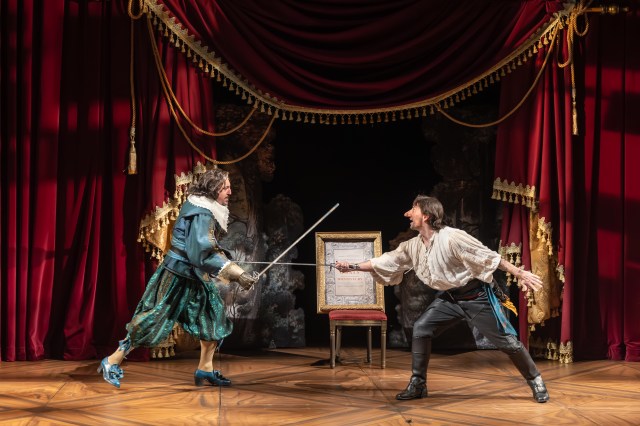





Already active across a number of north European theatre contexts – from her base in Lithuania to Sweden, Norway and Germany – American- and Russian-trained director Yana Ross has just made her Danish debut at the Royal Theatre in Copenhagen with a production of Chekhov’s Uncle Vanja.
This is the first production of Uncla Vanja at the Royal Theatre since 2002, but Ross’s second since an acclaimed version at Uppsala in 2014.
Due to a language barrier and the fact I was warned the production came without surtitles, for the first time since my own student days three decades ago, I took an unusually academic way into watching this version adapted by Ross together with the cast. I began by studying the text of the Danish adaptation with quite a bit of glee about its dramaturgical cleverness. The list of characters already communicates a no-nonsense efficiency in this version’s removal of the overly complicated nominal Russianness – except for the eponymous Vanja and his niece Sonja, all other characters’ names are given in their Westernised versions: so Alexander rather than Serebryakov, Mikael rather than Astrov and Helena rather than Yelena. Ilya Ilyich Telegin ‘Waffles’ is Danish Jens Jensen ‘Pizza’, and the two senior female characters, the old nurse Marina and Vanya’s mother Maria Vasilyevna Voynitskaya, are fused into one – Maria. The removal of the antiquated Russian class distinction signalled by this move also means that all the characters are even more of an ensemble on an equal footing, with Telegin/Jensen getting more dignity and agency then in previous versions.
Relocated to the contemporary Danish context, the Voynitskys’ 19th century estate becomes a Danish pig farm / tourist attraction. But where Chekhov tends to sprinkle information as seemingly incidental, clustered and idiosyncratic, Ross and company really pay attention, go in deep, stretch it out and weave it through in ways that suggest greater consistence and consequence. Helena is introduced from the outset as a failed musician rather than someone who we later discover once went to music school, Mikael Astrov’s dedication to forests is (similarly to Robert Icke’s 2016 version) elevated to a fully overarching thematic significance, and impish Sonja’s affection for the doctor is blatant from the start so it can travel its own arc from naïve infatuation via feverish delirium to a fully mature handling of heartbreak. Where Chekhov famously keeps things under wraps privileging controlled allusion over sensory excess, Ross’s version pulls out all the stops especially in relation to the sexual charge. This means the two women are put more closely in touch with their biological nature while the man they both fixate on is himself focused on lofty ideals and alcohol addiction. That said, Chekhov’s text is followed closely throughout and only ever modulated rather than really hacked at.
If there was such a thing as a musical score for a DJ mix, it would be a good analogy for the method of this adaptation – faders going up and down on individual characters’ channels of expression in a very skilled and strategic way so to keep the audience’s response to the mixed output within a carefully designed range. In its first half the script is more verbally expressive than even perhaps in the original, but in the second, it is drastically trimmed in favour of the actors’ non-verbal performance. Thus, as we will find out in the performance, this version’s 37-year-old Helena can fully evolve into a realistic 21st century sex-starved siren breaking out of the moral constraints of the 19th century prescription. Here Jens Jensen Pizza is given a more prominent function as a trusted ally and a carrier of the lines that have to be spoken on behalf of the characters otherwise engaged… On the other hand, Sonja’s soft sentimentality towards her uncle, designed by Chekhov to cajole Vanja into co-operation at a moment of his childish self-destructive stubbornness, is elided in this version in favour of a young authority earned through personal pain. But although very smart, these disparate interventions never quite cohere into a single dramaturgical penny that drops…
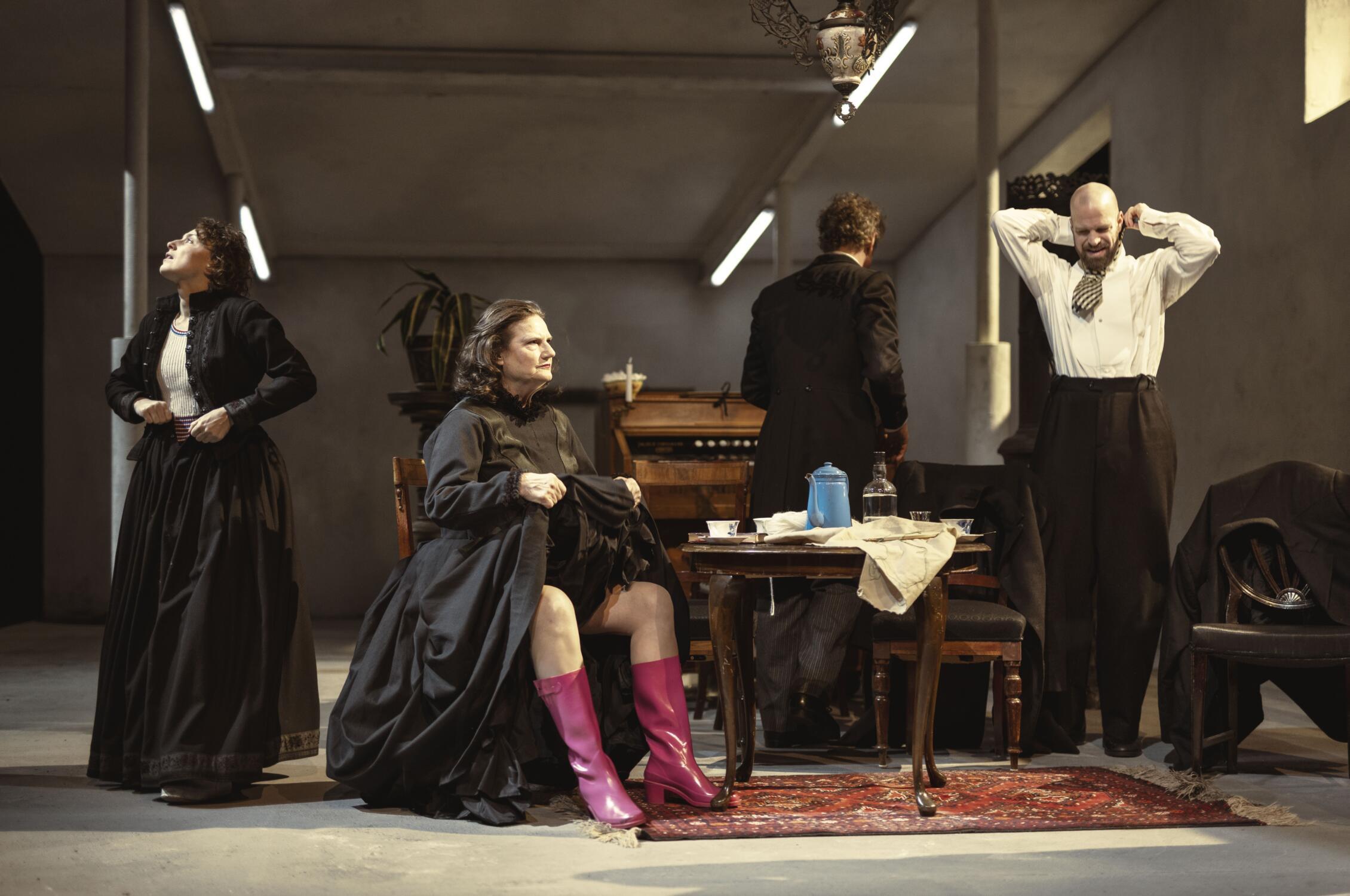
There are interesting moments of pregnant intertextuality here that reference British poet and hip hop artist Kae Tempest as well as Kate Bush’s 1978 hit ‘Wuthering Heights’. German designer Bettina Meyer’s set is uncompromisingly cold and grey with a clear designation of where the stink would be coming from if we were actually there on the real farm that has been replicated here in seemingly miniscule depressing detail. Her quirky costumes really do stand out against such a monochrome backdrop, though not in a way that enchants. Perhaps that is part of the directorial intention to generate discomfort rather than delusion.
The actors are sometimes cast against Chekhovian expectation but that only adds to their supposed believability as the 21st century Danish farm dwellers seeking solace in bucketloads of booze. Nicolas Bro’s Vanja is a cuddly bear version of the middle-aged man living someone else’s life, still however more stable on his feet than the stray urbanites temporarily occupying his space. Mathilde Arcel’s Sonja brings the play to its culmination with a kind of finesse of which the original author would most certainly approve. The measure of Ross’s success as the director on this occasion must be contained in the fact that the Copenhagen audience seems to hang on the cast’s every breath and lap up their every moment of their original wit.

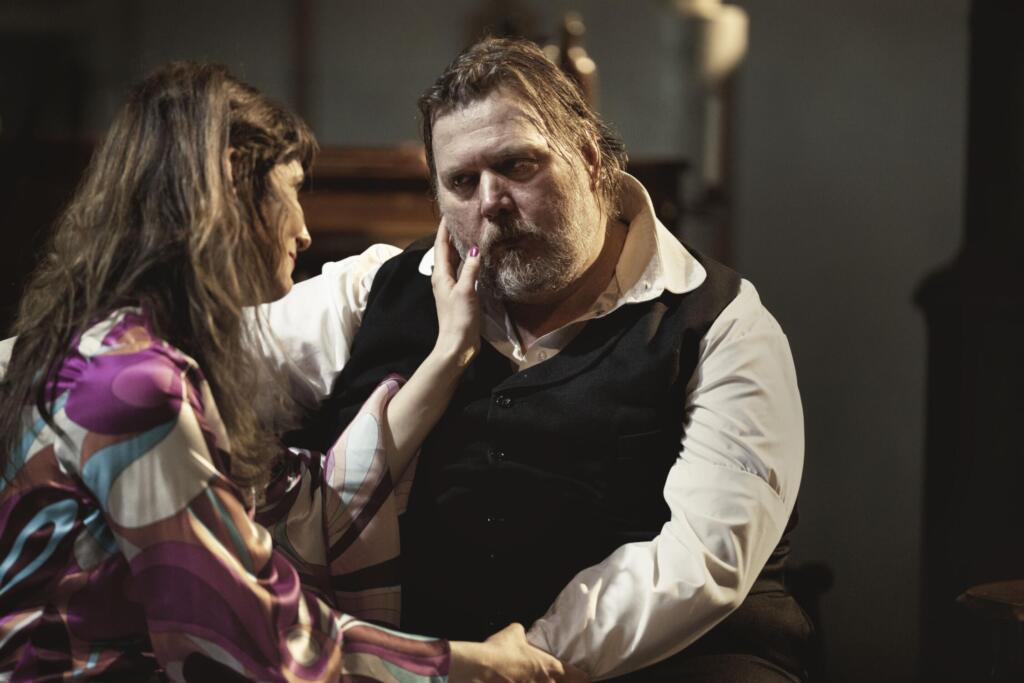
Sofia Nolsøe as Helena and Nicolas Bro as Vanja, photo by Camilla Winther
This post was written by the author in their personal capacity.The opinions expressed in this article are the author’s own and do not reflect the view of The Theatre Times, their staff or collaborators.
This post was written by Duška Radosavljević.
The views expressed here belong to the author and do not necessarily reflect our views and opinions.