






The Toronto Theatre Review: Erin Shields’ lyrical world premiere gives voice to the women who carried the story
By Ross
A story told over centuries rarely asks who was in the room but not on record. Watching Mary, Mary, Mary, Mary at Crow’s Theatre, that absence becomes impossible to ignore. This fascinating new play by Erin Shields begins with an extreme Handmaid Tale‘s presence. Four red shrouded women step forward, each bearing the same name, each insisting on being seen. From that moment onward, the act of telling recorded history, whether you believe it or not, becomes an act of reclamation. What unfolds is not a rejection of the familiar narrative but a reframing of it, one that shifts the focus away from the men and aims it squarely towards the women who witnessed, supported, and quietly constructed the moments that history has long attributed elsewhere.
This kind of reframing feels increasingly important across contemporary theatre these days, where familiar narratives, like Antigone and Medea, are being revisited from the perspectives of the women who were always central to them, even when they were pushed to the margins. Shields herself has explored this territory before with her magnificent play, Ransacking Troy, that premiered at Stratford last season, and here she continues that impulse with a focus that feels pointed, poetic, and expansive.
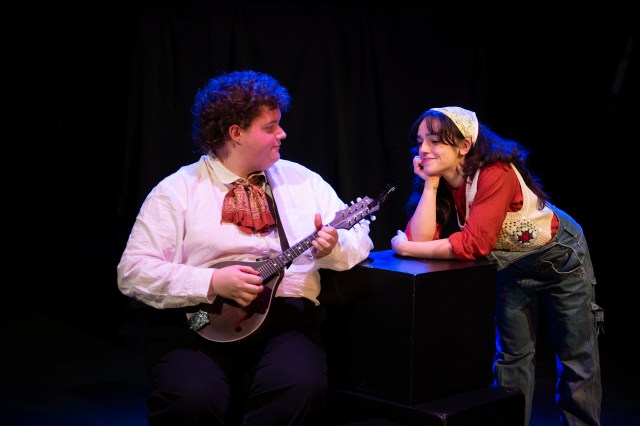
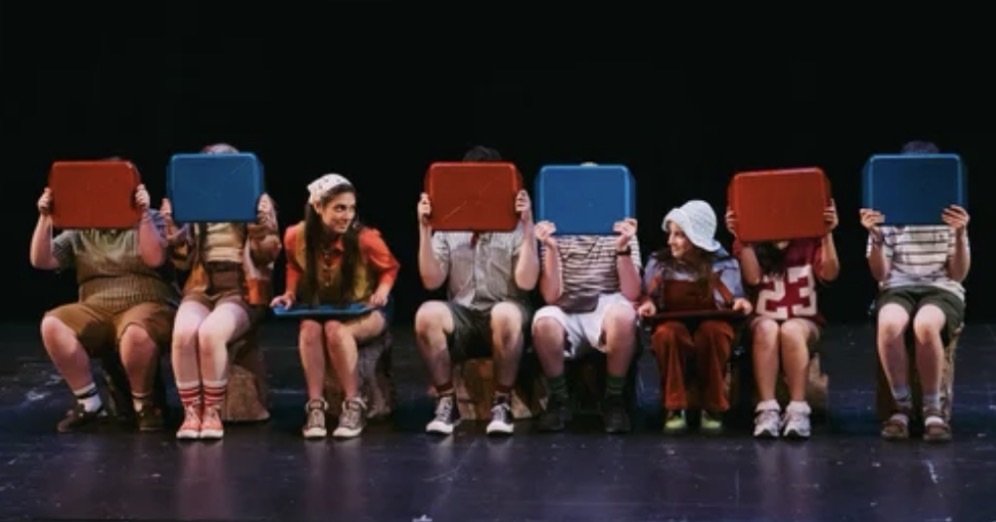
Directed with clarity and control by Ellen McDougall (Donmar’s Watch on the Rhine), the production leans into the fluidity of Shields’ writing, allowing time, place, and perspective to move with a kind of theatrical elasticity. The Marys, portrayed by Michelle Monteith, Sabryn Rock, Belinda Corpuz, and Nancy Palk, speak proudly, fluently, and often in chorus, finishing one another’s thoughts and moving as a collective body. Opposite them stands another, a “Not-A-Mary“, played with striking versatility by Amaka Umeh (StratFest’s Love’s Labour’s Lost), a figure in blue who shifts across roles and perspectives, challenging, interrupting, and at times destabilizing the narrative the Mary, Mary, Mary, Marys are trying to hold together.


Shields’ language is sublimely lyrical and playful, yet it carries an undercurrent of urgency and power. The play moves through well-known biblical moments: the annunciation, the journey to Bethlehem, and the miracles that define the Gospels, on a landscape of carpeted blocks of stone that carry hidden secrets and puzzles within. But instead of delivering the story as we know it, Shields reframes these Marys and their role through a lens of labour and foresight. When food appears to multiply, it is the women who have anticipated the need, organizing, gathering, and preparing behind the scenes. The miraculous remains, but it is grounded in action, in care, and in a kind of invisible work that has long gone uncredited. This pattern repeats with intention, gradually reshaping the audience’s understanding of miracles and actions that have been taken for granted.
There is, however, a barrier to entry that the production does not entirely smooth over. The early sections lean heavily on a familiarity with biblical narrative and structure. For those without that foundation, myself included, the layering of references and the chorus-driven delivery can feel momentarily disorienting. The play communicates its broader ideas clearly enough to follow. There is a sense that many nuances and resonances may pass by just out of my reach. That distance does not derail the experience, but it does create a gap between the play’s ambition and its accessibility.
Visually, the production establishes a striking and immediate contrast. Set and costume designer Moi Tran (Young Vic’s Chasing Hares) grounds the world in a textured, symbolic environment of carpeted stone-like forms. Lighting by Christian Horoszczak (Howland’s Three Sisters) carves out changes in time and tone with precision, and Olivia Wheeler’s sound design underscores the movement between ritual, storytelling, and spectacle. The four Marys move with a shared identity that evokes ritual, unity, and a history of imposed sameness, while “Not-A-Mary” stands apart as both observer and provocateur. The staging evolves with focused energy, shifting from stable to kitchen to something resembling a contemporary talk show, where the focus turns toward the sensationalism of storytelling, rather than its wonder and faith. In these moments, the play sharpens its critique, suggesting not only that these women were sidelined but that their stories have been filtered, reshaped, and, at times, trivialized by the standardized structures that retell them.

The performances anchor the production with commitment and clarity. Monteith’s Mary carries a grounded emotional weight, particularly in the moments surrounding the birth, where the physical and spiritual demands of the role intersect. Rock and Corpuz bring a dynamic responsiveness to the ensemble, their shared rhythms giving the chorus both precision and spontaneity. Palk adds a textured presence that reveals flashes of sharpness during specific moments, which deepens the collective voice of the Marys. Umeh’s “Not-A-Mary” climbs the ramps with ferocity and glee, injecting the production with a necessary volatility that shifts from humour and dance to argument and confrontation with ease, ultimately delivering some of the play’s most pointed observations.
As the narrative progresses, the play turns more directly toward the question of exclusion. The shift into the kitchen, where the Marys find themselves preparing food with a kind of methodical precision, as if assembling a puzzle, while the men engage in theological debate elsewhere, lands with particular force. What begins as a subtle undercurrent becomes explicit, the realization settling in that their proximity to the centre of the story has never translated into any kind of authority within. The arrival of Umeh’s Salome, pretending to be a runaway servant girl, reframes the familiar through sharper, more contemporary language. Their confrontation pushes the play into a space of open interrogation, where faith, authorship, and gendered expectation collide in a way that leaves the Marys confused, angry, but also somewhat enlightened.
At times, the breadth of ideas the play engages with stretches its focus. The movement between satire, ritual, and commentary can feel uneven, with certain threads introduced with compelling clarity only to be dropped or set aside as the narrative continues to shift. Yet within that fluctuation, there is a consistent drive to question, to re-examine, and to discard symbolic figures that resist a more inclusive telling.
What ultimately gives Mary, Mary, Mary, Mary its resonance is not just its reimagining of familiar events, but its insistence on recognizing the labour behind them. These women are not passive witnesses to history, but active participants in its construction, even when they are denied acknowledgment. Watching them move, speak, and push against the boundaries of their own story, the act of reclaiming space becomes both a theatrical gesture and something more personal. The voices that have been layered into the background step forward, not to replace the story that has been told, but to reshape how it is understood, and to assert that they were always there, carrying more than anyone chose to see.