






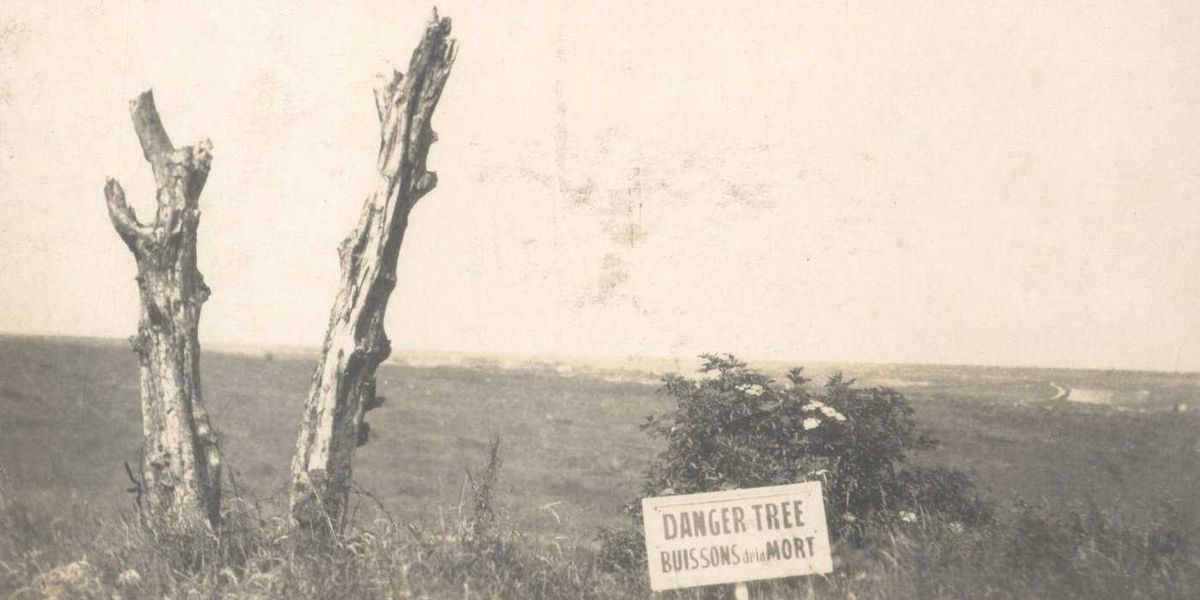
On the morning of July 1, 1916, about 800 soldiers with the Royal Newfoundland Regiment charged across the battlefield at Beaumont-Hamel toward the German trenches. Few made it across unharmed. Many were killed by machine-gun fire, falling near a tangled apple tree that stood about halfway across the mud-strewn field, on the slope toward the enemy.
A replica of the so-called danger tree was permanently installed Tuesday at the Beaumont-Hamel Newfoundland Memorial in northern France. Ministers from the Canadian and Newfoundland and Labrador governments joined officials from the Canadian Armed Forces and Memorial University to untie a red ribbon and lift a black cloth from the monument’s jagged branches.
“For my fellow Newfoundlanders and Labradorians, Beaumont-Hamel is not distant history,” Brig.-Gen. Mark Parsons told the gathering in France. “It is part of who we are. It lives on in our families, our communities and in our identity.”
“This tree stands as a solemn promise we will remember their courage,” he said of the soldiers. “We will remember their sacrifice.”
The fibreglass danger tree replica was built at Memorial University in partnership with Veterans Affairs Canada. The school was founded in 1925 as a memorial to the soldiers who died in the First World War.
A few dozen people gathered in a lecture hall at the university in St. John’s, N.L., Tuesday to watch a livestream of the unveiling ceremony in France. Simon Ernst, a machinist with the school’s department of technical services, helped build the core of the sculpture. He has lived in Newfoundland and Labrador for a decade and has come to understand how consequential the First World War was to the province.
“(This project) means a lot to me,” he said in an interview.
Frank Gogos, chair of the Royal Newfoundland Regimental Advisory Council, was in France for the ceremony with Veterans Affairs Canada. He said many of the regiment soldiers were directed toward the danger tree. Just beyond it was a passage through barbed wire to the Germans’ front line, he said.
But the Germans left the pathway there on purpose, Gogos said. It effectively funnelled a long line of Newfoundland Regiment soldiers right into the Germans’ machine-gun fire.
The few survivors told stories of climbing over the bodies of their fallen brothers in a desperate search for cover, he said.
The danger tree installation is an important reminder of the “futility of loss” in war, Gogos said — a message he said is more important than ever. Some may dismiss monuments documenting the death and horror of war as somehow glorifying the violence, Gogos acknowledged. But he believes they carry an important message that could help prevent more needless bloodshed.
“The young people that we’re trying to reach are going to be the next generation that are making decisions to put people in harm’s way,” he said. “If we can’t connect with them and make them understand that war has a very tragic side, that is generational … then it’s very easy to send someone off to die.”
A fibreglass replica of the danger tree, shown in this undated photo, was installed at Beaumont-Hamel in France on June 30, 2026, as a monument to the Royal Newfoundland Regiment soldiers who died by the tree in the First World War.THE CANADIAN PRESS/Handout – Memorial University (Mandatory Credit)
This report by The Canadian Press was first published June 30, 2026.
By Sarah Smellie | Copyright 2026, The Canadian Press. All rights reserved.