







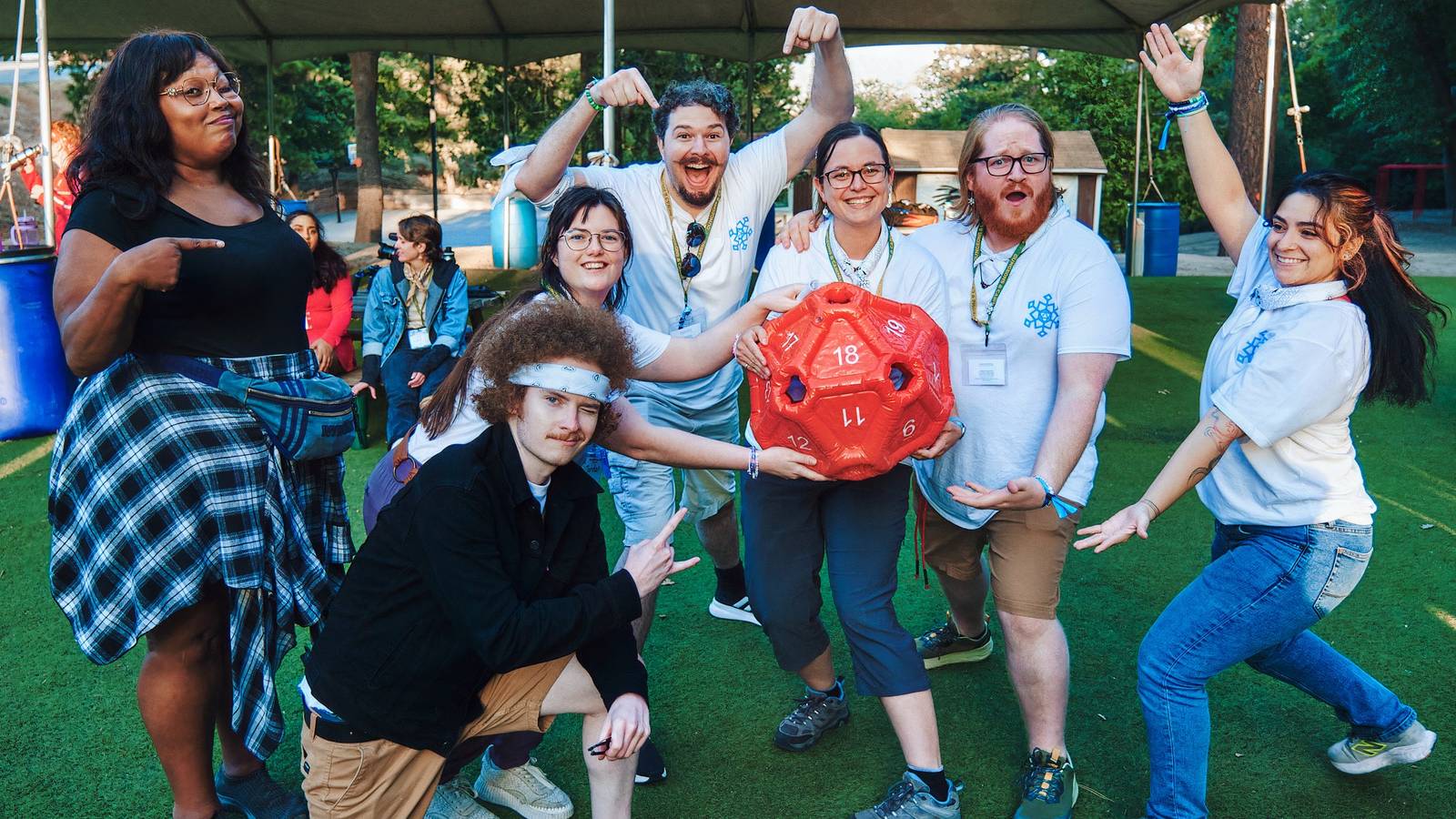
At Dungeons & Cabins, a weekend-long adult summer camp in Southern California, winning a game of archery might make your character stronger. Losing it might make the final boss harder for everyone.
That’s not a metaphor. That’s literally how this unique fusion of Dungeons & Dragons and a classic summer camp works.
Adventurers bunk up in premium, temperature-controlled cabins for four days and three nights in San Bernardino National Forest, located about three hours from Los Angeles. There, they’ll play hours of D&D punctuated by summer camp-style events, including tavern nights where the mead flows. Campers split into multiple adventuring parties, playing through the same story at once. What happens outside the game can directly influence what happens at the table, and vice versa.
During a phone call, Dungeons & Cabins founder Sammy Glicker told Polygon that the idea originated about three years ago, from what we might as well call a bit of FOMO. Glicker had never attended summer camp herself but had been playing D&D for years. She saw a link between both activities as a kind of radical intimacy: the camaraderie, the competition, and the way strangers could bond over something as simple as a game of tug-of-war — or rolling damage for Fireball.
“Many of these summer camp activities we do have a lot of crossover from the real-world into the game,” she said. “The more you opt in and lean into the experience, the more opportunities you have in the adventure.”
That means nearly everything campers do carries some kind of consequence. Winning competitions like archery or color wars might unlock tactical advantages or secret information about future encounters. In one event, players who survived a round of “archery tag” — firing foam-tipped arrows at one another — gained stat boosts for their characters. Those who didn’t? They added extra monsters to the campaign’s final battle.
During one past weekend, every group entered the an in-game temple at the same time. Players initially assumed they could only interact abstractly, until they realized they could physically get up, walk over, and communicate directly with other parties to solve a shared puzzle. It shattered the suspension of disbelief required to play D&D and veered into full-on immersion. The result is something closer to a living, communal story than a traditional tabletop session, one where dozens of players shape the same narrative in real time. But it’s also one where they roast s’mores by the campfire at night, probably while imagining some bard strumming on their lute nearby.
Narratively, Glicker has expanded upon an ongoing storyline set in the city of Paladin’s Retreat, which is surrounded by the Whispering Woods, where the trees themselves speak of the events that happen betwixt them. (Mechanically, that means individual parties can share their knowledge in between sessions.) Year one saw campers come up against an evil hag and her mobile hut on giant chicken legs, who D&D fans might recognize as Baba Yaga. In year two, her betrothed — a literal god — pursued the adventurers in a storyline that Glicker likened to I Know What You Did Last Summer.
“The returning campers had this really rich, rewarding storyline and it’s continuing again this year,” Glicker said, revealing that players ultimately had to slay that god as well. “I’m sure that will have no consequences whatsoever,” she joked. “They’re gonna show up and everything’s going to be perfectly fine…or maybe they’ll learn that actions have consequences.”
The mechanics behind Dungeons & Cabins may be novel and the ongoing storyline riddled with danger, but people keep coming back for the friends they made along the way. In just three short years, Dungeons & Cabins has built a dedicated following with a retention rate of about 70 percent. Even though the event has expanded into three weekends a year, Glicker said that many campers coordinate their schedules to attend once again with their previous adventuring party. Some have transitioned into staff roles as Dungeon Masters or NPCs on site.
“It’s a really wild thing, to see it go from something I thought would be a fun time… to a thing that’s really impacting people’s lives,” Glicker said.


Glicker recalled one pair of campers who had been friends online for years who finally met in-person for the first time at camp, as well as multiple marriage proposals that organizers helped plan through in-world puzzles and scavenger hunts.
Even smaller moments can carry just as much weight. One camper who arrived with a phobia of heights ended up conquering the camp’s zipline, encouraged by fellow players she had only just met days earlier.
For a game built on theater of the mind, Dungeons & Cabins works because it collapses the distance between player and character. The risks aren’t just narrative — they’re real, whether it’s stepping off a zipline platform, waddling in a three-legged race, or simply choosing to open up to a group of strangers.
In the process, those choices don’t just shape the story. They shape the people playing it.
This year, Dungeons & Cabins will run from August 28 to 31, September 11 to 14, and September 18 to 21. Camp registration opens May 1. Rates are $1,195 for the entire weekend, which includes three nights of lodging, chef-prepared meals, beverages, activities, swag, and a full weekend of D&D with professional DMs.