








Ten years doesn’t sound like a long time. “Decade” certainly sounds more daunting, but as far as media anniversaries go, 10 years is hardly a good reason for a band to trot out a nostalgic tour for their most influential record. Hell, it’s barely enough time for a piece of art’s long-term influence to become recognizable. But in the fast-moving world of video games, where entire genres are suddenly revolutionized and deconstructed in a flash, 10 years may as well be 50.
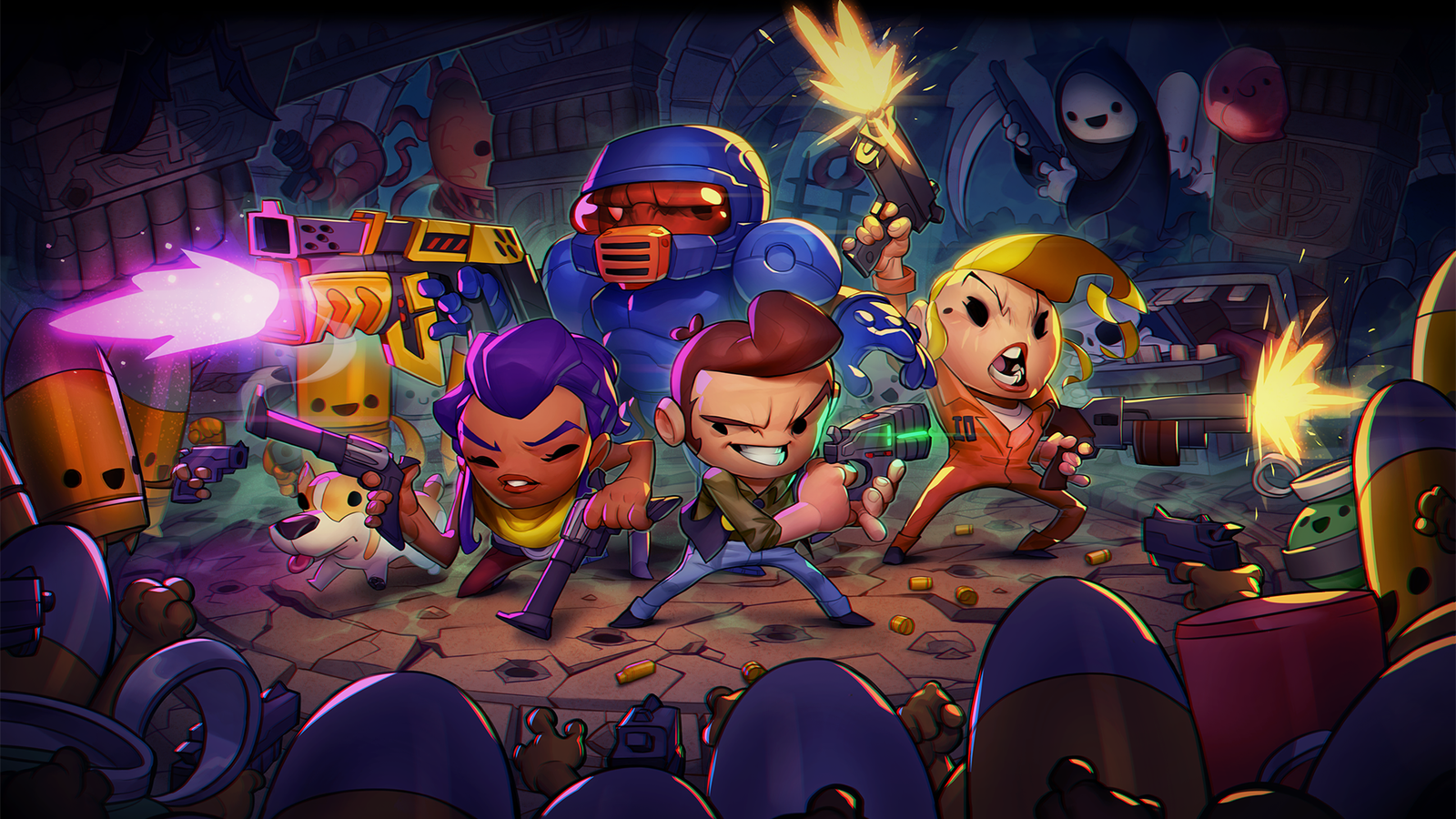
Look to a recent anniversary to see that dynamic in action: Enter the Gungeon turned 10 years old earlier this month. That doesn’t sound all too shocking on paper; I clearly recall playing developer Dodge Roll’s bullet hell roguelike on my PlayStation 4 in an apartment I can still draw from memory. But as some of the minds behind the game expressed when we met over a video interview to reflect on one decade of sentient bullets, it was practically a lifetime ago.
“If you think of it as a child, it almost doesn’t need you anymore,” composer Adam Kidd Drucker, who creates music under the name Doseone, told Polygon.
Call him cheeky, but Drucker has a point — at least when it comes to an art form that ages in dog years. Released in 2016, Enter the Gungeon launched into a landscape that sure sounds alien today. Just try to imagine a world where a roguelike that incorporated a dodge roll was still a novel concept! An entire genre has been shaped and reshaped in that time, becoming a Ship of Theseus built from stat-altering relics and passive bonuses. Gungeon’s creators still remember it like it was yesterday, but they’re all too aware that the genre they helped popularize has transformed into something entirely different since then.
Before developer Dodge Roll existed, there was EA Mythic, the Virginia-based studio known for its work on Dark Age of Camelot. Three of the developers who went on to create Enter the Gungeon worked there together in the early 2010s, including Dodge Roll studio co-founder Dave Crooks. In speaking to Polygon, Crooks explained that he and a group of friends inside the studio were growing eager to make a game “outside of the trappings of EA.” Crooks would get that chance, though not on his own terms. EA shuttered Mythic’s Fairfax office in 2014 after the team released Dungeon Keeper Mobile. It was a sudden end for a storied studio, but it gave Crooks and his colleagues space to chase their dream game.
The question was: What was that dream game? Crooks had a title in mind well before an actual game, but his brain started swirling around the roguelike. After all, it was starting to become a hot genre in the indie scene, thanks to success stories like The Binding of Isaac. That was an influence on Crooks, but at the time, it was actually Pokémon Mystery Dungeon that led him to researching the roguelike’s namesake game, Rogue. From there came some dissection of the popular roguelikes of the 2010s.
“I played Rogue Legacy and I really did not like how if you just kept grinding it, it would eventually trivialize the game,” Crooks told Polygon. “So one of the cornerstones [of Gungeon] was, I want to soften it from Rogue, for sure. But I did not want to get to a point where if you’re playing a run after 100 hours in the game, you don’t feel like you earned it. I also wanted to, as much as possible, telegraph all death pretty strongly, make it feel like you saw it coming and you can kind of in your head go, ‘If I had only done X.’”
Thus began the whirlwind development cycle of Enter the Gungeon. The idea came together fast; the team rushed out a prototype in five weeks so they could get it to E3. (They showed up to the expo with no appointments.) The game would take the basic ideas of The Binding of Isaac and combine it with the bullet hell chaos of Ikaruga. The extra twist was that players would have a dodge roll, playing off Dark Souls. Just as much as any actual roguelike, FromSoftware’s games became a major philosophical touchstone for Gungeon.
“One of the unsung superpowers that the Souls games have is that enemy variety in those games is off the charts compared to other games,” Crooks said. “So even though you might play that same level again, you just get to see a bunch of new stuff all the time just in the enemies. And I remember when Nioh came out, which is obviously in the lineage of Souls bursting out into other franchises, it was like every level had two or three enemies types. And then, later, it would be a purple version of it. And I was just like, I am actually shocked that you think you can show up to this genre with that few enemies!”
“Density of discovery” became a big focus in Enter the Gungeon. Dodge Roll wanted to load the game up with distinct enemies, unique weapons, and surprising interactions that made each run feel truly different. The trick was still making a game that felt coherent. Take the original score as an example. Drucker, who met Crooks by chance while DJing a Giant Bomb party, explained that the team wanted music that was cranked up to 11, would drive the pace of a run, and not get too annoying to listen to after tons of attempts. That was just one of the careful balancing acts Gungeon required, finding a happy medium between kitchen-sink design and restraint.
“When I got into indie games, there was just so much melodic abuse,” Drucker said. “I would always describe it as like in a cartoon when you see an octopus surrounded by nine pianos. I was like, ‘Yeah, we can’t do jazz shit.’”
Ironically, the experience of Enter the Gungeon does feel like jazz. A run is an act of improvisation where you’re left to jam with whatever weapons you can find and survive a symphony of bullets. It’s still an impressive feat 10 years later, and one that wasn’t exactly easy to pull off. Dodge Roll had a habit of playing “yes and” with game design. It wasn’t enough to add a Cheese Wheel weapon that paid visual homage to Pac-Man; it had to actually play Pac-Man, complete with blue enemies and cherries to eat.
Every wild swing like that would also have to slot into everything else the game had to offer, synergizing with other items and interacting with a wide cast of characters that didn’t lean on reused assets. Oh, and testing those changes would be a challenge too, because Dodge Roll didn’t have a dedicated machine that could pump out builds of the game easily.
When I asked Crooks what kinds of challenges that created in development, he paused: “Uh, like, all of them?”
“We built the game really fast,” he said. “It was about a 20-month development. And when I go back and look at the game, and I think about how much there was in that game, even at the initial launch after 20 months, I’m just like, I don’t know how we did it. I genuinely don’t.”

However the team pulled it off, Enter the Gungeon was a hit when it was released in 2016. Crooks’ dream was to make $50,000, a “life-changing” sum of money; the game instead went on to sell north of 14 million units over the last decade. For a time, it felt like anyone who played video games had tried it. Drucker recalled the “mind-blowing” moment where one of his favorite modern rappers, Teller Bank$, flipped out when he learned Drucker made the score, because he played the game with his daughters. Gungeon’s reach was wide.
Crooks and Drucker aren’t entirely sure how much that success has translated to direct influence on the genre. Crooks said that he saw a lot of games that lifted UI elements from Gungeon wholesale after its release, but he’s hesitant to take credit for any trend it might have produced. If Gungeon has shaped the roguelike genre in any way, Crooks hopes it’s in Dodge Roll’s respect for strong boss design.
“I care a lot about having bosses feel really memorable,” he said. “I’m from the school of bosses from Zelda and Metal Gear Solid, which is like, your game is only as good as your boss battles. These are the things you remember more than anything else about a game. So I was really pushing that sort of thing forward. I feel like I’ve seen that more in the genre than beforehand…. I feel I’m on the verge of being extremely presumptuous, but I’ve played some games where I’ve gotten to a boss and it’s very bullet hell-like. And I just think to myself, the cadence of this boss and the way you manage its patterns is so reminiscent of Gungeon that I want to believe we had some influence. Like Returnal, the way you manage their patterns. I was like, man, I feel like I’m playing Gungeon, just from a flow standpoint.”
I also have trouble putting my finger on precisely when Gungeon’s DNA became baked into games over the last 10 years. It’s not that those reverential examples of games that worshipped at Gungeon’s altar don’t exist; it’s that the roguelike genre has mutated a dozen times since 2016. Before Gungeon could even celebrate its fifth anniversary, Hades came along and completely changed the established framework for a roguelike. And since then, Balatro has twisted the idea even further.
Crooks said that it was easier to innovate ten years ago because of that. It just wouldn’t be possible to know if you were doing something new in the roguelike space anymore, considering the genre’s explosion in popularity. A dodge roll isn’t the exciting gimmick it once was when the bar is now “coin pusher physics simulator.” But with that fast iteration, Crooks sees the genre itself turning into something unrecognizable.
“What is a roguelike anymore?” he asked. “So few people are trying to make something that is truly evocative of this experience of playing Rogue. Yesterday, a new Devolver game called Minos came out. You design a dungeon and then adventurers come in and they get attacked. I was on the Steam page and I watched a dev explanation of the game and he said (paraphrasing), ‘But don’t worry, this is a roguelike, so death is not the end!’ And I’m like, that is the exact opposite of what 10 years ago somebody would’ve said a roguelike was!”

Our discussion about Gungeon’s potential influence quickly morphed into a dissection of the modern roguelike. While Crooks and Drucker offered praise for singular takes on the genre like Blue Prince, there was an undertone of disappointment to their voices when talking about what the games they love have become. Crooks declined to throw too much shade, but a bit of it came out when I asked him what he sees as the biggest difference between the genre now versus 10 years ago.
“The most obvious thing that I see is a screen that pops up three choices every 45 seconds. That’s changed,” he said. “There was a time where the thought of being interrupted in the game and anything even remotely fast-paced would be seen as anathema to game design. The whole game, the way the power curve is designed is like you have to be interrupted by this serotonin blast of fanfare and three choices… It’s more relatable to a slot machine being popular.”
It’s a fair assessment in the wake of Balatro. The popular deckbuilder took the fundamentals of poker and twisted them into a high-stakes game that played with the language of gambling. Several games have followed suit since its release, in less subtle terms. Most notably, CloverPit extrapolates Balatro to its furthest extreme by putting players in front of a literal slot machine. But more broadly, you can see the language of gambling even in something like Vampire Survivors, which plays a slot machine-like animation every time you open a chest.
There are very few people that will be in the circle of hell where you made money off of joy and fucking people enjoying something.
“Especially on the back of Vampire Survivors and Balatro, I think that it has gone a little bit … God, I don’t want to be the person that says this, but a little cash-grabby,” Crooks said. “Because I think that what fundamentally makes those things fun is much more like a slot machine than the experience of playing Rogue. And literally developing a game that ticks the boxes of a slot machine in those ways is just easier to do. There is a way to manipulate serotonin that game developers, especially game designers, use all the time to varying degrees of success and monetary success.”
“I think we’re seeing it mutate to the version of itself that popularity obfuscates,” Drucker added. “It’s like the term platformer. I’m pretty sure it used to mean there were platforms, and now I don’t really know.”
If Crooks and Drucker sound a little down on modern games, it comes from a place of love. Both have a deep appreciation for the roguelike genre in particular. They’re constantly playing and thinking about these games and where they fit into the genre’s storied past — a history that their own game has helped to shape. (And it will be again soon: Dodge Roll is currently working on Enter the Gungeon 2.) They can’t pretend to know how Gungeon will be remembered another 50 years from now, or what its lasting influence on games will be. For Drucker, all that matters is that they created something that means something to players.
“Everyone on this call and who will read this, we’re all going to hell,” Drucker said. “And when we go to hell, hell is stratified by how you made your living. So if you made your living off of blood money and lithium mines and exploitation, you’re in a worse part of hell. And there are very few people that will be in the circle of hell where you made money off of joy and fucking people enjoying something. I think video games are this last bastion of joy. Maybe that and, like, Nancy Drew novels.”
