



![31st Jul: Ladies in Black (2018), 1hr 49m [PG] – Streaming Again (6.4/10)](https://occ-0-1403-999.1.nflxso.net/dnm/api/v6/0Qzqdxw-HG1AiOKLWWPsFOUDA2E/AAAABS_MRtVnDX8egy-C7pPKCWfpKNm-KuFDa0CoXWa5pmUnvABj37IlPVPssUtfirqIjvZy7V89EvMWKQX_ZNff7nkFvO-fY96MICCN.jpg?r=5a6 "31st Jul: Ladies in Black (2018), 1hr 49m [PG] – Streaming Again (6.4/10)")



Belarus Free Theatre, which currently operates in exile in London, recently presented its production KS6: Small Forward for a three-night run at Théâtre Les Abbesses from May 11–13.
Directed by Natalia Kaliada and Nicolai Khalezin, the production tells the story of former professional basketball player and Olympic athlete Katsiaryna Snytsina, tracing her years in sports as her life gradually shifted toward politics.
KS6: Small Forward is an immersive theatre production that transforms the stage into a television studio, a gym, and other shifting spaces. The production features a live DJ, Blanka Barbara, whose presence adds another dynamic layer to the performance. Through live cameras, projected footage, archival material of historical events, and prerecorded videos of Snytsina herself, the production creates a powerful dialogue between personal memory, political history, and theatre.
When Katsiaryna Snytsina protested against Belarus’s fraudulent 2020 election under the Lukashenko regime, she could not remain silent and publicly expressed her opposition on social media. Soon afterward, she realized that the regime would not tolerate her dissent, forcing her into exile. By the time she left her country, she had been labeled an extremist and targeted because of her sexuality, simply because she refused to hide her true self.
The production is remarkably precise and professionally crafted. Its storytelling, stage design, blocking, costumes, and music work together harmoniously, resulting in a coherent and compelling theatrical experience that holds the audience’s attention from beginning to end.

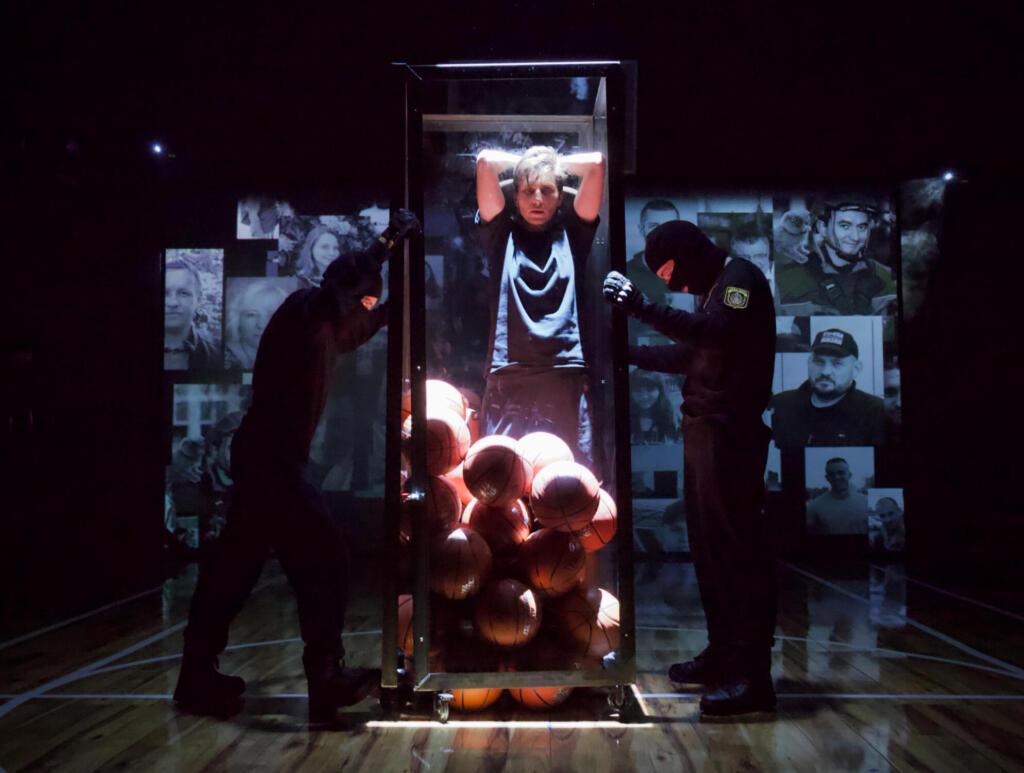
Katsiaryna Snytsina (centre), and Darya Andreyanova (left) and Raman Shytsko (right) as riot police in KS6_ Small Forward, a Belarus Free Theatre production. Photo by Nicolai Khalezin.
In one scene, Snytsina carries her suitcase as she tells the story of leaving her home and becoming an immigrant first in France and later in London. She shares the contents of her luggage with the audience. As an immigrant sitting among the audience, I could deeply relate to the question: what can one truly take in a suitcase when becoming either a refugee or an immigrant in another country? A suitcase carries not only the necessary material belongings one takes for survival, but also memories, identity, and a sense of belonging, emotional elements one refuses to leave behind because they help a person remain strong wherever they may live.
Snytsina also shares her struggles in expressing her attraction to the same gender to her family, while describing how warmly she was accepted by her parents. At the same time, society labeled her an “extremist lesbian,” reflecting one of the many ways authoritarian regimes attempt to control the minds of their citizens and misuse any opportunity to suppress those who wish to express themselves freely.
Another powerful element was the presence of Snytsina’s partner at the theatre. After the performance, Snytsina introduced her to the audience, which added another layer of authenticity and emotional immediacy to the experience.
During the performance, archival documentary footage of Václav Havel, the Czechoslovak playwright, dissident under communism, and later the country’s first president after the fall of communism in 1989, was projected on stage. Snytsina explained how Havel became a source of inspiration for her decision not to remain silent in the face of injustice in her society, and how his philosophy encouraged her to participate in what Havel described as “living in truth.”


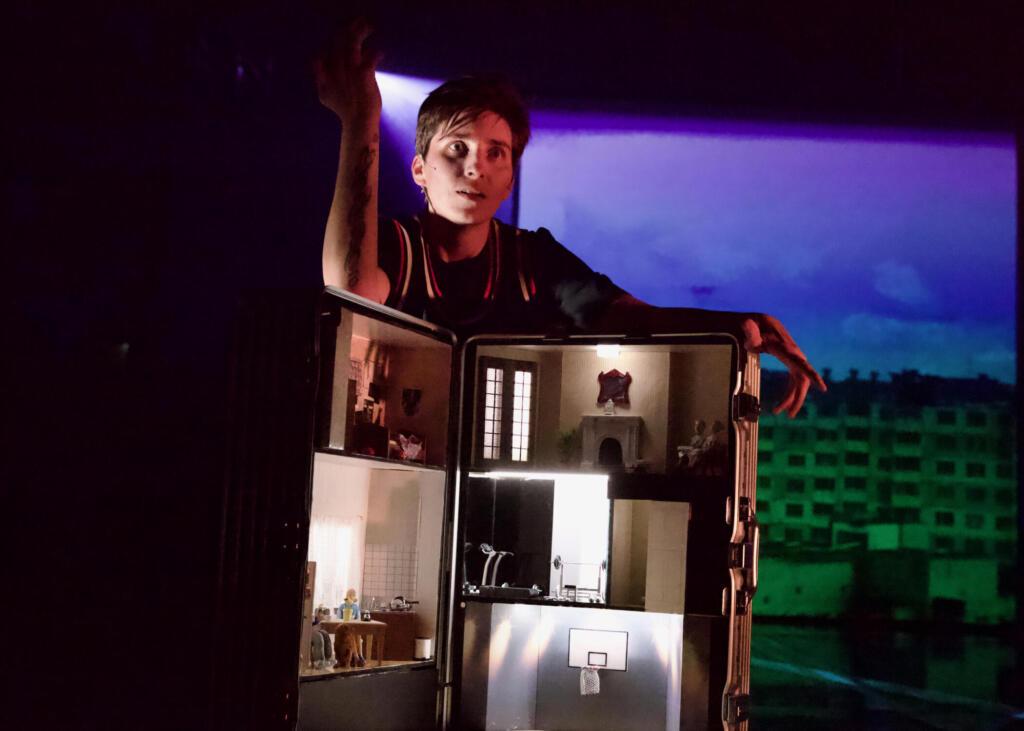
Katsiaryna Snytsina in KS6_ Small Forward, a Belarus Free Theatre production. Photo by Nicolai Khalezin.
Another meaningful aspect of the production was that each audience member received a leaflet containing information about political prisoners in Belarus. Each leaflet included a QR code linking to a website where audience members could write letters to political prisoners. This created another form of interaction between the audience and the performance, further strengthening the production’s immersive nature. However, it might have been even more effective to introduce this initiative before the performance began, allowing audience members more time to engage with the material and learn about the prisoners’ stories.
This is the magic of theatre: its ability to carry deeply personal stories across borders and create awareness within societies far beyond their original context. Katsiaryna Snytsina is not a professional actor, yet her authenticity and presence on stage make the audience want to know more about the life unfolding before their eyes. Watching a real person tell her own story with honesty and vulnerability creates a rare and powerful connection between performer and audience.
This post was written by the author in their personal capacity.The opinions expressed in this article are the author’s own and do not reflect the view of The Theatre Times, their staff or collaborators.
This post was written by Azadeh Kangarani.
The views expressed here belong to the author and do not necessarily reflect our views and opinions.