







The Toronto Theatre Review: Alex Jodi Verge’s contemporary adaptation reframes Shakespeare through intimacy, surveillance, and emotional fracture
By Ross
I have seen Hamlet more times than I can reasonably justify, and yet something in the framing of Hamlet, Sweet Prince, pulled me back in. Possibly, it was the promise of seeing this iconic play through a queer, contemporary lens. It’s not the newest idea, but I was curious and hopeful that this production might uncover something new within a text so often treated as immovable. What I discovered, upstairs in a dingy old warehouse building on Dupont near Dufferin, was not so much a radical reinvention as a deeply felt and often strikingly intimate interpretation, one that finds its strength in emotional immediacy rather than in a conceptual overhaul.
Abridged and directed by Alex Jodi Verge, the production drops us not into Elsinore, but into a modern corporate office, where power shifts not through crowns or royal proclamations, but through executive succession. After the sudden death of the company’s CEO, Claudius assumes control and marries Gertrude, setting in motion a chain of events that unfold with clarity and urgency. The ghost of Hamlet’s father (Andrew Pawarroo), rendered with a sharply defined unveiling, calls for vengeance, and we can’t help but lean in. From that moment onward, the play tightens into a study of grief colliding with expectation. The speed with which this Hamlet accepts the ghost’s revelation may raise questions within a contemporary framework. But the production does find its way through the tangles pretty brilliantly, committing fully to the emotional truth of that encounter, allowing its consequences to resonate and sink deep.
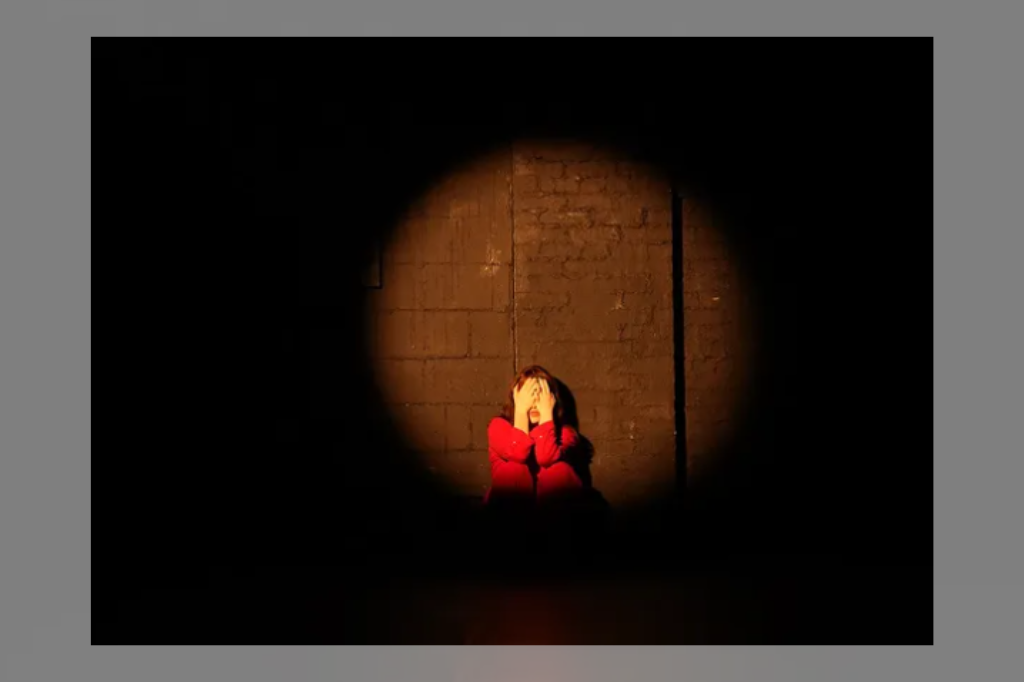
At the centre of the production is Gabby Kosmidis, who delivers a Hamlet that is exceptional and wisely focused. This Hamlet is raw and vulnerable, a prince shaped by grief and exhaustion as much as indecision. The grief manifests as both volatility and retreat, and Kosmidis vigorously navigates the language with clarity and intention. The character grounds this framing in a contemporary emotional landscape that feels accessible without losing its depth. Standing in opposition, Ashlie White’s Gertrude anchors one of the play’s most powerful scenes, their confrontation charged with a visceral intensity that is impossible to ignore, revealing the deep fractures beneath their love and relationship.


The surrounding performances contribute to a world that feels fully inhabited, even when certain thematic threads remain less defined. Jonnie Lombard’s Ophelia grows into a more affecting presence as the play progresses, finding a quiet desperation that resonates in the later scenes. Paul Stafford’s Claudius operates with a measured, guarded energy that gives weight to his desires, while Callan Forrester’s Horatio provides a steady emotional counterpoint. Hannah Sunley-Paisley’s reimagined Polonius introduces a commanding presence that complicates the play’s exploration of authority and control, yet somehow the dynamic works, even with its gender shift.
Visually, the world is defined with clever precision. Kenzia Dalie’s geometric office design traps the characters within a rigid environment, its semi-transparent plastic panels suggesting constant exposure that denies privacy at every turn. Franco Pang’s cool LED lighting is haunting and direct, and Lucy Ellis’s layered sound design works beautifully in tandem to create an atmosphere that feels both sterile and ominous. Together, these elements flicker between the tangible and the psychological with ease. Even with their modest means, the technical elements achieve a slick and unsettling cohesion, reinforcing the sense that this is a space where control is both asserted and eroded.
Central to that control is the presence of technology. Mobile phones are not incidental props but active agents within the storytelling, shaping how information is delivered and how relationships fracture. Characters enter and exit scenes with their attention tethered to screens, creating a distance that feels immediately recognizable. Calls replace letters, surveillance replaces speculation, and even moments of supposed intimacy are filtered through devices. This choice grounds the production in a contemporary rhythm, though it also introduces tensions when paired with elements of the original text that resist such translation.

That friction becomes most apparent in the latter half of the play. The graveyard scene and the final duel arrive with a sense of conceptual strain, as swords and ritualized death sit uneasily within a world defined by corporate hierarchy and digital mediation. While these moments are handled with efficiency, they never fully reconcile with the established environment, leaving a lingering sense of disconnection. The slight rotation of the panels to signify a change in location is a thoughtful choice, but it doesn’t fully do the trick. The absence of certain iconic elements, including the skull meditation, further underscores the challenges of balancing fidelity to the text with the demands of a modern realignment.
The production positions itself within a reading of patriarchal violence, suggesting that Hamlet’s tragedy lies not in hesitation but in the perpetuation of harm. While this framework is compelling, it does not always fully cohere across the performance. Certain moments, particularly those rooted in the original text’s misogyny, shift in meaning when delivered through this lens, creating an ambiguity that is intriguing but not always fully interrogated. Even so, the emotional through-line remains clear, anchoring our lead character in a sense of isolation that deepens as the play moves forward.
What ultimately gives Hamlet, Sweet Prince its impact is the tenderness that runs beneath its tension. Despite the surveillance, the corporate coldness, and the cycles of violence, there is a persistent ache for connection that never fully disappears. The title, drawn from Horatio’s final farewell, carries that sense of care into the production’s core. Watching this Hamlet navigate a world that demands action while offering no real solace, the tragedy unfolds as a slow erosion of the possibility of some much-needed closeness. Within that decay, the play finds something quietly affecting, a recognition that grief resists containment. It continues to reach outward, searching for something that might answer it and bring peace.