







It takes a remarkable director to vanish for nearly a decade and return with a vision as distinct as ever, but Na Hong-jin has always operated on his own wavelength. His track record speaks for itself. The Chaser and The Yellow Sea cemented his status as a titan of modern South Korean cinema long before his latest project, Hope, redefined what an action film could look like. Although his highly anticipated return escalates into bombastic sci-fi spectacle, its underlying DNA resonates with his earlier work. Na remains focused on ordinary people dragged into mysteries far beyond their comprehension.
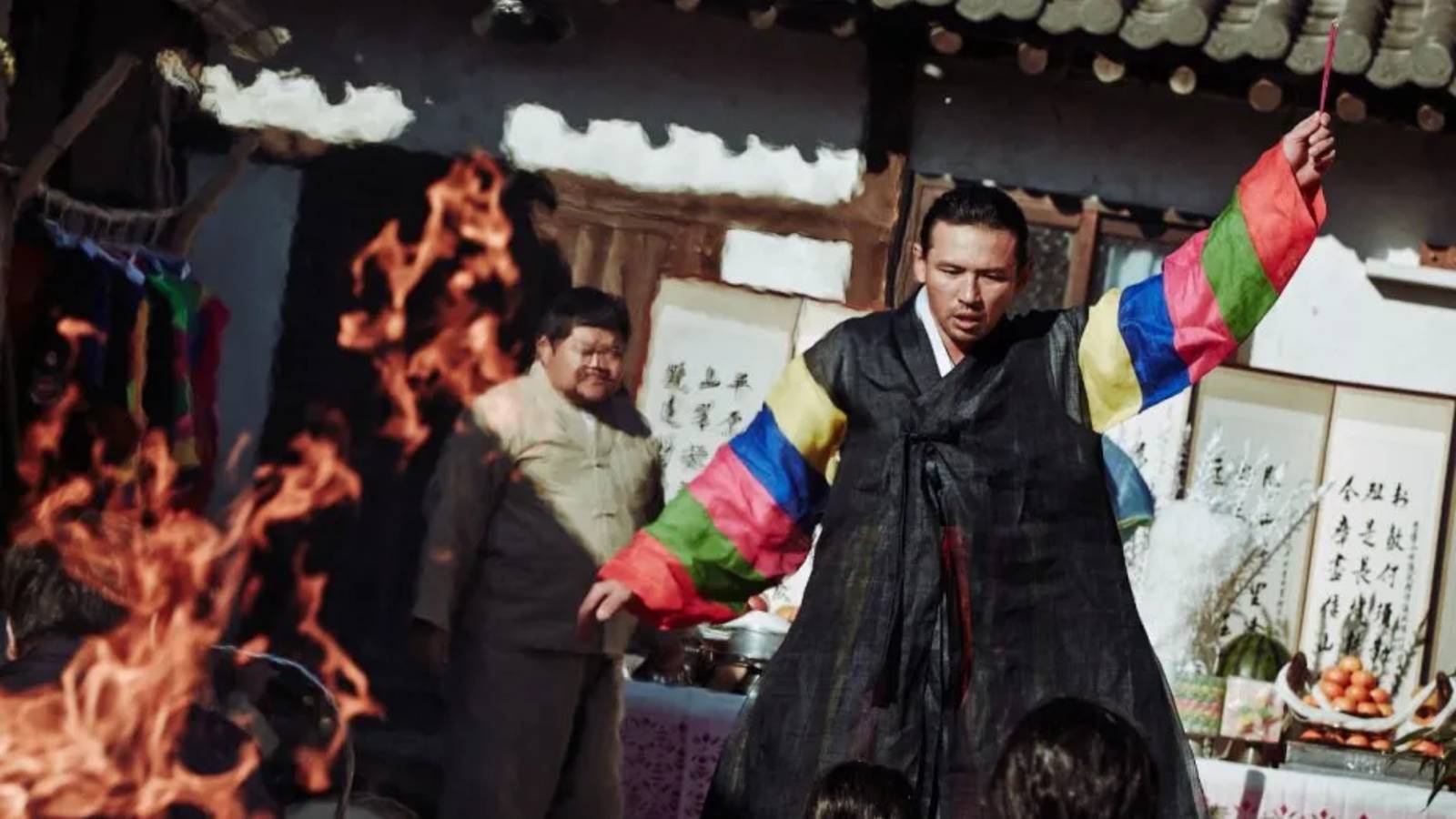
The crown jewel of those previous thrillers is undeniably The Wailing, the last feature-length film Na directed before Hope. The rain-slicked mystery opens in a remote village where a string of gruesome murders leaves the local police scrambling. Anchoring the chaos is Jong-goo (Kwak Do-won), a bumbling police officer forced to confront a force far larger than he can handle. What masquerades as a standard procedural gradually evolves into a supernatural nightmare, executed so seamlessly that the transition is almost imperceptible. Na embeds the occult so deeply into the fabric of his world that your brain reflexively tries to rationalize it.
Environmental storytelling has always been one of Na’s sharpest tools, as he often refuses to treat the natural world as mere background decoration. Hope is filled with its own sweeping drone shots of the verdant forests and mountains surrounding its setting. In The Wailing, the landscape itself similarly breathes with the narrative. The film opens on the calm banks of South Korea’s Seomjin River, where towering mountains and dense forests sit under the soft orange glow of morning. Na focuses first on the natural beauty of the world that surrounds his story before quickly switching to a Japanese man (Jun Kunimura) fishing in the river. Although seemingly incidental, you’ll find the fisherman’s lingering presence one of the film’s greatest tools.
What grounds that occult terror is an overriding sense of duty wrapped in tragedy. Jong-goo is a tired family man and a bit of a fool, utterly ill-equipped for the unimaginable conspiracy that awaits him and his family. Like the growing sense of desperation that drives Hope, the village’s police force at the center of The Wailing feels overworked and under-resourced. Officers often struggle to maintain order against circumstances outside of their control, all while a fierce rain beats down upon them.

The gloomy weather of The Wailing is how it adopts the visual grammar of a grimy noir even as it violently careens between horror, comedy, and folklore. The tonal instability is another one of the film’s strengths, pivoting from grotesque body horror to unexpected hijinks, thanks to the sheer incompetence of Jong-goo and his partner, Oh Seong-bok (Son Gang-guk). Even as the film drops out of its noir sheen, Na manages to maintain the film’s overriding spell. If anything, these jarring shifts make the world feel authentic and deeply human, heightening the impact of the horror when it inevitably strikes.
That same jarring brilliance extends to the mystery itself, which culminates in a finale that must be experienced blind. Without spoiling the film’s devastating conclusion, Na orchestrates a climax where three disparate storylines violently collide in real time, placing the audience in the exact same frantic headspace as Jong-goo. We’re forced to decide who to trust as an enigmatic woman issues cryptic warnings and a rooster’s crow acts as a ticking clock for a family’s survival. The movie pulls off a breathtaking bait-and-switch, making you absolutely certain of one reality before brutally pivoting to another. It’s a sequence that proves the film’s narrative structure is just as unpredictable as its genre shifts, and lands with a devastating truth that wraps back to its opening phrase, citing Luke 24:38–39:
“See my hands and my feet, that it is I myself. Touch me and see. For a spirit does not have flesh and bones as you see that I have.”

Fans of South Korean cinema will naturally place The Wailing alongside Bong Joon-ho’s Memories of Murder, another genre-blending mystery, though based on real events. While Na isn’t outright mimicking Bong’s masterpiece, both films brilliantly escalate a rural procedural into something unfathomably bleak, while also centering on two out-of-their-depth investigators, communities buckling under paranoia, and mysteries that grow more sickening the more the truth is revealed. Distinct echoes of Kiyoshi Kurosawa’s Cure also appear in how Na presents evil. The antagonist isn’t your conventional monster, but what feels like an eerie contagion slowly seeping into the ordinary world.
The Wailing stands as a flawless companion piece to Hope. It trades the Alien-inspired action set pieces for a darker, more slow-built mystery that pulls you ever-deeper into the terrifying secrets of its world with each chilling second. Na refuses to be confined to a single box. His films demand a complex narrative mystery that bleeds together different genres, like action, comedy, and horror. The Wailing remains one of the most razor-sharp presentations of that vision yet.
The Wailing is streaming on Philo
