



![1st Oct: Midnight Girls (2026), 1hr 44m [TV-MA] (6/10)](https://occ-0-2433-2430.1.nflxso.net/dnm/api/v6/0Qzqdxw-HG1AiOKLWWPsFOUDA2E/AAAABVKD33lVJmcCnMgQI9hP4e3S8FbT16KuBsMccfGOPvMVD2xRpCZ7_aY7tX-6xkA7hxHwpXEB8u5gBAQcXcfT9HW9mquL_xcaRUGg5AniN31hpw8rDwhpxFZF4S0ZzBAN7B0MIqOlOj4515XxfVI1rrfiG9aNqiAcfzs9VwIqspy-gw.jpg?r=297 "1st Oct: Midnight Girls (2026), 1hr 44m [TV-MA] (6/10)")




Whether you love or hate it, you can’t deny that showrunner Ryan Condal and writer Sara Hess’s adaptation of George R.R. Martin’s Targaryen history book, Fire & Blood, has been entertaining from start to finish. The House of the Dragon season 3 finale proved to be no exception, even if it also introduced a number of changes to the original story.
For the most part, these changes from Condal and Hess have been for the best. Making Alicent and Rhaenyra around the same age, for example, has proven to be a far more interesting move than going down the evil crone stepmother versus young stepdaughter route. However, the latest changes in the House of the Dragon season 3 finale have us questioning just how far the show’s planned fourth and final season may deviate from the original ending for a certain character in Fire & Blood.
Warning: This article contains spoilers for House of the Dragon’s season 3 finale and the ending of The Dance of Dragons segment in Fire & Blood.
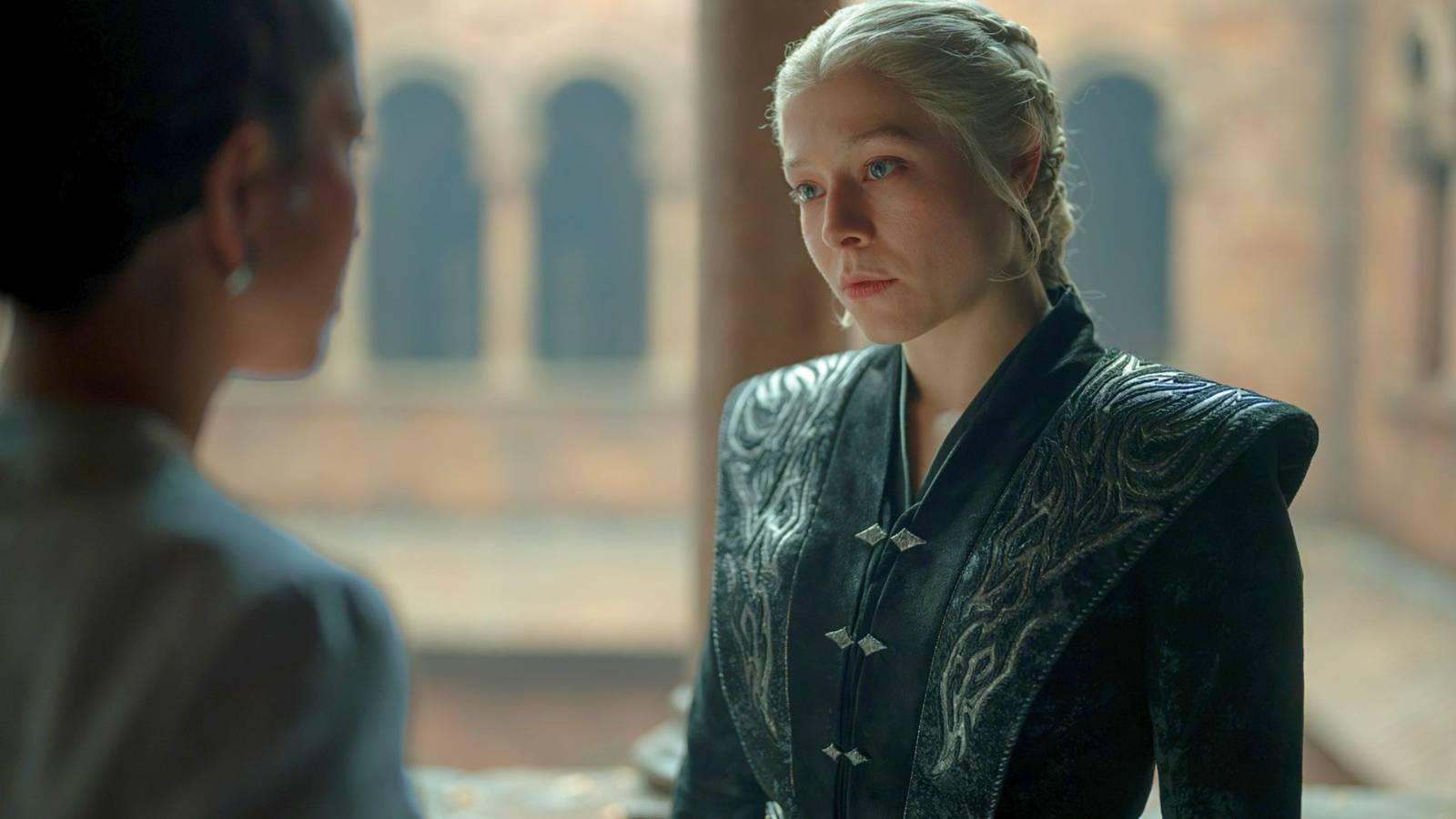
After three seasons of trying to prove herself capable of ruling, both to the people of Westeros and to her own allies, Rhaenyra Targaryen (Emma D’Arcy) has officially hit the point of no return. The two people who have the power to keep her moral conscience in line, Alicent Hightower (Olivia Cooke) and Mysaria (Sonoya Mizuno), have both been sent away. This leaves Rhaenyra with only Daemon Targaryen (Matt Smith), who, while certainly the Black Queen’s biggest supporter, has godlike ambitions and cares little for anyone and anything outside of Targaryen exceptionalism.
It’s no wonder then that after losing her sons, and with the ongoing panic at the realization that her biggest threat, Aegon Targaryen (Tom Glynn-Carney) and his dragon Sunfyre are still alive, Rhaenyra isn’t afraid to sacrifice anyone and everything to ensure her future as ruler of Westeros. This is especially felt in her treatment of her half-sister, Helaena Targaryen, whom she force-fed gruel and then, quite literally, shut the window on, after uncovering her sister’s death at the end of the episode.
However, a major change in season 3’s finale suggests things are only going to get worse for Rhaenyra. In Fire & Blood, Rhaenyra’s short reign of King’s Landing is so horrific in the eyes of the smallfolk that she is given the rather crude nickname of “Maegor with Teats” — referring to a previous mad Targaryen ruler, Maegor the Cruel. She also becomes known as “Rhaenyra the Cruel.” While these nicknames do originally stem from the heavy taxation the Master of Coin puts on the smallfolk of King’s Landing to help with the war effort, the name sticks to Rhaenyra after the people learn about Helaena’s suicide and immediately assume Rhaenyra had something to do with it, as well as her increasing paranoia and distrust of those close to her. This eventually leads to Rhaenyra having so few allies that it’s easy for Aegon to capture her and her forces on Dragonstone.
The paranoia, however, is understandable in the book. In Fire & Blood, Rhaenyra loses the Battle of Tumbleton when her dragonriders, Ulf the White (Tom Bennett) and Hugh Hammer (Kieran Bew), betray her army and supporters, bathing them in dragonfire. Any betrayal is terrible, but two of her best dragons? It’s a blow that leaves Rhaenyra distrusting the rest of her allies — namely Addam Velaryon (Clinton Liberty), who, like Ulf and Hugh, is a bastard. This distrust prompts Rhaenyra to call for Addam’s arrest, but he escapes with help from his father, Corlys (Steve Toussaint). Enraged, Rhaenyra imprisons Corlys — losing yet another dragon and her Hand in one fell swoop. With three dragons down and Daemon nowhere to be found after he learns Rhaenyra planned to kill his ward/lover, Nettles (in the show, her storyline has been merged with Rhaena Targaryen), Rhaenyra is in a terrible position.

In Condal and Hess’s adaptation, however, things are going a little differently. For one thing, only Ulf betrays Rhaenyra and the Black Council, not Hugh. Also, Rhaenyra and Daemon’s relationship is fairly stable, and he leads the battle at Tumbleton. Furthermore, during the battle, Daemon sees Hugh searching for his wife, Kat, and knows that Hugh wasn’t actively attacking his own men, unlike Ulf. With that in mind, Rhaenyra in the show hasn’t lost all her dragonriders and dragons — only Ulf and Silverwing.
Even with Aegon and Sunfyre confirmed to still be alive, Vhagar — the biggest and strongest of the Green Council’s dragons — is still missing, and Rhaenyra still has a fair number of dragons to her name. Rhaenyra’s power remains fairly resolute, which makes us curious how her descent into paranoia will play out on screen in a way that makes as much sense as it does in Fire & Blood.
It can be argued, however, that Rhaenyra’s paranoia will still play a key part in season 4 of House of the Dragon. What Fire & Blood doesn’t explore as much as the TV adaptation does is just how often Rhaenyra has been defied by her own allies throughout her reign. Even as her supporters rally behind her, she has also been questioned and ignored, with the latter in particular being the reason she loses her heir, Jace (Harry Collett), in the Battle of the Gullet. When you’ve been ignored that many times by the people who you’re supposed to trust, it wouldn’t be too much of a shock for Rhaenyra to feel like she’s being besieged by all sides.

Additionally, Rhaenyra’s actions in the season 3 finale have condemned her to a lonely path going forward. Mysaria is no longer on her side, and after Helaena’s death, we highly doubt Alicent will ever forgive her. Then there’s Corlys, who, hypocritical as he may be, isn’t too pleased with Rhaenyra for denying his sons, Addam and Alyn (Abubakar Salim), their birthright as Velaryons. She’s also ostracized herself from her more noble allies earlier in the season, taking from them in an attempt to feed the smallfolk. And a few episodes later, Rhaenyra is hated by them now, too. Even her relationship with her son Joffrey — as well as her sons from Daemon, Aegon III and Viserys II — has turned sour due to either the weight of rulership or them being sent away from her. It’s no wonder, then, that the only person Rhaenyra now seems to turn to for answers is her husband-uncle, Daemon.
It’s uncertain how much the season 3 finale changes will impact House of the Dragon season 4. However, given the setup Condal and Hess have provided to depict Rhaenyra’s struggles, we shouldn’t be surprised if, when House of the Dragon returns in 2028, we see Rhaenyra the Cruel in her full, paranoid form.
