








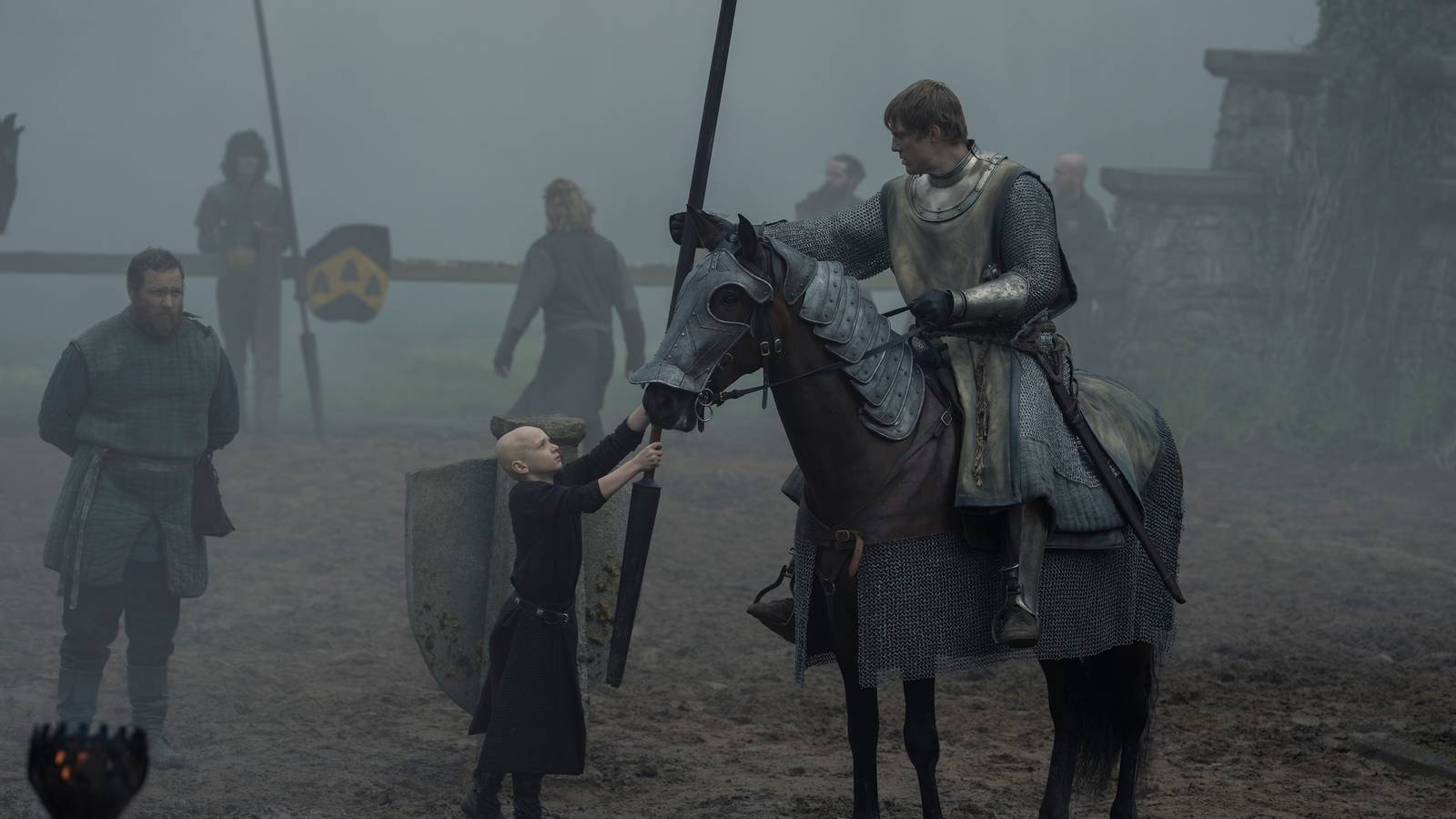
Season 1 of HBO’s A Knight of the Seven Kingdoms season 1 has concluded, and it was a huge success. The series launch was one of HBO’s top three most-watched premieres of all time. The show boasts one of the highest IMDB-rated episodes of any series in the Game of Thrones franchise. It also has something its predecessors didn’t: a fully completed story to adapt. That’s likely no coincidence when it comes to explaining why it’s landed so well with critics and viewers.
Game of Thrones outpaced George R.R. Martin’s unfinished novels, while House of the Dragon draws from a fictional history book rather than a traditionally structured narrative. By contrast, The Hedge Knight — the first of the Dunk and Egg novellas — is part of a trio of completed stories with a built-in fanbase and a clear narrative arc. The road map is already there. The characters have defined trajectories. The audience knows the destination.
Without the risk of overtaking the source material or inventing a late-game pivot that could derail the story, season 1 of The Knight of the Seven Kingdoms benefits from clarity and cohesion. No one, not even the audience, was going to be blindsided by abrupt turns reminiscent of Game of Thrones season 8. That stability gives the season confidence and thematic unity that the other two Game of Thrones shows lack.
Game of Thrones’ ending wasn’t inherently bad; it was the rushed, uneven path leading to it that made it feel unsatisfying. Many fans could agree on where most of the major characters ultimately landed (Bran aside, in my opinion), largely because readers had been theorizing about those outcomes since Martin’s A Dance with Dragons was published in 2011. The series concluded in a place the fandom had already headcanoned for years before it finally played out on-screen.
But the lack of source material to guide the journey was a clear issue. Once the show moved beyond Martin’s published work, showrunners David Benioff and D.B. Weiss had to chart their own course to those endgames, and that’s where the execution faltered.
Meanwhile, Martin himself has had issues with House of the Dragon’s adaptation of Fire & Blood, stating “everything wrong” with the HBO series in a now-deleted blog post. Showrunner Ryan Condal responded to the post, noting that Martin’s criticism “was disappointing.” He also explained why some changes were necessary for the adaptation, since Fire & Blood isn’t a traditional narrative. “It’s this incomplete history, and it requires a lot of joining of the dots and a lot of invention as you go along the way,” he said.
Rather than unfolding as a traditional novel, Fire & Blood is structured as an in-universe historical account of the Targaryen dynasty, written by a scholar within the world of A Song of Ice and Fire. Because it isn’t a traditional narrative, liberties had to be taken in its adaptation, which yielded mixed results.

We’re no strangers to comparing the Game of Thrones universe to Star Wars, and a key reason is how each handles its source material. Since Disney acquired Lucasfilm, the studio has tended to cherry-pick highlights from the now-non-canonical Expanded Universe rather than fully adapt its stories. As a result, the franchise now feels scattered. Lucasfilm is currently looking to course-correct by bringing a popular Disney Plus show to theaters — a show with no real connection to the larger Star Wars universe.
Game of Thrones was never better than its first four seasons, when it was accurately adapting Marin’s novels. A Knight of the Seven Kingdoms is a return to form in terms of faithful adaptations. (At least for the most part.) For the next two seasons, at least, the series has a clear road with no detours in sight, with two more published Martin novellas to adapt, each of them telling a complete, resolved story.
Past that, the future is less clear. Showrunner Ira Parker has laid out an ambitious plan to work closely with Martin on further seasons, and Martin continues to claim he’ll write more Dunk and Egg stories in the near future. Whether those stories materialize remains to be seen. But unless the creative team maps out a long-term plan, they risk landing this latest celebrated wing of the franchise in the same position as the other two.
![29th Apr: Allegedly with Ellison Barber (2026), 1 Episode [TV-MA] (6/10)](https://occ-0-1381-999.1.nflxso.net/dnm/api/v6/0Qzqdxw-HG1AiOKLWWPsFOUDA2E/AAAABcFYvCDbLMA6BBhdbHEEZjpPL8RHba_M0iOMuPWY1qTgbCVVeJmi_byeCcPcWA4_Iy78pPMLphu2812M07mA65vUd29QTxrRZxBxKWfrb4RhV3UuHFrQKIHD8pLX1x8nKaDQl9BhWwBfFWTSuB7KVxWC0LGh-qpGAwYrjwhpFlqy3U4_LSWW2FmUnbPD2NVChdKQ2l1OR1zzym2C__0Qf--HBLdCkSg0pRrwugjAedwQEpQic60sls6BO4bfHg54gfc11tWDlOMeM3-mZpdedjP_77MKqw_mTbUdxMtXTV2QMx7lMgHGg0xCeNpsQyGj6Gtoh-vLz06ztPRqs9zR-U9CSimc8QsqW514igP7uDU5xee_h1xjXmSdwTjIQg.jpg?r=a4a "29th Apr: Allegedly with Ellison Barber (2026), 1 Episode [TV-MA] (6/10)")