![30th Sep: Thomas & Friends – Really Helpful Engines (2026), 30m [TV-Y] (6/10)](https://occ-0-7328-1001.1.nflxso.net/dnm/api/v6/0Qzqdxw-HG1AiOKLWWPsFOUDA2E/AAAABYzOkoTiI5jwrTJXfRw3BIZs1lpvNfiHEUvivdNG1NucHHD3IjewiFb3a-PmLLrblckw9tRq300qxQjjdJJDV5QjZvV4rgV2BL67uFl-38vcvgJ23eDlCGKlpC1UbCHK9lCrxpyLlm-uYC0SzBO_wAuoCN8iu6Mw8YnvBxzirXqKGQ.jpg?r=65d "30th Sep: Thomas & Friends – Really Helpful Engines (2026), 30m [TV-Y] (6/10)")








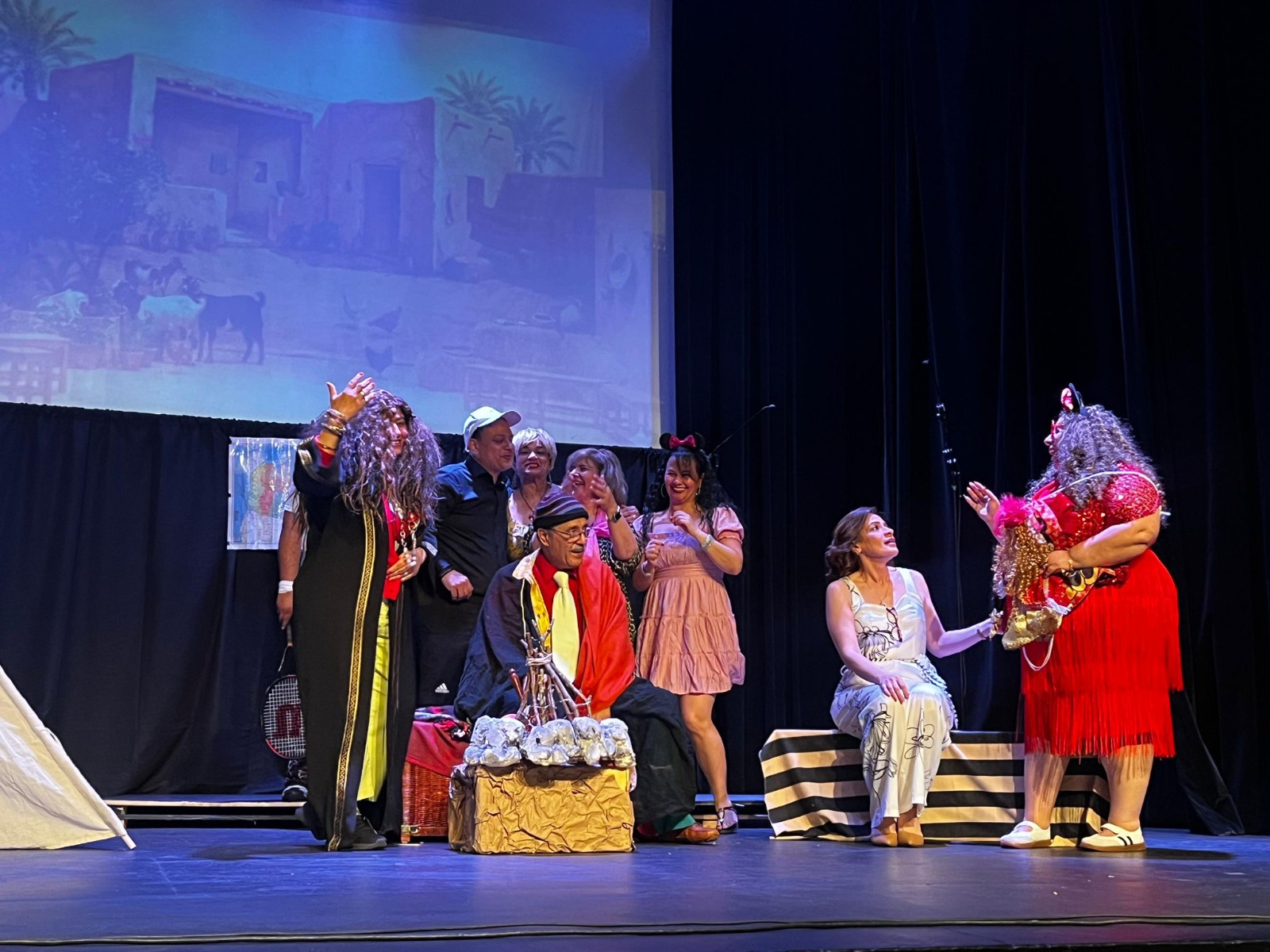
Arab Canadian theatre is frequently discussed through the language of war, displacement, exile, and trauma. Although such themes have produced some of the field’s most significant works, they have also overshadowed another important dimension of Arab Canadian theatrical practice: humor. Comedy, satire, and absurdism remain comparatively understudied despite their presence on Canadian stages and their popularity among Arab audiences.
Two plays in particular, Mohammad Haroun’s Madrasat al-Muhajirin (School of Immigrants) and Karim Boudabous’s Falija (Suitcase), reveal the richness of this overlooked terrain. Although both works engage questions of migration and belonging, they do so through markedly different dramaturgies. School of Immigrants, directed by George Wadei, employs community comedy and collective laughter, whereas Falija foregrounds fragmentation and absurdist humor. These plays demonstrate that Arab Canadian theatre is not solely a theatre of suffering, but also a theatre of wit, contradiction, and imagination.
Language constitutes one of the most important sources of humor in both plays, shaping not only comic exchange but also the representation of immigrant identities. School of Immigrants almost creates what Mikhail Bakhtin would describe as a heteroglossic space in which multiple social languages coexist and compete. Many of its comic moments emerge not simply from Arabic-English code-switching but from encounters among Palestinian, Egyptian, Iraqi, Lebanese, Sudanese, and Gulf dialects, each carrying distinct cultural associations and comic possibilities. Falija, however, reflects a different linguistic environment, one shaped by the interplay of Tunisian dialect and French within Montreal’s Arab communities. In both works, language becomes not only a means of communication but also a source of theatricality, identity formation, and comic invention.
The Classroom as a Theatre of Community
Presented by Teatro Al-Arab Al-Canadian, a community-based theatre company formally established in 2017 in Mississauga, School of Immigrants occupies a distinctive place within Arab-language theatre in Canada. The production brought together experienced actors and community performers, reflecting the company’s community-based theatrical model.
The title immediately evokes the iconic Egyptian comedy Madrasat al-Mushaghibin (School of the Naughty Students), a landmark work in the history of modern Arab comedy. For Arab audiences, the reference activates a rich reservoir of theatrical memory even before the performance begins. The play also recalls the multicultural classroom dynamics of the British sitcom Mind Your Language. Like that series, it gathers individuals from different backgrounds in a language-learning environment and mines comedy from misunderstanding and miscommunication. Yet School of Immigrants goes beyond entertainment by transforming the classroom into a space where newcomers collectively negotiate life in Canada.
More than a conventional classroom comedy, School of Immigrants is a community comedy whose classroom setting functions as a miniature multicultural Canada, bringing together immigrants from diverse backgrounds as they navigate language, work, family, bureaucracy, and social integration through linguistic and cultural encounters.
During an introductory classroom exercise, Um Shalbak jokes that she has “no homeland” and that Arab countries refuse her visas, before describing Palestine as a place she knows only through “Google images and my mom’s stories.” The scene then shifts from political irony to linguistic comedy when Abu Shalbak is asked why he came to Canada and confidently replies, “because I love terrorism!” The shocked reaction of his classmates prompts the teacher’s correction: “you mean you love tourism.” On one level, the joke emerges from a simple phonetic error. Yet the slippage between tourism and terrorism exposes an underlying prejudice that continues to link Arab identity with terrorism in contemporary Western discourse. Rather than reproducing the stereotype, the joke subjects it to ridicule.
The play also draws upon recognizable immigrant figures: the Egyptian hustler constantly searching for opportunities, the Iraqi physician unable to practice medicine despite his qualifications, the Palestinian patriarch struggling with language acquisition and changing family dynamics, and a range of national identities brought together within the same classroom. These figures function less as stereotypes than as comic points of recognition. Their familiarity allows audiences to immediately identify with the situations being staged. As School of Immigrants derives much of its humor from recurring misunderstandings and comic encounters, characterization sometimes remains secondary to the collective portrait of immigrant life. The play prioritizes recognizable situations and collective experience over psychological depth and individual character development, reflecting its roots in community theatre and ensemble comedy.
What makes the play distinctive is that comedy creates community. Misunderstandings become conversations, disagreements become jokes, and cultural differences become opportunities for connection. The classroom is not simply a site of language instruction; it is a theatrical space in which newcomers collectively learn how to belong. Yet, the play does not present integration as effortless, repeatedly returning to concerns about employment, language acquisition, credential recognition, and family adjustment in the immigrant experience. At the same time, the play’s emphasis on community occasionally obscures differences in how migration is experienced across gender lines.
Female characters often function less as fully developed subjects than as vehicles through which male characters negotiate the challenges of migration and social change. The play’s treatment of female self-transformation is marked by a degree of ambivalence. As Um Shalbak embraces aspects of her new life in Canada, including linguistic and personal change, these aspirations are repeatedly filtered through jokes about desirability, and role as a wife. As a result, the comedy sometimes reinforces the very gendered assumptions it appears to challenge, making female independence a source of humor rather than a subject of sustained exploration.
Falija and the Absurdity of Movement
If School of Immigrants is a comedy of settlement, Falija is a comedy of movement. Boudabous embraces absurdism. Characters pursue ordinary desires through increasingly illogical forms of reasoning, searching obsessively for love, belonging, and stability in a world structured by perpetual transit. Comedy arises not from resolution but from disorientation, coincidence, and the gap between expectation and reality. Through exaggerated situations and absurd encounters, the play presents migration not as a linear journey from departure to arrival but as an ongoing condition of uncertainty.
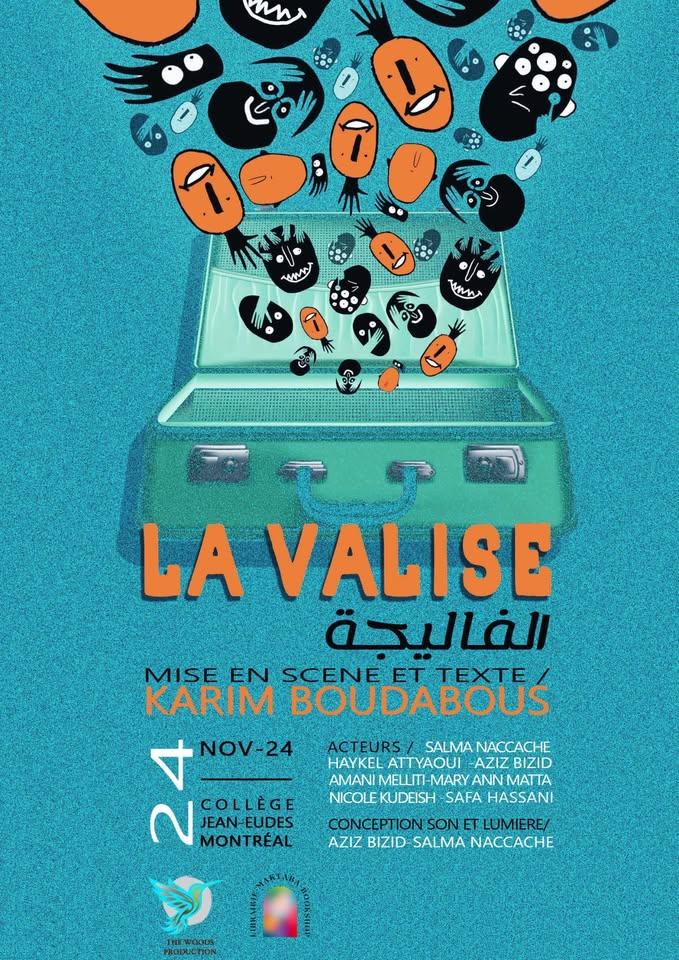
Image provided by Karim Boudabous
Produced in Montreal in 2024, Karim Boudabous’s Falija departs from conventional dramatic structure. The play unfolds as a series of loosely connected scenes framed by recurring announcements from an airline pilot. Airports, airplanes, waiting rooms, apartments, suitcases, and border crossings form the landscape through which the characters move.
The play introduces a range of figures whose lives are shaped by migration: a mother inventing increasingly extravagant stories about her son’s life in Canada, a young woman searching obsessively for an ideal husband across Montreal, couples navigating the disappointments of everyday life, and Omar, whose recurring presence provides the emotional center of the work.
The play also offers a more substantial space for female subjectivity than School of Immigrants. Much of its emotional and comic energy derives from women’s perspectives, whether through Fatima’s obsessive search for love, the mother’s fantasies about her son abroad, or Samira’s frustrations with married life in Canada. Nevertheless, these stories are themselves rendered through exaggeration and irony.
Unlike School of Immigrants, which gradually builds a sense of community, Falija foregrounds instability. The scenes are connected not by chronology but by movement itself. Everyone is traveling, waiting, searching, or departing. Migration is not presented as a journey from departure to arrival but as a permanent condition of transit. Airports, suitcases, and airplanes become theatrical metaphors for lives suspended between multiple homes and identities.
By privileging movement over resolution, Falija captures the uncertainty of migrant life with considerable force. Yet its emphasis on allegorical situations and recurring comic motifs sometimes limits the psychological depth of its characters, who often function as representatives of broader migrant experiences rather than fully individualized figures.
The humor therefore approaches absurdism. Characters pursue impossible plans, misread situations, construct elaborate fantasies, and search endlessly for certainty. A woman mistakes a thief for her destined husband. Passengers frantically redistribute luggage according to mysterious regulations that nobody understands. Everyday life becomes both comic and irrational.
The play ultimately refuses the reassuring conclusion often associated with immigrant success stories. In its final moments, Omar is asked to choose between Canada and Tunisia. His response is simple:
“What am I supposed to choose?”
The question remains unanswered.
Beyond the Theatre of Trauma
The significance of both plays extends beyond their subject matter. Created within Arab-language theatrical communities that often face limited resources, volunteer-driven production models, and persistent challenges of visibility, both works represent important acts of cultural persistence.
More importantly, they challenge dominant expectations of Arab Canadian theatre. Neither play presents immigrants as passive victims, nor do they celebrate straightforward narratives of assimilation and success. Instead, both foreground contradiction, uncertainty, misunderstanding, and the comic dimensions of everyday life.
Their contributions are as much dramaturgical as thematic. School of Immigrants adapts traditions of Arab popular comedy, community theatre, and multicultural classroom humor to create a collective portrait of immigrant life. Falija employs fragmentation, irony, and absurdism to represent migration as an unfinished journey.
At a time when Arab Canadian theatre is often framed through exile and trauma, these plays remind us that laughter is equally important. Humor does not diminish hardship; it becomes a way of confronting it. Through satire, irony, and absurdist imagination, School of Immigrants and Falija reveal migration not only as a story of loss, but also as a source of comedy, creativity, and enduring human connection.
This post was written by the author in their personal capacity.The opinions expressed in this article are the author’s own and do not reflect the view of The Theatre Times, their staff or collaborators.
This post was written by Amir Al-Azraki.
The views expressed here belong to the author and do not necessarily reflect our views and opinions.