



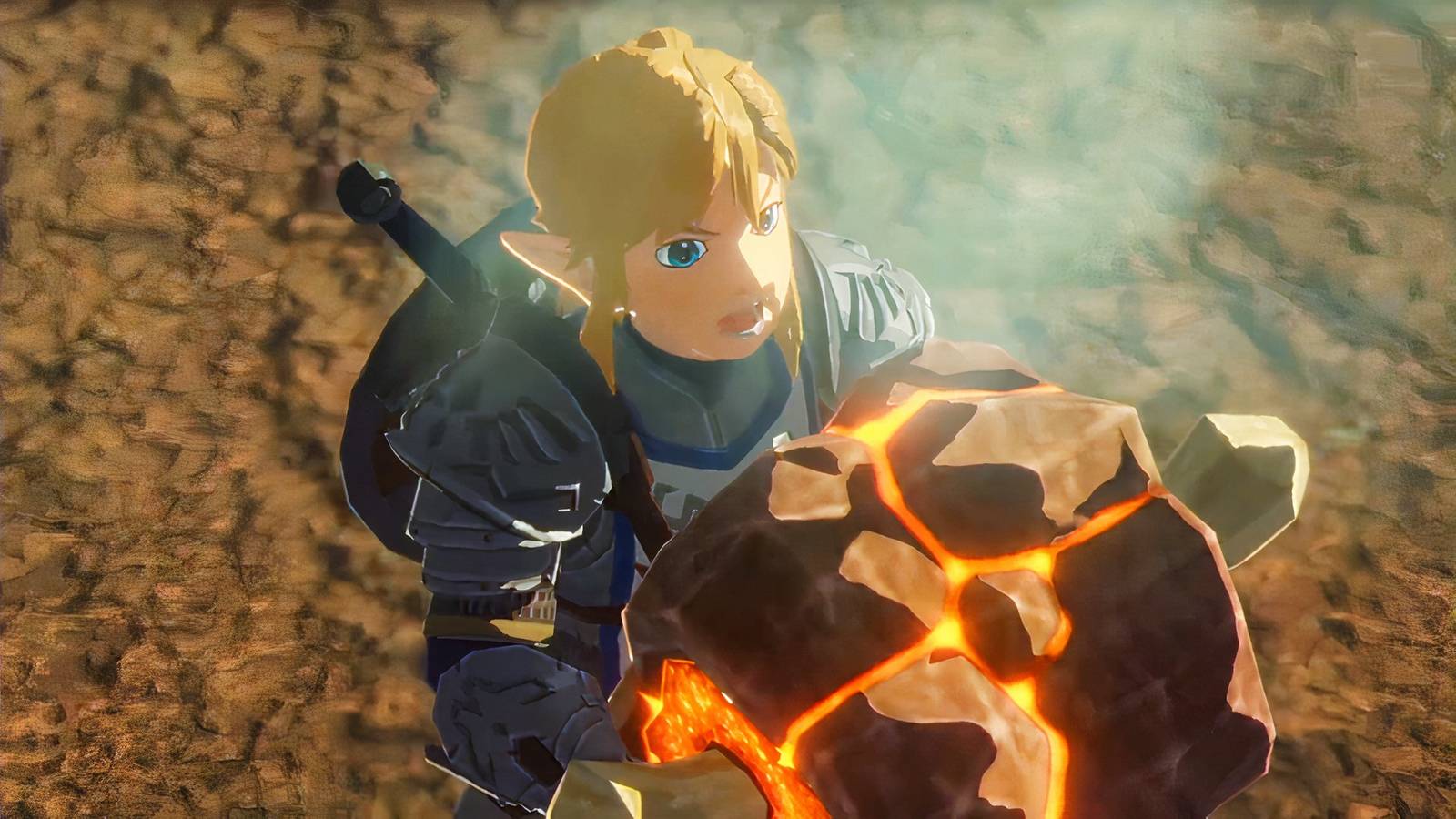


After an early-game battle in Hyrule Warriors: Age of Calamity, the gregarious Goron Daruk offers the hero Link a massive hunk of Prime Rock Roast. “Why don’tcha dig in, little guy?” he says with a beaming smile. Link, expressionless, nods and grunts before tearing into the giant rock with his teeth. Zelda and Impa recoil with shock and horror. We’re not even allowed to see the “little guy” chowing down, but we hear the horrible gnashing of Hylian teeth on a rock dripping with lava.
I still find this scene hilarious, as do many Zelda fans, but I also hate it so very much. It’s funny for all the wrong reasons, a rare moment when the series pokes fun at itself for its single most stubborn gameplay convention. Link is literally mute here, and the joke only works because he’s treated like he’s really, really dumb. The problem isn’t just his lack of dialogue, either. It’s that he doesn’t have a voice or much of a personality.
Look, I get it. This was intentional when series creator Shigeru Miyamoto created The Legend of Zelda nearly 40 years ago. Link wasn’t given any dialogue to maintain the illusion that he was a blank slate who could function as a player surrogate. Since Link is devoid of a personality, it’s that much easier for the player to project themselves onto him. That helped with immersion four decades ago. Today, that same design philosophy often has the opposite effect. We live in an era when Zelda herself and real-life toddlers have their own tablet computers. The world has changed. Zelda games have changed. Why can’t Link?
When I first played The Legend of Zelda: A Link to the Past and Ocarina of Time as a kid with my grandma, obviously I renamed the protagonist “Corey.” Because I didn’t just want to play the hero. I wanted to be the hero. That’s the inherent power fantasy of virtually every video game. But particularly since Breath of the Wild, the willful suspension of disbelief this requires has become increasingly difficult to maintain. In fact, I think it might be obsolete.
This flaw is most glaring in games like Age of Calamity that lean heavily on cinematic cutscenes where characters like Daruk, Zelda, and Impa drip with charisma. The voice acting brings so much energy to the storytelling. But every time they turn to Link with a random question, comment, or joke, he just stares blankly off into space. It’s a buzzkill that totally breaks the immersion. Patricia Summersett does a phenomenal job as the voice of Zelda in Age of Calamity, Breath of the Wild, and Tears of the Kingdom. Her incredible work makes it all the more frustrating and obvious when her scene partner is a silent elf boy who only makes a noise when he swings his sword.
Series production head Eiji Aonuma explained his philosophy behind Link’s silence in a 2010 interview with Nintendo Power. “Personally, I don’t want to have Link speak in the game,” he said. “We haven’t had him talk at all up to this point. It’s part of the series’ history. It would just, to me, break the image of Link to have him speak.” At what point does this design choice begin to feel like a vestigial organ decaying inside this body of work? Is this a case of a beloved storyteller refusing to kill one of his darlings?

In a 2017 interview with YouTuber ZackScottGames, Aonuma doubled down yet again. “The Link from Breath of the Wild doesn’t have much of a character, and that was done intentionally,” he said. “We wanted the players to be able to relate to Link and to play as themselves. You can probably see that there’s not much expression on Link’s face.” As cinematic storytelling has improved in the Zelda games, Link has conversely been intentionally designed to be even less expressive.
Then in a 2024 interview with Famitsu about the Zelda-led Echoes of Wisdom, Aonuma and game director Satoshi Terada confirmed that Link almost had a voice in that game. “No matter what I made him say, it just didn’t feel right,” Terada said. “Link would never speak like that,” Aonuma added. “It felt really strange. Nobody knew what Link would say. That’s only natural, because he’s never spoken before.” Instead, the game explains that Link lost his voice after falling into a magical rift as a child. [Insert eyeroll emoji here.]
Most of the moment-to-moment gameplay in Breath of the Wild and its direct sequel Tears of the Kingdom is superb. I’m not here to debate the merits or overall quality of these games. They’re genre-defining open-world experiences. Though they do feature fully voiced cutscenes to tell parts of the story, neither game relies on them all that much. What’s more, these scenes are often scripted in such a way that Link doesn’t need to speak — characters talk around him and almost never directly to him. It’s implied in some of the dialogue that he can talk, but chooses not to.
If you read Zelda’s Diary in Breath of the Wild, this is outright confirmed. Link does actually make words with his mouth that people can hear and comprehend with their brains. “When I finally got around to asking why he’s so quiet all the time, I could tell it was difficult for him to say,” her diary reads. “But he did. With so much at stake, and so many eyes upon him, he feels it necessary to stay strong and to silently bear any burden.” There’s a canonical reason why Link doesn’t talk, but it doesn’t fix any of the actual problems.

In Tears of the Kingdom’s true ending [spoilers follow], the Sages assemble with Link and Zelda and make a solemn oath to support the princess and protect the land of Hyrule. It’s an epic moment for a beloved series that comes after more than 100 hours of soaring through the skies, solving puzzles, and defeating powerful enemies. While the fish guy, bird kid, rocky man, and Gerudo Sage make their heartfelt pledge, our hero Link simply stares silently off into space — probably daydreaming about eating more rocks!
Link will probably never find his voice in a Zelda game. Silence has become one of Nintendo’s most stubborn traditions, a design choice preserved not because it still works, but because it always has. But a live-action Legend of Zelda movie is now officially on the way, and when Link finally speaks on the big screen, the illusion will shatter for good. Once that happens, it’ll be hard to keep pretending that the hero of Hyrule doesn’t have anything to say.

![7th Feb: The Time Machine (2002), 1hr 35m [PG-13] (6/10)](https://occ-0-6631-616.1.nflxso.net/dnm/api/v6/Qs00mKCpRvrkl3HZAN5KwEL1kpE/AAAABWEpzgB_2tXvjjOoZAJflQu63KWNvs4jsphvaxzswUOIywfRzSQspvmODiwXdOhNOjl_h-sKTuvpgLMr4WteKq6CqupcBOUgokYfVVILuVLfNc6vL_NdgnrMD3vpjIEnIDtORzzH44JJv26_w6ZsNF1mstKjVdyuuC8_5LNJ_9m8YQ.jpg?r=f32 "7th Feb: The Time Machine (2002), 1hr 35m [PG-13] (6/10)")