







The Off-Broadway Theatre Review: Diane Paulus reshapes a classic into a living, breathing environment
By Ross
The first step through the doors on West 57th Street felt like stepping into a secret I had been waiting months to be invited into. The familiar chords and shadows of The Phantom of the Opera did not greet me from a proscenium stage, but from within arm’s reach, as Masquerade pulls us directly into the belly of the Paris Opera House and asks us to join them for a dance and a drink.
This immersive reimagining, directed by Diane Paulus (Broadway’s Jagged Little Pill), transforms that beloved Andrew Lloyd Webber musical into a living, breathing environmental experience that completely surrounds its audience with all the gilded darkness we come to expect from the story. Guiding us through a maze of rooms, staircases, and hidden corridors, we become something more than just mere observers. We are invited guests, privy to an opening night and a masquerade party. But not only that, we are also led into the world of a creepy carnival, and silent witnesses to personal interactions tucked quickly and quietly into dark corners as the story unfolds in overlapping fragments. The production skillfully moves across multiple floors and more than thirty distinct scenes, shifting from grand hallways to intimate dressing rooms with a fluidity that feels both thrilling and disorienting. It is easy to get lost, and that sense of detachment from reality becomes part of the experience itself.

The structure asks for a certain level of familiarity with the original story. Without it, the tale can feel somewhat elusive, moving at a speed that blurs the narrative. Yet for those, like myself, who carry a history with the material, the experience draws us deeper into something unexpectedly personal and vital. Having first encountered the musical in its original West End run, I found that connection rushing back in surprising ways. The score, still lush and emotionally immediate, resonates differently when sung just inches away. Voices rise not from an orchestra pit but from beside you, behind you, sometimes directly in front of you, creating a sonic intimacy that feels almost startling in its clarity.
That closeness extends beyond sound. Performers move through the same spaces as the audience, occasionally reaching out, locking eyes, or even grabbing at us to guide us along. During the opening masquerade sequence, the invitation to physically engage dissolves the boundary between performer and spectator. It is a carefully orchestrated illusion of spontaneity, supported by an impressive logistical design that allows six separate audience groups to move through the building simultaneously without ever feeling rushed or neglected. Even as my companion and I began to echo our guide’s urgent “quickly” prompt from room to room, the experience never lost its sense of sharp control or intention.

Across the six performance time slots, the Phantom is played by a number of talented performers: Jeff Kready, Telly Leung, Hugh Panaro, Kyle Scatliffe, Clay Singer, and Nik Walker, while Christine and Meg are embodied by a rotating group of gifted actors that includes Haile Ferrier, Eryn LeCroy, Francesca Mehrotra, Riley Noland, Kaley Ann Voorhees, and Anna Zavelson. The production extends this shared structure across the company, with Raoul portrayed at various points by Paul Adam Schaefer, Nicholas Edwards, and Francisco Javier González, and Madame Giry performed by Satomi Hofmann, Maree Johnson, Tia Karaplis, and Betsy Morgan. Supporting roles are similarly distributed, with Buquet played by Jacob Lacopo and Andrew Wojtal, Carlotta by Satomi Hofmann and Betsy Morgan, and André, Barker, Firmin, and Piangi brought to life by Raymond J. Lee, Chris Ryan, Jeremy Stolle, and Phumzile Sojola. The role of Boy in the Cage is shared by Maxfield Haynes, Kody Jauron, and Kevin Zambrano.
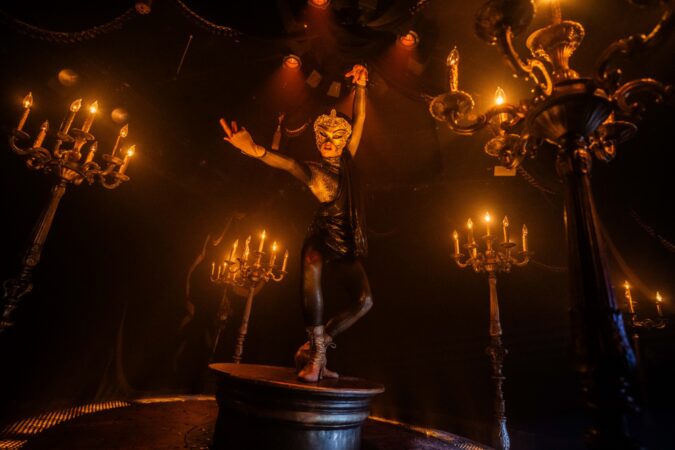
The production adds a layer of focus to the Phantom’s backstory with another layer of intrigue and caged understanding. The newly introduced carnival sequence offers a vivid glimpse into his origins, unfolding as a sideshow of astonishing physical feats. Fire eaters and performers drive nails through their acts with a level of skill that commands attention, grounding the Phantom’s mythology in something visceral and unsettling. This addition reframes his presence within the story, giving weight to his isolation and shaping the emotional stakes in a way that feels immediate within this immersive context.
Visually, the world is richly realized, though not without inconsistency. Certain spaces, such as Carlotta’s dressing room, are filled with detail and atmosphere, while some transitional hallways feel comparatively sparse. These shifts are noticeable, though they rarely break the overall spell. The design is supported by a strict dress code of black, white, or silver, a choice that proves surprisingly effective. The audience blends into the environment, becoming part of the visual language rather than a distraction. Masks further heighten this effect, creating a shared anonymity that allows the focus to remain on the unfolding drama.
The physical demands of the production are significant, with frequent movement between floors via stairs and escalators. Yet the experience remains accessible, with staff ensuring that all patrons can navigate the space comfortably. This attention to detail extends to every aspect of the evening, from the coordinated movement of audiences to the seamless integration of performance and environment.

As an adaptation, Masquerade succeeds in translating the grandeur of a large-scale musical into something intimate and immediate. It captures the essence of the original while reshaping it into a format that prioritizes proximity and presence. The story may occasionally feel fragmented, and certain transitions may lack the same level of detail, but the overall impact remains undeniable.
Emerging back onto West 57th Street, the memory that stayed with me was not just the spectacle or the scale, but the sensation of having been inside the story itself. The music, the movement, and the fleeting moments of connection lingered in a way that felt deeply tied to that first step through the door. What began as an invitation to observe became an experience of participation, one where the line between audience and world dissolved, and the familiar tale revealed itself from entirely new angles.


