







![26th Aug: The Eighth Day (2010), 6 Episodes [TV-PG] (6/10)](https://occ-0-7324-92.1.nflxso.net/dnm/api/v6/0Qzqdxw-HG1AiOKLWWPsFOUDA2E/AAAABZZrU9vnfwM_Tg8aXtthR7Xc1Vn0JFaW7V9XSsvcOxV0pOjh069gIIplvQefQBZUf1yN2cYz5zTsZzTu8SGcJTeefHn-3c1EQzgBaSD9RRUs11_iJnaynKCSz0Zwp57Srm_LbD8Fx7hQRyfAgzlPbl3uxhREBjRcvptU48AWwBvCEA.jpg?r=92a "26th Aug: The Eighth Day (2010), 6 Episodes [TV-PG] (6/10)")


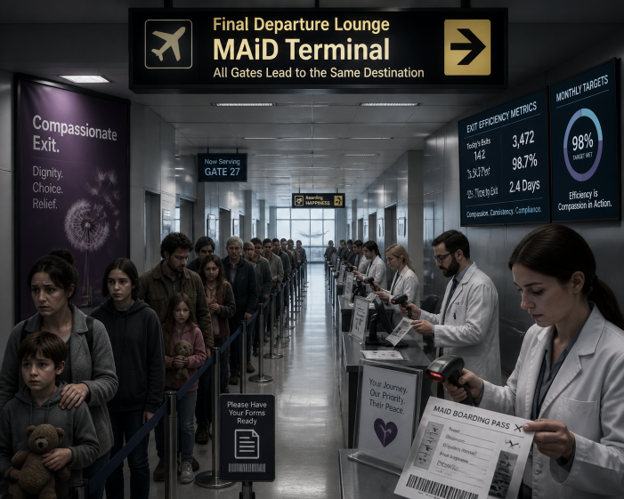
Prospective 2036 government-multi-stakeholder press release
“Today, Canada celebrates an important milestone – 20 years of compassionate care! Following broad consultation with ethicists, families, clinicians, and equity partners, Medical Assistance in Dying (MAiD) has been expanded to include mature minors experiencing profound existential distress from anticipated future life frictions, including projected housing insecurity, climate anxiety, and intergenerational economic burden.
Parental consent remains encouraged, but is not required where capacity is demonstrated. This extension upholds autonomy, reduces system strain, optimizes budget responsibility, and advances our national commitment to dignity at every stage and age of life. As always, be comforted that our safeguards are robust.”
The original impulse behind MAiD, Sue Rodriguez’s dignified plea for relief from terminal physical agony, was bounded and human. Two decades on, the question is no longer how much the program has expanded, but where the rational logic of therapeutic compassion ultimately stops.
Babies cannot consent. Children cannot legally commit suicide. Marginalized are disempowered.
Yet the same institutional momentum that reframed adult autonomy as a solution to suffering is pressing at these boundaries. Quebec physicians have publicly stated that MAiD may be appropriate for severely ill infants from birth to one year with untreatable conditions and unrelievable pain. Parliamentary committees and advocacy organizations have discussed or recommended mature minor eligibility,” to which the therapeutic state, wrapped in the language of care and dignity and equally pregnable to those skilled at wielding that language, finds it increasingly difficult to say “this far, but no further.”
This is not slippery-slope rhetoric. It is the predictable advance of a system that defines suffering subjectively, prioritizes procedural autonomy, and operates under resource pressure. Once the state and medical system accept the role of ending life as a compassionate service, the categories of who qualifies expand cultural tolerances and accrue institutional incentives (https:///financial-reckonings-in-assisted-death-incentives-savings-and-single-payer-pressure/).
International comparators reveal pattern
It is instructive to explore what trailblazers experienced for guidance.
Belgium and the Netherlands, often cited as models, show what Canada’s trajectory foreshadows. Belgium legalized euthanasia for minors of any age in 2014 (with parental consent and capacity assessment). The Netherlands permits it from age 12, with proposals to lower the threshold further for younger children with unbearable suffering. Both countries have expanded euthanasia eligibility debates beyond terminal illness, including psychiatric suffering and minors. In the Netherlands, dozens of cases involving mental illness in those under 30 have been reported in recent years. These jurisdictions began with terminal illness and strict safeguards, but now navigate requests rooted in psychological distress, autism, depression, and “completed life” feelings.
Deceased organ and tissue donation after medical assistance in dying and other conscious and competent donors: guidance for policy
Canada’s delays on mental illness-only MAiD (pushed to 2027) demonstrates that expansionary pressure exists around mental illness eligibility. The logic is consistent: if a competent adult can choose death to escape suffering, why deny a “mature” 16-year-old facing a lifetime of projected hardship? Why force parents or the state to bear the cost of a child’s severe disability when a “dignified” exit is available? The line between severe physiological defects and what might be categorized as “future life frictions” (poverty, housing, social isolation) becomes one of degree. Once subjective distress and autonomy are the guiding stars, the lines are blurred.
Precautionary principles, prudent safeguarding, and precedent constraint are supplanted by permissiveness. Wedges have edges by which they purchase entry, blow by blow.
I want to enlist bioethics here and recommend an excellent, accessible article from January 2022 by Lee Hunt, the concept of which I have applied in the following table.[1]
The bioethical principles invoked during COVID debates – autonomy, nonmaleficence, beneficence, and justice – remain the proper framework. Applied consistently, however, they point toward caution rather than perpetual expansion. To navigate along the continuum:
- The principles are not self-executing.
- They require clear, defensible thresholds (terminal physical illness + competent adult + robust safeguards + excellent palliative alternatives first).
- Expansionist interpretations risk inverting the principles (harm becomes “relief”, justice becomes efficiency).
- Constrained application preserves their integrity.
COVID is seen by many as a dress rehearsal. The state asserted sweeping authority over bodies and choices in the name of collective care. Dissent was pathologized, the non-compliant were stigmatized, even deemed dangerous, with families, friends, and communities still bearing those scars. Societal frustration and stigma opened up state and institutional power to impose.
With MAiD, the impulse turns inward: individual suffering is managed through elimination rather than sustained investment in living supports. The nurturing dialect – “autonomy”, “dignity”, “reducing burden”, – veils this deeper shift.
As the 2022 analysis of COVID-era pressures warned, frustration with system strain is no justification for setting aside fundamental safeguards. The same principles that protected the unvaccinated from discriminatory denial of care should protect vulnerable patients from normalized exit ramps.
Big Mother, however, does not command; it offers. It does not directly punish refusal so much as frame the continuation of life to feel like unnecessary hardship, and death a dignified alternative.
The Huxley echo and the recycling question
Aldous Huxley’s Brave New World portrayed a society in which the dead were efficiently recycled – phosphorus from crematoria returned to the soil to feed plants. Today’s conversations about organ donation following MAiD raise a troubling, parallel ethical terrain. Protocols already exist.
Donation after MAiD has risen significantly in some provinces, including Quebec, where it accounted for 14% of deceased organ donations in 2022. While framed as voluntary altruism, the layering of donation discussions on to end-of-life planning creates subtle incentives. Robert Cialdini’s Influence is recommended reading; I’d wager that end-of-life planners know its principles.
When living is expensive and dying efficient, the therapeutic state quietly benefits from the transaction. They will, of course, speak nothing of it.
The question is not conspiracy but direction. Does the system that struggles to provide housing, mental health care, and palliative excellence find it easier to harvest organs from those it helps exit? Do the economics, as they say, compound? Might hedge funds see an investable, captive market?
Unguarded, these become structural – not performative and not speculative.
Once structural, they morph into managed abandonment dressed as compassion. The same institutions that expand MAiD while palliative care remains inadequate are optimizing the human lifecycle for fiscal and logistical efficiency.
There is little confidence that provincial or federal governments have the interest, much less the capacity and resolve, to back-fill these deficiencies. A better, easier option is a new budget calculus, aided by actuarial acumen and contracted consultancies, to inform new policies to provide relief: emotional, social, ethical, practical, fiscal.
The Nazi comparison is invoked too readily and often dishonestly – today’s system uses consent language and operates in a liberal democracy. But the caution remains valid: efficiency in killing, once normalized and incentivized, develops its own momentum. Investments draw in investments. Resources get resourced. Cost-benefit is calculated. Boundaries get tested, defences dismantled, and what was once unimaginable becomes routinized. Eventually banal.
Historical regimes began with restrictions on certain segments of society, entered as “mercy” for the severely disabled, less desirable, and unproductive – and ended in industrialized horror.
Efficiency arguments that once justified COVID restrictions now quietly align with MAiD scaling and organ-recovery protocols. The temptation to optimize the human lifecycle must be checked by the same ethical guardrails urged during the pandemic.
These principles do not forbid all MAiD; they demand narrow, exceptional application. The continuum from terminal physical suffering to “future life frictions” or pediatric cases reveals how easily compassion bureaucratized becomes computational abandonment.
Canada is not there. The guardrails of consent and adult eligibility still matter. The trajectory, however, warrants unflinching scrutiny.
Where the line must be drawn
True compassion distinguishes between relieving irremediable terminal suffering in competent adults and positioning death as a solution to poverty, disability, mental illness, or projected future hardship. It invests first in palliative excellence, housing, and community supports. It refuses to treat children – who cannot fully consent – as candidates for state-facilitated death, regardless of parental pressure or institutional “capacity” assessment.
We are seeing factional, parental pressure (and concordant anti-parental splintering) in other edges of society, even cases where parents are pitted against one another on the surgical reassignments of their children. Kramer vs Kramer, for those who remember, is child’s play.
The therapeutic state’s gentle hand offers release wrapped in kindness. A wiser course chooses the harder, more human path: excellence in accompaniment, robust safeguards, and honest reckoning with incentives. Where MAiD ends is not a question of compassion alone, but of what kind of society we resolve to become.
Might this press release, with a different tenor, better mark the 20-year anniversary of MAiD:
“After careful review and broad consultation, Canada is pausing further expansion of Medical Assistance in Dying. While respecting adult autonomy in cases of irremediable terminal physical illness, we reaffirm that children cannot provide meaningful consent, mental illness requires protection rather than acceleration, and systemic failure in housing, palliative care, and social supports must be addressed directly. Dignity demands we accompany people through suffering where possible, not manage them out of existence when care grows inconvenient. This pause prioritizes investments in living with dignity over efficiencies in dying.”
[1] Table adapted from Lee Hunt, Mounting COVID frustration is no reason to abandon fundamental principles, 2022.
Richard LeBlanc writes about new institutional language, new meanings, and consequent actions arising from care-ceral institutions at againstcomfort.substack.com, essays that build toward a book titled Big Mother.
(Richard LeBlanc – BIG Media Ltd.)