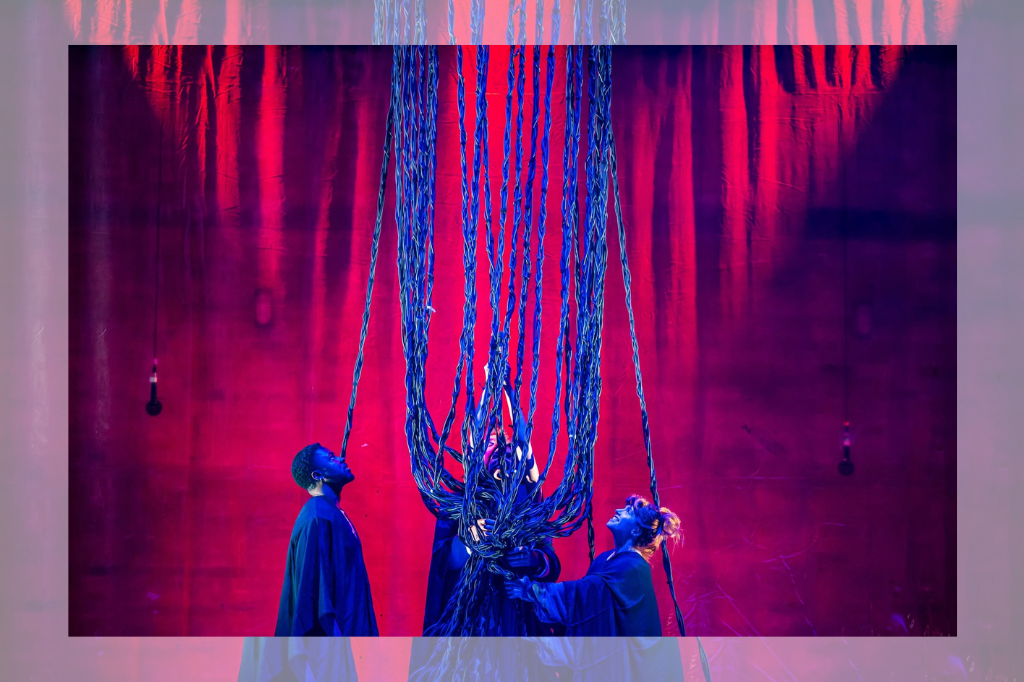






Marta Górnicka’s choral theatre has been wowing Europe for the last 15 years. At the age of 51, she is already a holder of major honorary professorships and lifetime achievement awards – and it takes only one of her works to see exactly why.
It sounds simple – Górnicka is often credited with having rediscovered the power of the ancient Greek chorus. Choral speech or singing can indeed seem powerful on stage even in the hands of a less skilled director, but Górnicka’s reinvention corrects one important centuries-long misconception: that just because it acts in unison a chorus is necessarily a homogenous entity.
Built centrally into Górnicka’s conception is diversity and difference, even when – as it often is – her chorus consists only of women. This is a deliberately intergenerational gathering of individuals embodying very varied physicalities and movement idioms. Integrating Hardt and Negri’s ideas about democracy in the 21st century, one exhibition of Górnicka’s works was even titled Multitude (in a potential echo of the duo’s 2004 classic) and another overtly explored what the German constitution means today and who it is for. In 2014, she even brought together Arab and Israeli women, soldiers and children in a choral reinterpretation of Brecht’s Mother Courage.
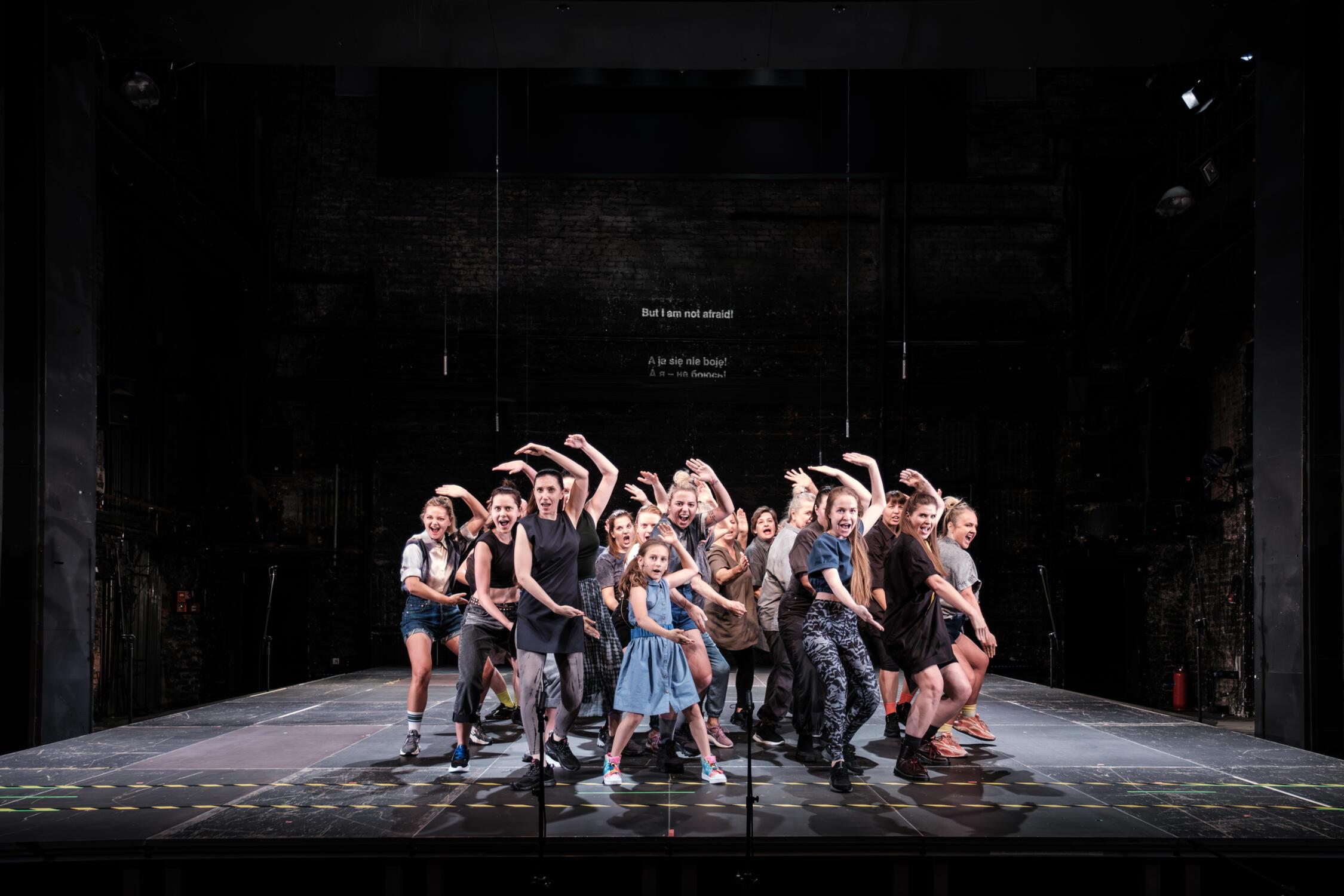
Although politically and philosophically considered at its initiation, the work however lands with the audience as primarily an emotional, even visceral experience. Just an hour of this show made in 2023 with the women refugees from the war in Ukraine, leaves the audience completely speechless, and often quite shaken. The day I watched it as part of Ricksteatern’s tour at Gothenburg, the entire auditorium was up on its feet at the end, and then this particular multitude receded quietly in thoughtful silence.
One might wonder what makes it theatre rather than just a concert or a community project? Mothers: A Song for Wartime is in fact carefully staged in a manner revealing a fine dramaturgical and scenographic sensibility. The opening image has the choir in a freeze frame surrounded by strategically placed microphones and lanterns. Górnicka herself stands in a spotlight in the middle of the auditorium from where she conducts throughout in a way that is mesmerizing to watch. The piece is made in collaboration with a choreographer Evelin Facchini whose arrangements are sometimes designed to provide a beat (of stomping feet for example) to accompany the singing. Movement-wise it is an extraordinarily dynamic piece especially given that it is billed as a choral performance.
Although the libretto is devised together with the ensemble members, Górnicka’s compositional prowess means that she is able to arrange the score in an inherently dialogic way rather than the more common line up of discrete numbers one might find in a concert performance. Here the individual segments overlap, bleed into each other, resonate throughout, disappear and return. Authentic Slavonic folklore meets DIY punk. Notably there is a section in which each individual chorus member tells a short story about themselves and their individual journey, and because the piece uses subtitles for translation – a conscious call and response is set up at times between the spoken or sung content on the one hand and the written text on the other. In short the work is a virtuosic feat of dramaturgy, where dramaturgy might be considered a compositional practice in an expanded postdramatic, 21st century way.
On my way out from the theatre in a spellbound stupor of my own, all I could do was send a spontaneous WhatsApp exclamation to Kasia Lech, a reliably empathetic Polish friend in such a situation (and incidentally this publication’s executive director). What was this theatre effect of having the air knocked out of you? – I wondered. Sierz’s ‘in-yer-face’ – coined for the likes of Sarah Kane’s outrage at the violence of war – comes close, but no, this one was more like ‘in-yer-heart’, we agreed – ‘in-yer-chest’ more precisely perhaps.
Lose no chance to check for yourself.
This post was written by the author in their personal capacity.The opinions expressed in this article are the author’s own and do not reflect the view of The Theatre Times, their staff or collaborators.
This post was written by Duška Radosavljević.
The views expressed here belong to the author and do not necessarily reflect our views and opinions.