







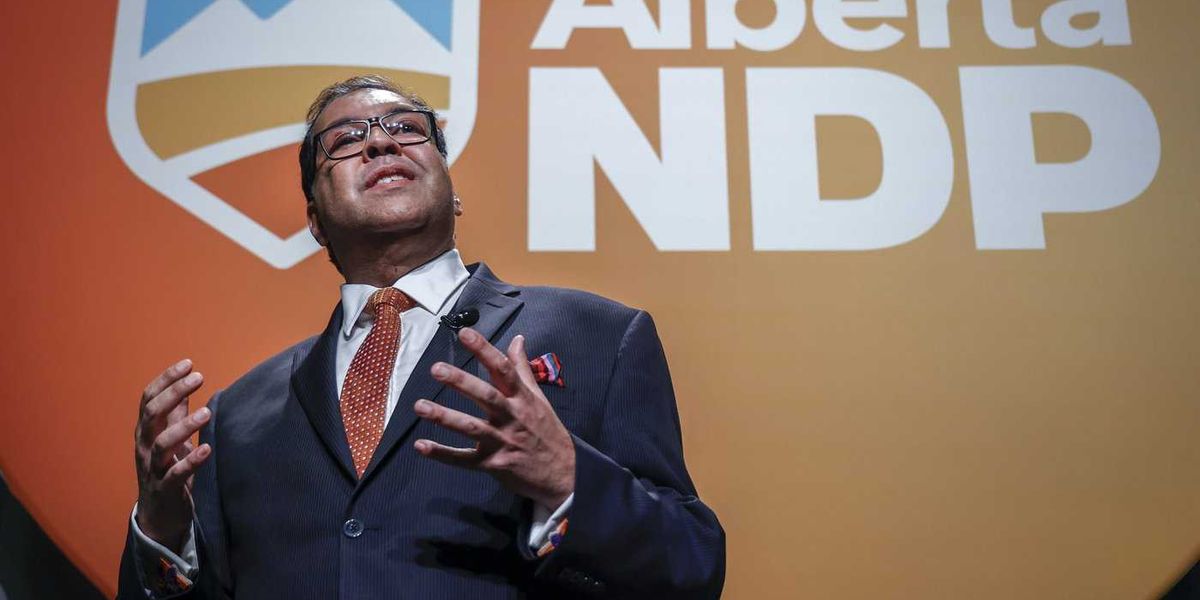
Alberta’s Opposition NDP leader says Premier Danielle Smith’s plan for a new pipeline has his support, but he’s calling on her to be honest about how much taxpayers could be on the hook for it.
Naheed Nenshi also says public financing for the pipeline shouldn’t be a deal-breaker.
“There sometimes is space for public dollars, and the big pipelines that have been built over many years in Canada certainly had public participation in different ways,” Nenshi said in an interview Friday.
“What we really need is transparency and honesty from the premier and from the (United Conservative) government on precisely what they’re putting in, and if they’re doing it for good economic reasons.”
Smith announced Thursday that her United Conservative Party government has submitted to Ottawa a finalized route with builders on board for a new bitumen pipeline to the British Columbia coast.
It stems from an energy accord she signed last year with Prime Minister Mark Carney, who walked back several federal environmental laws and, in the hours before the announcement with Smith, signed a deal with B.C. Premier David Eby that made a new pipeline more realistic.
Carney said a decision is to made by October on whether the project gets a national interest designation for fast-tracking through federal permitting processes.
Smith’s pipeline would run from Bruderheim, Alta., northeast of Edmonton, to a marine terminal in Delta on the southern B.C. coast. It would largely follow the path of the existing Trans Mountain pipeline and deliver more than one million barrels per day to be shipped to Asian markets.
The private-sector stake in Smith’s project — held by Pembina Pipeline — is currently pegged at 10 per cent, but the premier said things could change as the project progresses and Indigenous groups sign on.
The remaining interest is shared by Alberta and Trans Mountain Corp., a federal Crown corporation.
Alberta’s submission package says the estimated cost is between $35.2 billion and $43.7 billion, including contingency costs.
Smith said Thursday that exactly how much public financing will be put into the project remains to be negotiated, but she and Carney were quick to say profits would more than pay for construction costs.
“This is transformational wealth, an opportunity neither Canada nor Alberta can afford to leave unrealized,” she said.
Smith and Carney have said initial construction could begin in the fall of 2027 and be completed by 2033-2024.
The energy deal signed between Smith and Carney last year stipulated any new pipeline be privately financed, and Nenshi said he took Thursday’s announcement to mean that condition has been abandoned.
“This is not privately financed, it is publicly financed,” he said.
“But that said, if the business case pencils out, then that’s a good thing.”
Nenshi also compared it the last Trans Mountain expansion project, or TMX, which was finished in 2024 about six years after Ottawa bought the line and the infrastructure. The federal government stepped in to make sure the endeavour wasn’t abandoned after it faced significant public pushback.
The Trans Mountain pipeline’s capacity now sits at 890,000 barrels per day, though another expansion project in the works could boost it to nearly 1.2 million barrels per day.
Nenshi said it was a shame the public purse was opened for TMX, but the economic benefit has been worthwhile.
“I am a finance professor at heart, so if the math maths, then we’re happy to support that,” Nenshi said of the new pipeline.
Ronald Ewasiuk, the mayor of Bruderheim, said the town is cautiously optimistic about the project, pointing to a list of cancelled pipelines in the past.
“When they break ground, then we will be ecstatic and ready for the challenge,” Ewasiuk said Friday.
He said the town, which sits about 60 kilometres northeast of Edmonton, has seen little growth in the past 20 years, but it is ready to welcome workers and families should the pipeline become a reality.
Until it is, Ewasiuk said Bruderheim will be doing business as usual.
“The town is not gonna live or die with this project.”
Nenshi also said he found the lack of Indigenous partners backing the proposal so far to be a challenge, but also not a surprise.
Smith and her high-ranking staffers have been in a war of words with First Nations chiefs for more than a year over talk of Alberta separating from Canada.
The conflict became more tense in recent weeks as Alberta’s government fights in court over the duty to consult for a potential referendum on the topic, and a petition calling for a separation vote that was quashed by a judge.
Smith has called a provincewide vote in October that will see Albertans decide whether they want to remain in Canada or hold a second, binding referendum on quitting the country.
First Nations leaders have said Smith’s behaviour amounts to treason, leading one of the premier’s senior advisers to say the chiefs should focus on addressing poverty in their communities. Smith responded by telling the chiefs to “check themselves.”
“The relationship’s got to be pretty broken for you to say something like that,” Nenshi said Friday.
“When we have a new government, that relationship will be a top priority.”
This report by The Canadian Press was first published July 3, 2026.
By Jack Farrell | Copyright 2026, The Canadian Press. All rights reserved.