

![22nd Sep: Dil Chahta Hai (2001), 3hr 4m [TV-14] – Streaming Again (7.05/10)](https://occ-0-1508-92.1.nflxso.net/dnm/api/v6/0Qzqdxw-HG1AiOKLWWPsFOUDA2E/AAAABcjKq66srRNoxTisdrWjIumvZYL1lzn3DOTntJ_DLAmgSLkb_QFDxVUbeZFm60ldeP59vpwWlo47XYukqb5qNdm2v80JbJNexlDD.jpg?r=adc "22nd Sep: Dil Chahta Hai (2001), 3hr 4m [TV-14] – Streaming Again (7.05/10)")


Another thing you’re so good at conveying is the perceived importance of intention. The whole movie, Louis intends to be good, right? There’s this constant guilt and urge to make penance. But, ultimately, he is his own sort of evil. Lestat is more honest about it, I suppose. I think of another film you made with The Geffen Film Company a few years later: The Butcher Boy.
I grew up in Ireland under the Catholic Church, which is the biggest joke known to humankind, isn’t it? You’re stuck with those realities. I think Anne Rice was, too. She’s from some kind of weird Irish Catholic background. That’s what I responded to in the novel. There was a horrible irony, in the fact that Louis is seduced and possessed for his beauty. Once he’s been given this gift, he’s running his entire life from it. It’s like somebody running from their sexuality. There were all these undercurrents that I thought were interesting and that I wanted to deal with. Let them bubble underneath this vampire story.
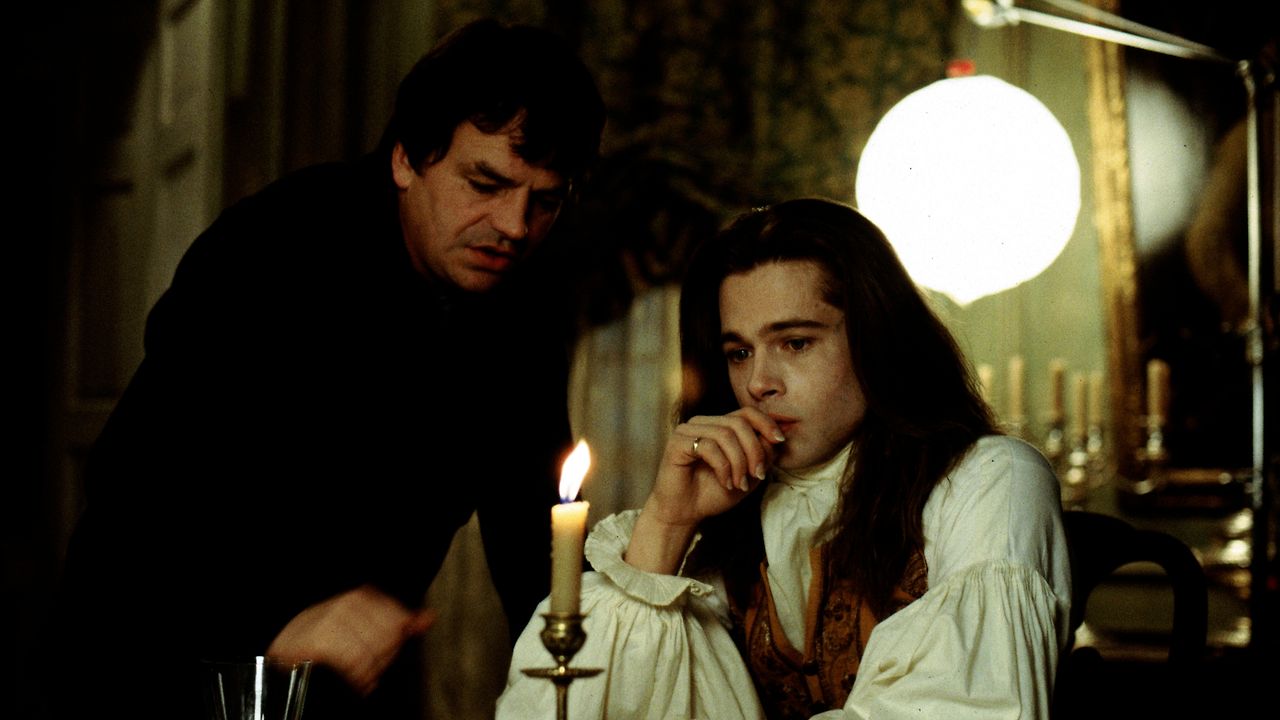
There are some great behind-the-scenes features included in the new release. One element discussed is how you filmed the vast majority of Interview with the Vampire at night. What an undertaking that must have been, 32 years ago, to just design all that light with [cinematographer] Philippe Rousselot.
It was absolutely brilliant. The reason horror movies and fantasy movies are so satisfying is because they’re not to do with the real world. You have to create everything within them. Look at Francis Ford Coppola’s Bram Stoker’s Dracula—what was wonderful was that he returned to these old filmmaking techniques, matte painting and all that sort of stuff. It was beautiful. Everything in that movie was as Francis designed it. If you make a movie like Interview with the Vampire, everything in it can be like the director intended. If the director is strong enough to do that and if you’re given the resources and partners to realize it that way. I had Philippe Rousselot, who I had done two movies with before, and I had [production designer] Dante Ferretti.
We worked out what the basic visual challenge of the entire movie was: to turn 18th-century New Orleans, 20th-century San Francisco, 18th-century Paris into an enormous tomb, an enormous mausoleum. To make the equivalent of a historical vampire epic, which, to my mind, had not been done before. That’s a great challenge. When you’re shooting at night, it’s great. You’re never worried about the clouds coming over the sun, or the light to be right, because the light is actually designed by you. It was a very tiring, exhausting thing to do. For the actors, it was hard. It was hard for Brad [Pitt]. I’m sure it was hard for Tom [Cruise], too, and for little Kirsten [Dunst] as well.
If you look at F. W. Murnau’s Nosferatu and Carl Dreyer’s Vampyr, they’re expressionist, poetic nightmares in a strange way. But then the entirety of Bela Lugosi and Hammer Horror turned the whole vampire into a joke, really. It was great to restore it to something like its origins, in a way. And that’s what Francis did. He was brave enough to add all this huge opulence to the Carpathian Mountains and the characters. I had this different, beautiful book, which was even richer than Bram Stoker’s Dracula novel, and it was more challenging and more interesting in many ways. In a strange way, it was more like: What if this was real? What if you’re given the gift of eternal life? Would you be able to stand this? Would you be able to get through it? Would you kill yourself? You can’t kill yourself, you know? It was a great conundrum that the movie could explore.