
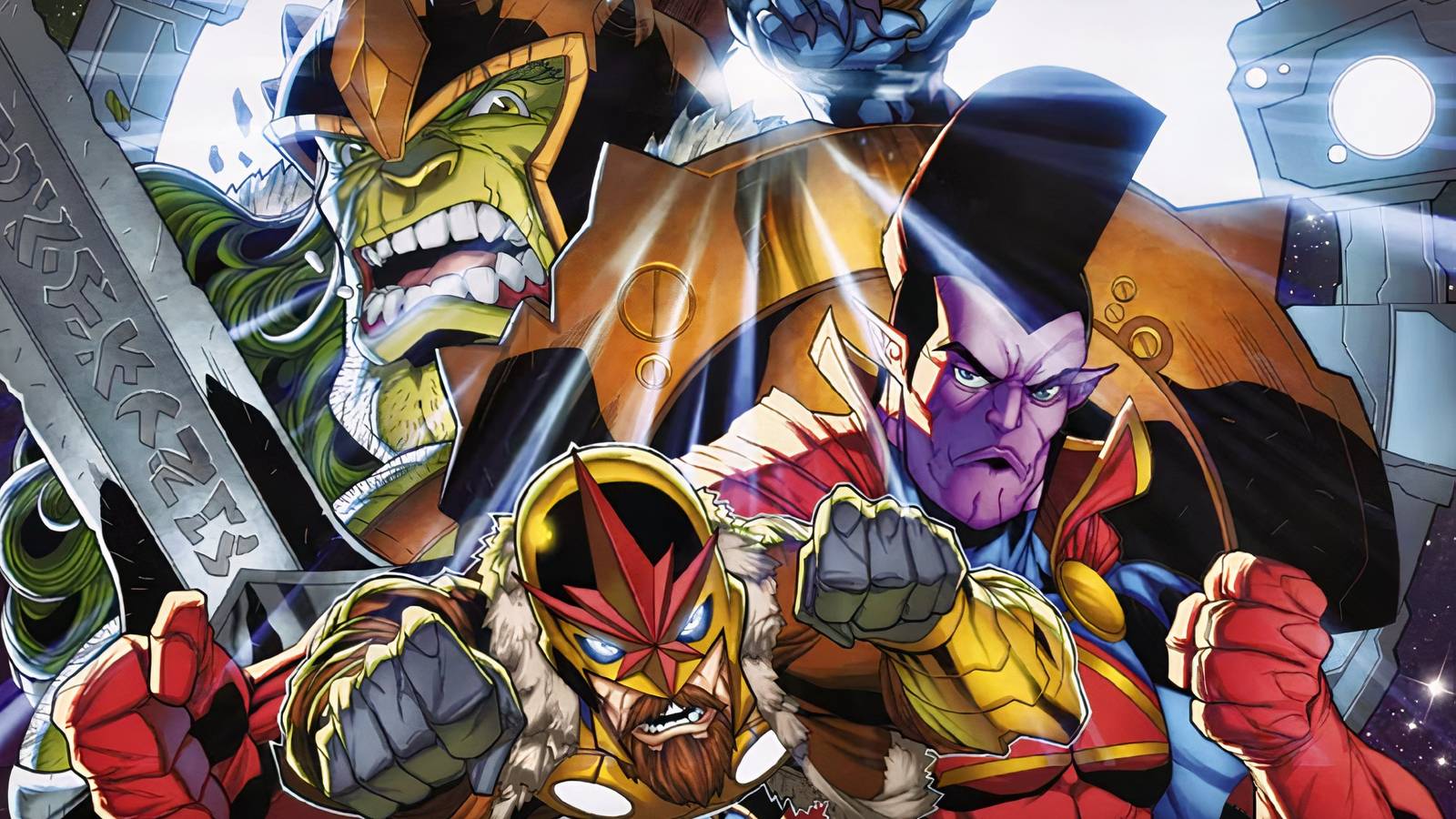





It’s a rough life on the eternal midcard. In every big shared fictional universe, there’s always someone whose “job,” so to speak, is to get merked in order to establish a new threat’s danger level. Star Trek fans, the architects of fandom, have successfully branded this as the “Worf effect,” but you can point to dozens of other characters and organizations who primarily exist to suffer.
There are a lot of go-to Worfs in the Marvel Universe. Whether it’s Wolverine, SHIELD, the U.S. Agent, or even the Juggernaut, they’ve all been known to take a sudden dive to let the reader know that this villain is serious business. However, there’s one character who’s the MVP of LVPs, who can be relied upon to greet every new cosmic threat by staring up at it from the floor. That’s Gladiator, the king of Marvel’s jobbers.
(Naturally, we’re talking about the alien enforcer, not the part-time tailor who occasionally goes crazy and tries to cut Daredevil in half. Kallark, not Melvin Potter.)
Gladiator first appeared in Uncanny X-Men v1 #107 (1977) as the leader and most powerful member of the Imperial Guard, a team of alien superheroes that directly serves the emperor of the alien Sh’iar Empire. As with all the other Guardsmen, Gladiator is an unsubtle homage to a member of the Silver Age Legion of Super-Heroes. In his case, he’s Superboy with blue skin and a mohawk hairdo.
Gladiator is one of the last living Strontians, an alien race that has incredible strength and power, but it’s fueled directly by their self-confidence. If their resolve is ever shaken for as little as a second, a Strontian goes from a planet-level threat to a 98-pound weakling. They’re difficult to beat in a straight-up fight, but are uniquely vulnerable to tricks, short cons, and telepathic attacks.
On paper, Gladiator ought to be a big deal. He’s almost a one-for-one match with a particularly powerful version of Superman, which makes him one of the heaviest hitters anywhere in Marvel. If you need somebody to break worlds, fight space armadas, or reach lightspeed without a starship, Gladiator’s your guy.
However, he’s gone on a strange bounce pass through Marvel continuity, from antagonist to occasional ally to frequently mind-controlled stooge to sacrificial lamb. As a result, Gladiator has one of the worst lives in the Marvel Universe. For almost 50 years now, when Gladiator shows up, it’s usually to get beat down. Everyone from Thanos to Annihilus to Gambit to Cannonball has unceremoniously thrown Gladiator into the closest dumpster.


As of 2026, Gladiator has one more fat L on his record. One of the first things you see when you start Marvel Tōkon‘s story mode is Gladiator’s freshly-kicked ass, courtesy of the Champion of the Universe, at the end of a trail of pummeled Sh’iar soldiers and Imperial Guardsmen.
While Gladiator isn’t completely without victories, like beating up Colossus during the Dark Phoenix Saga or as a member of the cosmic team the Annihilators, a surprising number of characters have caved in Gladiator’s hairstyle. As part of the summer of Marvel Tōkon, here’s a look at some of Gladiator’s greatest hits, which is to say, hits he’s taken.
Gladiator vs. Reed and Sue Richards (Fantastic Four v1 #250, 1982)


This isn’t the first big loss Gladiator ever took, as he got KOed off-panel in his very first appearance, but this is arguably the start of his downhill slalom.
To be fair, Gladiator starts this story strong, as he initially wipes the floor with the Fantastic Four, going so far as to shake the entire Baxter Building off its foundation like he’s trying to get the last few chips out of the bag. It isn’t until the next issue that we discover Gladiator’s been deceived into attacking the team by the Skrulls, who at this point in Marvel history were almost always plug-and-play villains.
Finally, Reed figures out Gladiator’s weakness and exploits it with the help of Captain America, which sets Gladiator up for an easy KO by the Invisible Woman. C’est la vie.
Gladiator vs. Gambit (Uncanny X-Men v1 #277, 1991)


The story behind this fight is almost more interesting than the fight itself. At this point in Marvel Comics history, a young Jim Lee was one of a handful of new artists who were dominating the sales charts, alongside Todd McFarlane, Rob Liefeld, and Erik Larsen. As a result, Marvel’s editors gave those artists more and more leeway on deadlines and creative control.
The rumor about Lee’s run on X-Men is that by its end, Lee would turn in whatever art he felt like, leaving long-time writer Chris Claremont to hammer it into some form of narrative coherence after the fact. That’s easy to believe when you’re reading issues #275 through #277, which feature a weird team of X-Men suddenly kidnapped across the universe to unravel an alien conspiracy. It’s fun, but it feels like it’s got more than a few missing pages.
That might also explain why Gladiator, despite his established power level, gets absolutely destroyed in this short arc. First he and the entire Imperial Guard inexplicably lose to the X-Men and Starjammers despite having them vastly outgunned, and then Gambit suddenly KOs Gladiator in a single panel (above).
To be fair, this technically isn’t the real Gladiator. He, along with many other X-Men and Imperial Guardsmen, were replaced by technologically advanced Skrulls, as part of a nearly-successful plan to take over the Sh’iar Empire from within. This is also very early in Gambit’s history as a character, so this is more establishing Gambit’s power level than discrediting Gladiator’s. Even with those excuses, however, this is a particularly humiliating loss for Gladiator, as well as one of the stories that made Gambit a ’90s fan favorite.
Gladiator vs. Cannonball (Uncanny X-Men v1 #341, 1996)


Gladiator never simply enters a building when he could instead fly straight through a load-bearing wall. He’s ostensibly not trying to start a fight in this issue of X-Men, but he still announces his presence by demolishing a toy store in Midtown Manhattan. This kind of thing is a non-trivial part of why he gets beaten up so much.
At the height of the Christmas season, Gladiator comes to Earth in search of the X-Men, who he needs for yet another Sh’iar rescue mission. The first one he finds is Cannonball, the newest member of the team at the time, and it naturally turns into a fight because this is a comic book. The only reason Cannonball even survives the encounter is because he manages to absorb and redirect the kinetic energy from one of Gladiator’s punches, which isn’t something that he usually does. This stuns Gladiator for long enough to end the fight.
This is one of the more iconic stories from Joe Madureira’s star-making run on Uncanny X-Men. If your first thought on seeing these panels is how manga they are, that’s a big part of Madureira’s style. He went on from here to help make video games like Darksiders and Battle Chasers: Nightwar.
Gladiator vs. the Champion of the Universe (She-Hulk v1 #7, 2004)


On the planet Skardon, might makes right. By law, you can do anything you like on Skardon if you’ve got the strength and martial prowess to back it up. That made it an irresistible target for the Champion of the Universe, who used an Infinity Gem to make himself the planet’s dictator. In an attempt to dethrone him, Adam Warlock and Gamora brought a who’s-who of cosmic powerhouses to Skardon, but the Power Gem gave the Champion the, well, power to beat them all.
The Champion was eventually brought down by She-Hulk, who found a local legal technicality that forced the Champion to fight her without the Power Gem. Before that point, however, the Champion put several heavy hitters like Beta Ray Bill, the Silver Surfer, and of course, Gladiator into intensive care.
Gladiator vs. the Phoenix Five (Wolverine & The X-Men #13, 2012)


The Phoenix Force is one of the most infamous powers of cosmic destruction in Marvel. While it’s best-known in the comics for empowering superheroes like Jean Grey and Rachel Summers, the Phoenix and its hosts have also destroyed multiple inhabited worlds. Whenever it appears, the Sh’iar usually make a point to try and destroy it, and that means they send Gladiator.
The 2012 crossover Avengers vs. X-Men started as a simple team-on-team brawl and eventually took a turn where five members of the X-Men became hosts for the Phoenix Force at once. (Incidentally, this is the story behind Phoenix Cyclops, who’s been announced as the first DLC character for Marvel Tōkon.)
While the Sh’iar didn’t appear in the main AVX book, they made their presence known in one of the tie-ins. The Sh’iar, led by Gladiator, attacked Earth and the Phoenix in Wolverine & The X-Men #13, and the “Phoenix Five” proceeded to unceremoniously beat Gladiator into a coma. So it goes.
Gladiator vs. Iron Man (Avengers v5 #44, 2015)


In mainstream Marvel continuity, Gladiator usually just loses fights. While he’s been killed several times in alternate universes and non-canon stories, such as 2016’s Thanos: The Infinity Finale, he’s almost never actually dead in Universe 616. Still, this is a superhero universe, where death is surprisingly reversible, so “almost never” does mean it’s happened more than once. Welcome to Marvel, kid. Nobody here gets out alive.
Jonathan Hickman’s run on Avengers is largely about the threat posed by the Incursions, a series of collisions between alternate universes with Earth as their focal point. One of the only ways to stop an Incursion is to destroy one of the two Earths, which spares both universes and the other planet.
With one final Incursion on the way, the Sh’iar showed up in Earth space with a full fleet, intending to save the universe by destroying the planet. Instead, Iron Man pulled out his final weapon: Sol’s Hammer, which was designed to weaponize the sun. Its first shot was also its last, but that shot was enough to destroy most of the Sh’iar’s fleet — and Gladiator with it.
It’s probably useful here to note that Tony Stark, in any continuity, has never been a big believer in the “superheroes don’t kill” rule.
Gladiator was later quietly resurrected in the aftermath of Secret Wars (2015), along with the rest of Marvel’s multiverse, with no memory of the Incursions.
Gladiator has reappeared a handful of times in the last decade, but despite the new era of the multiverse, he’s still stuck in his old status quo of being extremely powerful, but extremely expendable. Since Secret Wars, he’s racked up losses against characters like Galactus, the X-Men, Annihilus… and “Throg,” or Frog Thor. (Long story.) Some things, at this point, may never change.

![16th Aug: Iryu Team Medical Dragon (2006), 11 Episodes [TV-MA] (7.1/10)](https://occ-0-7324-92.1.nflxso.net/dnm/api/v6/0Qzqdxw-HG1AiOKLWWPsFOUDA2E/AAAABclNQNMhCX6tXafC_0zV5pFUH7g89zUep66niXKBDzQxEh26P4R-sssqgNlJL6ufFl0-HKJe5SS5qiG3y3QO3wanrQ3ouMT4OXF8BH375NqSRFh3QPW4xiinTNNzX2JCcRYQHdJb9X1Md-ThChW6KBiynP01g-Oyn4lf7PEQ6leB8w.jpg?r=55f "16th Aug: Iryu Team Medical Dragon (2006), 11 Episodes [TV-MA] (7.1/10)")