

![16th Jul: Ghosts (2024), 10 Episodes [TV-14] (6.95/10)](https://occ-0-503-2430.1.nflxso.net/dnm/api/v6/0Qzqdxw-HG1AiOKLWWPsFOUDA2E/AAAABYg2jC-H0-flzOKd0qFELyXgbXHnT4dfNWCREF9eVYpOOHLeBDdVrUIx-95-0M5nvaH5fBvbRz4kuFRSHbd01n7o8GJ_5eeWrXdsd8n6x-tXaRrfPfzyGmeX7a9BRaGBraiHWknOoq47GTmD6KicMrSwlt3t1SIlrERIxGek-ctIjw.jpg?r=360 "16th Jul: Ghosts (2024), 10 Episodes [TV-14] (6.95/10)")





Blizzard Entertainment’s Overwatch was born from bitter failure and a moment of unexpected inspiration more than a decade ago. Soon after it launched on May 24, 2016, Overwatch became a cultural touchpoint and an icon for diversity. By October 2022, Overwatch had sold approximately 50 million copies, making it one of the best-selling games of all time. It saw competitors rise then drown in the tides of an ever-expanding sea of canceled projects. Over the last decade, the oft-copied hero shooter stagnated and disappointed, growing out of touch with its most devoted fans. It’s an underdog story, a cautionary lesson, and a redemption tale of the kind you might expect from its own flawed, relatable heroes.
Before Overwatch, there was Titan, an ambitious MMO that Blizzard hoped would recreate the substantial success of World of Warcraft, the MMO responsible for much of the company’s growth at that point. Despite having such high hopes for the project, though, Blizzard allocated comparatively little to it, as WoW devoured most of the company’s resources. And the Titan team was struggling.
To mark the 10th anniversary of Overwatch, Polygon spoke to five members of the development team, many of whom have been working on the game since its earliest days, to reflect on its evolution. They include:
- Aaron Keller, game director
- Walter Kong, general manager
- Dion Rogers, art director
- Pete Lee, associate art director
- Scott Lawlor, audio and technical narrative director
The interviews below have been lightly edited for clarity and brevity.
Aaron Keller: We were struggling with Titan, and I remember just before the end of that project, we had a big team-wide playtest. It didn’t go very well. I remember coming out of that, talking to Dion [Rogers] and Pete [Lee] about an issue we had. Inside this building in Bay City, which was like San Francisco for that game, there was a prop — an apple, just a piece of fruit. It was on a counter, and the size of the apple was larger than a character’s head, like the size of a pumpkin or something.
I remember us talking about how we had gotten one of the most basic fundamentals of game design and development wrong: the scale of the world. And it kind of cascaded into this big topic, where we were literally talking about whether we had to go back and scale the entire world down, or scale up all of the characters in the game. I mean, it was just kind of representative of one of many pieces of that project that weren’t going right. Just weeks later, it was canceled, right as we were checking in on our scaled-down versions of our characters.
Walter Kong: It was a fairly painful failure.
Keller: We had this meeting — it’s now infamously known as The White Chair Meeting, because there was just a bunch of white chairs set up in our lounge, and nobody really knew what they were for. That’s when they called us all together and announced the cancellation of Titan.
It was devastating, because a lot of us had worked on Titan for five or six years. We built up this world and became very invested in it. As a creative, as a craftsman, this is what you do it for. You can’t really accept this reality — that all of that stuff is just going to disappear. I still remember the moment that they hit the button to archive that project, deleting everything that we had done.
But following that, we started this process where we’re like, okay, what else can this team do?

Kong: Our parent company at the time felt like, “Hey, here’s an opportunity out of a negative event to find a way to resource World of Warcraft.” But there was a group of people that were very passionate about creating something new for Blizzard and had a very strong desire to essentially fight for the right to build something new out of the ashes of the previous game.
Keller: They moved a lot of people off of the Titan team. We were left with maybe like a core of 30 people or so, and we still thought of ourselves as the MMO development team. So we had this process where we were going to take two months to work on new pitches, and we were going to do a month on each one.
The very first one was a Starcraft MMO. I still have some of the paper maps of zones that we would make for Starcraft, and we went through that. We got a whole deck put together, and then we immediately pivoted to another game. I might get some of this wrong, but I think we called it Cross Worlds or something like that. Another big MMO, new IP, something totally new.
I think that’s where the Cassidy concept originally came from. It was one of the key art pieces for that game.
Pete Lee: The Cassidy picture has a hidden story that we never told to anyone — and probably not many people in this room know about either.
So the art team’s task was just drawing the character, and [concept artist Arnold Tsang] asked me to draw the character’s background, too. I was like, “Gee, I have a deal. So, if I draw this background, you give me a coupon to draw a character, like, whenever I want to.”
I still have that coupon, and haven’t used it yet.

Keller: We were a few weeks into that [Cross Worlds] pitch, and somebody on the team — I think it was Jeff Goodman, our original lead hero designer — mentioned doing a hero-based shooter with abilities and a cast of like 50 characters, or something like that. The idea just caught like wildfire.
No one could keep working on Cross Worlds, and everyone’s talking about this game. People started sending in pitches for heroes. All these email suggestions were pouring in about using things that we had on Titan, which is originally where Tracer, Reaper, and Genji came from. There was an idea for this Russian woman that rides a bear, and for her ultimate, the bear pulls out two AK-47s and stuff like that. That was a little bit further than Overwatch ended up going, but we just couldn’t help ourselves.
Lee: When that transition was happening, Chris Metzen, our creative director, was having a talk with us, and the one thing that I still remember is when he asked if we remembered the older design rules we had to follow. There was a lot of “Don’t do this, don’t do that. The cars can’t fly, this thing can’t do that.”
He said, “Pete, forget everything. Forget every ruleset and limitation we talked about. Just go for the fantasy. Go for pure fun.”
Everything changed, at least from my perspective. We got all excited and just started pulling out all the fun ideas we wanted to see. That was just the perfect moment. Whether the idea was good or not, we spent a long time developing the stories and setting of this world, so we just needed to filter it, take out the unfun parts and just squeeze like… the most fun juice out of all this stuff that we created. We packed it with fantasies and dreams, and that was the moment the idea of Overwatch became super exciting,
Scott Lawlor: Metzen joined Team Four in the last year of Titan‘s life. Prior to that, there were a bunch of cool concepts in Titan that just never congealed into a unified vision. There were a lot of good ideas, but the world itself just felt kind of disjointed, and there wasn’t a ton of fantasy in the world.
One of my favorite moments of Titan development was when Chris came in and started drawing up the Bay City map, and he’s like, “Oh, this corner here, this is the motorcycle gang area, and this is where the body modification guys hang out. Over here is where this cool thing is going to happen.” And everyone started to get these ideas churning. Years and years later, a lot of that stuff ended up making it into Overwatch — the Deadlock gang, the Phreaks, and various different things. So, even though Titan was never going to make it, having that big injection of fantasy was really special towards the end of the project. It really served us in that transition, once it came time to make all these new heroes.
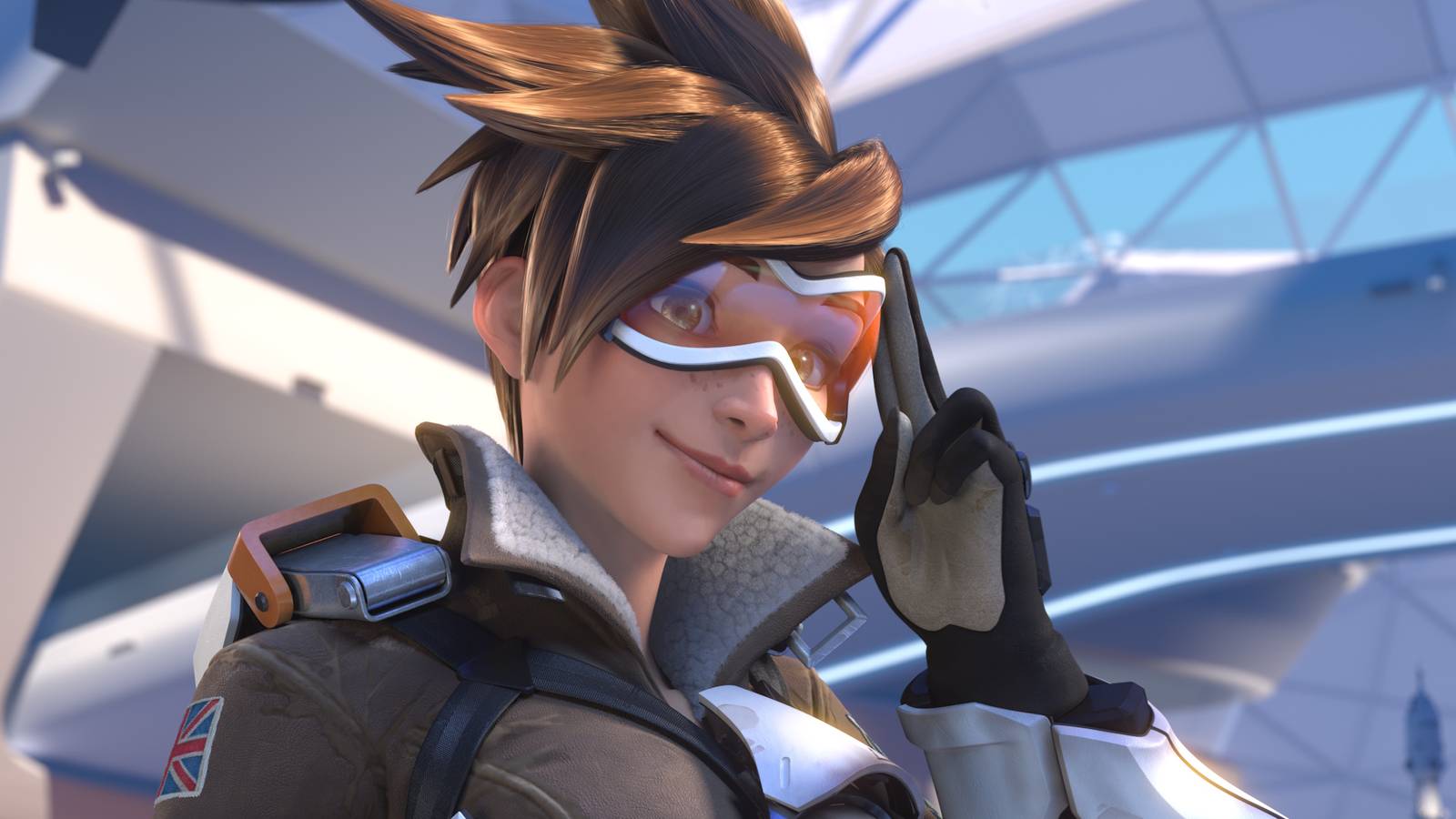
We had Tracer’s kit in Titan, more or less, as the Jumper job class. You could make them have different hair colors and weapons, and they didn’t talk. But when you congealed the idea down to: Here is Tracer, she’s from the UK, she has a voice — I can’t emphasize enough how much being able to put a face and a name on these gameplay concepts really elevated the whole [pitch process].
We packed it with fantasies and dreams, and that was the moment the idea of Overwatch became super exciting.
We actually voiced her with the engineering manager’s wife, who was from Britain. She did temporary voiceover for us over some line art. That was actually one of my favorite moments during the pitch. There was a bit of line art of Tracer, this brand-new character, going, blink, blink, blink, putting the time bomb on the screen, which is now a “play of the game” sequence in Overwatch. It was all hand-drawn, and we had the engineering manager’s wife say whatever lines they were, probably something like, “Cheers, love!”
Anyway, that core concept came in super, super early, and when we put the voice over this line art, it just made everything click. We started to put all this detail and love into creating a character that was three-dimensional, rather than the more generic “create a class” kind of thing in Titan.
Dion Rogers: Coming out of Titan, we got a chance to know exactly what we wanted and what we didn’t want to do with the game. We had a really clear picture of what didn’t work and what we should hyper-focus on.
Keller: We also appreciated the very tightly controlled scope of what a project like this would be. We had just come off of something that was massive, that you could barely wrap your head around. We could point at this thing and figure out how we could actually build it quickly and do it really, really well.
We had the team vote on whether they wanted to keep working on Cross Worlds or Overwatch. It was unanimously Overwatch, and we put this pitch together and never looked back.
The team’s belief in their new project didn’t guarantee approval, though. Their post-Titan efforts were still experimental in Blizzard’s eyes, an allocation of resources that might still be better suited to supporting World of Warcraft. The company’s decision-makers needed convincing — passion and hope almost weren’t enough to do it.

Kong: While these guys were working that creative magic back then, I had been pulled into the project to put together a deck to present to our parent company. I was working on building a spreadsheet model for the business case. Meeting with management of Blizzard — just to prep for that meeting! — it felt more than a little anxiety-inducing.
I think we were all really nervous, and the meeting started out pretty rough. There was skepticism from the execs at the parent company. On the Blizzard side, we were pitching a thing we loved, and we were very good at building big, bombastic settings and kick-ass characters. We would be presenting a game with a very unique, stylized look, and the response was initially, “Well, that’s because you don’t want to compete with Call of Duty, so we get why you want to build a stylized game.” And then I felt really bad when one of the executives there said, “Oh, so you mean you’re building Call of Skylanders?” So it was a rough start to the meeting.
There was a very specific turning point in the meeting, when we put up a slide showing the lineup of heroes. The response was immediate and incredible. Our group CEO said this was unlike anything in any medium, that it was amazing, and he had never seen art like that before. From that moment, it became a meeting about imagining the future and imagining the potential of what this new IP could do. That was an incredible moment. I’ve been in the industry a long time, and I think when I’m retired, I’ll remember that day, and just how special it was to see that turn.
Development began in earnest after the initial approval, with the goal of showcasing the game at the next year’s BlizzCon. That gave the team roughly 14 months to turn a pitch into a playable build. Making a game is always hard, but the team says Overwatch was different.
Keller: I’ve never said this before, but it was easy.
There were times where we were working extra hours and working hard, but it just felt like everything came together on that project. There weren’t a lot of moments that I can pinpoint and be like, “Here’s where things were falling apart,” or, “We had a big existential crisis on the project.” It just didn’t happen.
We really started working on it, maybe in June of 2013. That green-light pitch was in October, and we were running around with a new engine with Tracer shooting red lasers out of her eyes, because we didn’t have guns yet in November and December.
Rogers: Sometimes with Titan, it felt like we were building the game and the engine at the same time, like you’re making the tracks that the train goes on them at the same time. It was pretty challenging to get art in and out of the game.

Going into Prometheus — the code name for Overwatch — we had a hyperfixation on the engine. We focused a lot on the beginning parts while we developed all the pre-production and the ideas that people had for the game, but this was a direct reflection of Titan. We knew we needed to do a better job with the tools and how we create the game.
Lawlor: Just to add to that: The difference between Titan tools and Overwatch tools was night and day.
The engineering team deserves so much credit, because it was very hard to work on Titan, and within six months, they basically reworked a lot of existing stuff that we had built for Titan into this really tight engine. Everything just worked all of a sudden, and it worked really, really well. It was part of the magic of that first six to eight months of development, that we were all able to just go 100 miles an hour.
Lee: Obviously, the whole process was a challenge that we needed to solve, but then the whole experience was very fun and smooth. It made it difficult to choose what we should add. But in a good way.
Keller: We were incredibly hungry, because we all felt like we had something to prove, and then it just kind of kept going from there. The ideas were just kind of nonstop.
Rogers: Designing around the heroes helped a ton, even just on the worldbuilding side — “What should we add based on the story we wanted to tell?” Once we gave heroes a name, and where they’re from, things became much easier. Pharah was from Cairo, Tracer was from London. We knew Hanzo and Genji were an eventual thing, so we started to make the Hanamura map.
I felt really bad when one of the executives there said, “Oh, so you mean you’re building Call of Skylanders?”
Lawlor: One more example of just like… how blessed our development was, how the VO of the characters came together so smoothly.
That eight-month run, up from December through BlizzCon, was a very short development window to get all the planned content together. We didn’t have any voices in the game at all. We didn’t have a voice system.
This all had to be created, so we had a design for it pretty early in that December/January window — but we couldn’t get programming resources for some time. We were waiting until around April, when we could start the programming of what we hoped was a really cool voice system — very contextual, making the characters talk to each other and say relevant things.
Within a month and a half, I used my own voice to cover every single character in the game, and pitch them up and down to sort of match the different characters. I think that was done by maybe June. Then we had a writer join the team, Michael Chu, who wrote all our characters within like a month.
We went into the studio in August and had everything in the game for all 12 heroes in September — and thankfully, it all sounded good. But it was basically four months to create all these heroes and their personalities and select the voice actors and get it functioning in-game. It just went flawlessly.
Keller: On our team, we have a meeting called Game Check-In three times a week. On one of them, we had our at-the-time executive producer Ray Gresko attending, and he stopped the meeting and just asked everybody to look around at all the people that you’re with, and take this moment in. Because from his point of view, he’s like, “I’ve been doing this a long time, and the chances of you getting an experience like this again are really low, so take this moment in, and remember it, and treasure it.” It was really special.
The team debuted Overwatch at BlizzCon 2014, with a lengthy cinematic trailer, a panel outlining their vision, and a playable build with a dozen characters and three maps. Everyone was hopeful the game would resonate with attendees, but reactions far exceeded their expectations.
Lawlor: Even though we weren’t available for everyone to play, we were in the zeitgeist, so to speak, from that point forward. At the opening ceremony at BlizzCon, we were about to announce Overwatch. Everyone was super nervous and super excited and visibly emotional at that moment, because we were so excited about what we were about to reveal.
After that cinematic played with the museum piece, I was walking out of the main hall, and people were just buzzing. I was just hearing these pieces of conversations from people being like, “And then Winston came in…” They already knew the characters and were just immediately invested.
I had worked at Obsidian before coming to Blizzard, and some of my old coworkers reached out to me. One of them said, “I’ve never seen grown men react like that to an announcement before in my entire life. Just people running around the office like, oh my god, did you see what just happened?”
Rogers: That launch cinematic, even though I saw it a bunch of times — the moment when we first shared it, and Winston was the first hero that dropped down — just felt so different. I realized the spirit of what we were making, because we didn’t show a human character, or some sort of military-esque hero first. It was this ape that was smart and intelligent, and it really showed the difference between our hero shooter and what was out there at the time.
Keller: I have this theory about why people get into hero shooters, and maybe even just superheroes in general. When you see a lineup, it’s always more than the sum of its parts, and once you hit a certain number of characters, you can no longer take all of them in at one time.

An image like that invites you to take a closer look at each hero, and there’s something appealing that speaks to different people. You can’t help but look at each hero and wonder who they really are. What’s their personality like, or their history with the other people? That’s what’s appealing about games with large rosters like this, and what makes Overwatch really special — our characters are unique.
We do them in the Blizzard style, which means they’re larger than life. But they’re also these millennia-old archetypes. Reinhardt is really a knight in a suit of armor, but he’s the modern version of that knight in a suit of armor. Mercy is an angel who uses medical technology. We have all of these things that speak to very deep, primordial parts of people, so you get this spark to your imagination.
Lawlor: We had 14 characters at the BlizzCon debut and 12 playable on the floor. The two that were there that weren’t playable were Cassidy and Genji. We didn’t say anything about it. We just put the lineup out, let you play the 12 heroes, and there’s just two more sitting there for people to theorycraft about.
Keller: The number of heroes in that original lineup and the number that we had playable at Blizzcon was very intentional. One of our big inspirations was Team Fortress 2, and we needed to have more heroes than they had classes in that game. This was all a strategy from Jeff Kaplan, the original game director, because we needed it to be kind of overwhelming — how many there were to pick from — to make players realize how big this game was going to be.
Lawlor: I remember being at the signing table, and everybody’s asking, “Who’s the ninja? Who’s the cowboy? What do they do?”
And somewhere in there, I think someone misheard what someone said about the cowboy.
They’re like, “What’s his name?” And I think — this is just a theory — I was like, “Hey, Joel, do you blah blah blah blah,” and I was talking to my sound producer, Joel. Someone misheard that and thought the cowboy’s name was Joel. So if you go online, there were actually all kinds of people who referred to him as Joel for like the first six months after BlizzCon, until we eventually announced the name later.
That imagination moment of just seeing it and wondering who they are is an incredibly powerful one, and you get some of that with our current [Season 1] lineup with all those silhouettes. People are doing the same thing right now. Who are they, and what’s their story?
Keller: The feedback we were getting from people was that it felt like the game was finished at Blizzcon, and we had been working on it actually in-engine and in the editor for maybe a year at the very most.
We even had moments where we’re like “Can we ship this thing earlier?” We had this belief that we could have shipped the game by the end of 2015, and that’s what we were driving towards for the entire development. We even had another slide in the original pitch deck that had a 2015 date, though I don’t think anybody believed that we could do it.
The call was made later to delay it a bit, and it was the right thing for us to do. We ended up being able to put a lot of polish into the game over the course of early 2016. And we had an esports scene develop and a whole phenomenon of people trying to get into the Overwatch beta.
Taking Overwatch from pitch to launch took only three years. It was an impressive feat for a team finding its way again after a canceled project — and for a studio that hadn’t made a new franchise in nearly two decades.
Keller: Shipping a game at Blizzard is pretty special. What we used to do back in the day — we don’t do this anymore — is the whole company would gather for a big celebration when a game launched. There would be champagne. It wasn’t really for drinking. It was just for spraying on people, a time to just kind of like let loose and celebrate the launch.
For this one, Ray [Gresko] and Jeff [Kaplan] had a secret agenda. They had ordered special champagne launcher guns. So they got up on a stage on the Blizzard campus, they made a speech, and then they pulled out their launchers and drenched the crowd. Then everyone ran around for a little bit, doing the same thing.
Rogers: This was an awesome moment, because it had been a long time since Blizzard made a new IP.
Kong: Seventeen years.
I’ve never seen grown men react like that to an announcement before in my entire life. Just people running around the office like, oh my god, did you see what just happened?
Rogers: We came out of Titan and proved we could still do this, and launched a successful new IP. It was redemption.
Keller: There was so much excitement from people who were playing it in the betas. The number of people talking about, or doing fan art, or cosplay of the characters — it felt like a cultural phenomenon.
After it launched, that’s when it started to get harder. It’s a transition from putting a game in a box to now having an entire team support it full time, while you’re also trying to work on bigger things for the future. That’s a much harder endeavor. We did well at it — for a little bit.
Overwatch had the pull Keller and the rest of the team hoped for. The gameplay was a major draw, but the broader Overwatch universe — the characters and what they fought for — kept people invested over the course of the game’s first year, from mid-2016 into 2017.
Kong: In its soul, it’s a hopeful and optimistic universe. I think that really resonated. There were a lot of people that didn’t come to the game because they were already team-based PvP players. There was some magic there that stole their imagination. I think it was the same thing that happened in that boardroom years earlier.
Keller: When you start looking at some of the other shooters that were on the market then, they take place in war-torn or post-apocalyptic scenarios, and we came out with something that takes place in the real world. It’s the future, but it’s this bright and optimistic future, a place you would want to live if you could.
There’s a map that we have in the game called Oasis that I think provides one of the clearest contrast points. Oasis is located in Iraq, and it’s this amazing, top-tier city in the universe of Overwatch, the hub of really high-tech scientific research. You compare that to what a city in the Middle East would look like in any other shooter, and it’s drastically different.
And then all of our heroes… you could call it a superhero game, but they’re not. Most of our heroes are ordinary people who answered the call to defend people and do what they felt was right.

Rogers: You can feel like you can become them a lot easier than heroes that have powers that are difficult to imagine. Our heroes are a scientist, a mercenary. They’re not so farfetched that it’s impossible for you to feel like you could be them.
Lawlor: You see so much pride when we put a character out from a smaller country, like with Hazard, the Scottish hero. People were like, “Oh my god, there’s a hero from Scotland!?”
There’s a ton of people that felt really represented by that, or gender diversity, body type diversity, all the things that we’ve done over the years. It just makes a more colorful tapestry of unique experiences, like the real world.
We’re actually insanely detailed when it comes to the audio side. We got audio recordings from Peru, because we couldn’t find anything accurate in the sound library. We worked with a college in Korea to record all the instruments you can knock around in the Busan map’s temple areas.
Keller: We wanted people to feel an affinity for these heroes, but also to have a sense of pride for what and who they represented.
Interesting characters and good sentiments only carried the game so far, though. The team struggled with how to balance maintaining the game and expanding it, and the results of that struggle started showing through in Overwatch‘s second year.
Keller: There’s a really hard transition into live-service operations. You go from working on the game’s main release branch to here’s four different branches you’re working on at the exact same time. There’s this big tax you have to pay mentally and operationally, swapping back and forth, and suddenly you don’t just get to spend all of your time creating new stuff.
The day that Sombra came out with her translocator [in November 2016] was like the worst thing for the level design team of all time, because of the amount of places that people could get to with it. Like Mei puts you up on a wall, and it allows you to throw your translocator in some hole in the geometry to get out of the map. So you spend a lot of time fixing it.
The hero designers are fixing bugs. They’re doing balance patches and all of these things before you even get to think about the next hero that we’re releasing. We handled it pretty well, because for about a year the game kept growing, and we set a framework for what Overwatch live service would look like with seasonal event rotations.
The original philosophy from Jeff [Kaplan] was that we always wanted the game to be in touch with the players — putting stuff out and tying it into something that happened in the real world, like winter events during the winter holidays.
If you rewind the clock all the way back to like 2017, that’s where Overwatch peaked. And then we started losing players at a fairly linear rate ever since. PUBG and Fortnite came out, and they offered a very different experience. The battle royale format was very dynamic. More and more shooter genres have popped up in the meantime, and Overwatch stayed relatively the same. We had very ambitious plans to do a lot more than just run the game, but it was very, very difficult to think about anything else we could be doing on top of that.
The big ambition was Overwatch 2. Blizzard announced Overwatch 2 at BlizzCon 2019 and promised a robust PvE campaign with new heroes, new abilities for existing heroes, and a large-scale expansion of Overwatch‘s story. That ambitious promise was understandably appealing for players, but also immediately became an enormous problem for the development team to solve.
Kong: For the team supporting that heartbeat of the game, we eventually got to a point where it was a choice between “Do we maintain that cadence of releases in the live-service pattern” or “Do we spend the resources on going for this next thing?”
There was a pretty tough period where we were trying to do both, and the trade-off became slowing down the live-service additions. There was a fairly painful drought in content and a lot of difficulty seeing the finish line for that original vision of Overwatch 2. It was such a difficult time. We saw attrition on the team as well. I think it was 2021 when we saw the game director, executive producer, production director, art director all leave the team.
Keller: And the assistant director. And assistant art director.
Kong: There were a bunch of folks who had to step up, look for a way to move the game forward. I stepped into the general manager role for Overwatch. I had been an executive producer on Hearthstone, and I was actually really afraid to take the job because I had been in those regular exec meetings hearing updates on how development was going on Overwatch. And it didn’t sound fun. But I felt like there was something really special there, and that hope made me feel like Overwatch was not done.

I still remember meeting the team for the very first time, having dinner with Aaron [Keller] and just talking about how we were going to get things back on track. We made a very clear decision to reprioritize, and that led to the 2022 launch of Overwatch 2.
I remember getting in front of the team at the beginning of 2022 and saying that we’re going to ship a game by the end of this year. There was silence after that, but at the end of the meeting, I got messages from various team members saying, “It’s really scary to hear that we have to ship by the end of the year — but it’s also energizing and exciting.”
Keller: This put a light at the end of the tunnel for some people, because the progress that we were making on the original vision of Overwatch 2 wasn’t good. The game wasn’t shaping up the way we wanted it to, it wasn’t as fun as we wanted, and we were hitting a lot of dead ends. There were a lot of people internally that had this feeling of, like, “When are we ever going to be able to cross the finish line?”
Kong: When we released in October 2022, Overwatch 2 broke all types of records for Blizzard. It was the most concurrent players, the most daily active players, it broke Twitch records for Blizzard — but it was a bit of a mirage. After the novelty of launch, things started getting tough again.
We started seeing some real sentiment challenges around what was new and what was perceived to be not new enough. People wanted to know where PvE was, and they didn’t like the battle pass. We had succeeded in bringing back focus on Overwatch, but we had a lot of work to do to build up those competencies in meeting expectations.
Kong: We made the decision to ship Chapter One of the story missions in mid-2023. We wanted to validate whether there was a future for this content in Overwatch 2 and be very objective.

There was very clear feedback from players that this didn’t really resonate. We got the worst reviews of all time on Steam. It was a really rough time for our team, and morale was at a really challenging place. But it really clarified our vision of what’s next for Overwatch.
Players enjoyed this core competitive PvP experience, and it made it easy for us to put together the plan moving forward — we would focus on that, we would focus on pain points, we would think about a new relationship with our players, one that was as transparent as we could make it. Instead of just telling what we’re working on, we would tell the why as well.
We took that approach to BlizzCon that year, and I remember we had this Future of Overwatch panel where we laid out no giant promises of what’s coming next, but a really long list of improvements.
Keller: There’s a process we had to go through to regain the trust of the team, our players, and maybe we’ve started to do that with the broader gaming community also. But for the team, we did some of the same things that we’ve done with our players: We try to be as open and transparent as possible.
I had been in those regular exec meetings hearing updates on how development was going on Overwatch. And it didn’t sound fun
Every few months, we get in front of the team and talk about not just the roadmap, but we really get into the why of it — the goals that we’re trying to reach — and we presented them the state of the business: how much money we’re making, how many players we’ve got, what’s doing well, and what’s not doing well.
For a while, there was a lot of what’s not doing well, so you could come out of a meeting like that with low morale. But you at least had context for what was going on. They weren’t in the dark anymore, and we would get a lot of feedback from our team that they were just happy that we were being honest with them, rather than just trying to sugarcoat it. We started doing that with players, too.
Rogers: We’re from Titan, so we took that moment and used it to keep moving forward. Listening to what people did and didn’t like helped us identify what was going to work and what wasn’t.
We created a few more strike teams within the main team, and we started to refocus on tools and the engine again — and as we got around Season 9 [in February 2024], we started to see we could create more without growing the team like crazy. The player base started to be happier with what we were creating, and the team liked the quality of the work.
Keller: Even though we were trying to be more honest with the team, there were moments where we would get in front of them and be like, “We’ve got this thing coming up, so just don’t go on the internet today. Just avoid it, please.” Because it can be so damaging to read some of the… very unfiltered, I guess, reactions from the community.
Rogers: There was a big concern that if we needed to chase so much more, would the quality of the game drop? We were able to maintain the quality that we expected from ourselves, and players could also see that the game was doing well. We had to ask the team to trust us that this would work, and then we started to see it pay off, so it helped the team buy more into what we needed to do to be successful again.
By February 2024, Overwatch 2 had passed its lowest point. The team began making plans for winning people’s trust again in the aftermath of PvE’s cancellation and, if not fulfilling their earlier promises, setting new goals that benefited both players and developers.
Keller: We had this moment where we felt like, for some of our players, the game might be getting a little boring. The fantasy that you have at the start doesn’t actually play out that way. You get into the game, you find a handful of heroes that you really click with, and you play them. Once you learn how they all play, once you learn what your role is on the team — I think the game is still great, but for some people it can start to feel a little stale, especially when you start comparing it to what other games on the market do.
They wanted a very competitive experience and that was always evolving. So we started to come up with a different framework. Every year, we wanted players to have a moment where they look at the roster of heroes and think about them differently. That’s what Perks were for.
Lee: We were thinking about what we’re good at and what fans are really excited about. What stood out is that we’re good at making fun PvP experiences, and fans — and ourselves — really enjoy the storytelling aspects. So we looked at ways to add story elements and change the timeline for maps, and the world, and even the heroes we were designing.

We were also looking at ways to make things more exciting for players, like when we were updating the Gibraltar map with the destroyed version of it for season 1’s story. It reflects Vendetta’s attack on the base, but it was such a great opportunity to rework the level design so we can try different playstyles and relieve some of the pain points players had experienced for a decade.
Lawlor: One of the things the team mourned was the loss of the storytelling that PvE could provide. We loved working on PvE, because it gave us a chance to move the story forward. If you really think about Overwatch throughout the years, a lot of the storytelling we had done was backstory, and we hadn’t really had a lot of opportunity to take the world state forward.
If you think back to 2024, I think our heroes like Venture, Juno, Hazard — all awesome heroes, some fan favorites in there, for sure. But all of them feel a little disjointed. One’s a treasure hunter, one’s from Mars, one’s a Phreak, a new world group that didn’t have a lot of grounding toward that central theme of Overwatch.
We had an idea within the narrative team to take some of the best parts of what we did in [the original] Overwatch, which was a lot of storytelling outside of the game, and do that in a way that’s moving the story forward, and then also keeping it in the game.
Keller: [In 2024], a few of us were at the OWCS finals in Stockholm, Sweden, and one night we all went out for pizza. One of the narrative designers, Jude Stacy, pitched the original idea of who Vendetta could be, how she could try to take back Talon from Doomfist. That was November, so like 14 months before we actually launched that storyline.
From there, the idea kind of germinated and turned into this whole story that we wanted to tell across the entire year, and we wanted to make that one of the pillars of the way Overwatch runs going forward.
I don’t know if we ever get to turn our reputation all the way around with everybody
Lawlor: A lot of that planning was happening last year. You could see, if you look back to Freja, there were some pieces that were starting to come together, or Wuyang with his sister Anran being teased, and then obviously Vendetta being a central character. We were laying the groundwork for how we wanted to start telling the story.
Keller: We did a lot of gameplay experiments. We have this series that we call Quick Play Hacked in Overwatch, and we just take over the main way to play the game and add a bunch of changes. With the first one, it was a really small set of changes, but we actually kept some of the things we experimented with.
And we just kept doing that, and we would do that in some of our [seasonal] events, where we changed the ways some of our heroes would play. We were using those as test beds for things like Perks and Stadium. We started getting a better sense not just of what our players wanted, but how we could implement that in-game.
Rogers: The way we have the team designed now, we’re able to work on things in parallel. Parts of the team are working on this area, and there’s parts of the teams working on another area. It’s not like we shrunk how long it takes to make a hero.
At some point, we had about eight heroes in progress last year at the same time. We can make more heroes and more content for the game in general, again, without sacrificing the quality we expect from ourselves.
Keller: If I could give us a critique — we also released the sub-role passive system. I think it’s a great system, but it’s more of a nuanced one. It doesn’t quite give you that drive to look at the entire roster and with fresh eyes again. It’s something that, when we start looking at Season 1 of next year, we’ll probably try to correct going forward.
For now, though, Keller and his team are proud of Overwatch‘s turnaround. Blizzard re-launched the game as Overwatch again — without the 2 — in February 2026. It was a sign of what to expect for the game’s future along with the first phase of everything the team had been working on since 2024. The results have been positive so far.
“I don’t know if we ever get to turn our reputation all the way around with everybody. There’s some people out there that feel burned from that original [Overwatch 2] announcement and our inability to actually ship what we had promised,” Keller says. “People can reserve the right to hold that against us for as long as they want to.”
It’s clear the momentum and ambition that emerged from the death of Titan 13 years ago are firmly in place again — and they’re already bearing fruit. Player sentiment toward Overwatch is growing more positive again, as lapsed players return to see what big things Blizzard has in store — and encourage their friends to do the same. The relaunch’s first-year roadmap, with its new roster silhouettes a deliberate callback to the original lineup, once again has people buzzing with curiosity about who’s coming to the game and how it’ll feel to play them. And the people responsible for Overwatch‘s future are shaking off the burden of legacy and expectation, finding a new way forward that, they hope, will keep Overwatch alive and well for the next 10 years.
![16th Jul: Love You So Bad (2025), 1hr 52m [TV-MA] (7.1/10)](https://occ-0-1081-999.1.nflxso.net/dnm/api/v6/0Qzqdxw-HG1AiOKLWWPsFOUDA2E/AAAABXp7LqXdmMie3ipWo5U5HxDBMzE0HTyRnpXWhVBasRO24Fj42s3vB8YdXE3yOiGDOcWUhihLNuLoX8t_ptoU6IGoe8k9ozt4RU03oKCjun25EcbpwJel1vSOwMncpoGlLRfAJubNWYogCjI60L6Dg2ZzapSWAkEqeCOwdKm_NkEC9Q.jpg?r=b94 "16th Jul: Love You So Bad (2025), 1hr 52m [TV-MA] (7.1/10)")