![7th Oct: Afterburn Aftershock: Closed Door (2017), 1hr 33m [TV-MA] (6/10)](https://occ-0-953-1001.1.nflxso.net/dnm/api/v6/0Qzqdxw-HG1AiOKLWWPsFOUDA2E/AAAABXde_kKQkIONeXdUTAUtPmwpCOhvRjTn05T80ryNzGApY7MQ3O3Z6pFq0qXO8pyD6DHdRBL725C3TZTPAiXADWkU6iAwREe3MyAsTZGgHa3-LF2FpP-UDRefD7GFzd49KCVF5ee11b7UHKR_rPMkXY8pMwnJEC6DtESA_wrgA85u1w.jpg?r=5cd "7th Oct: Afterburn Aftershock: Closed Door (2017), 1hr 33m [TV-MA] (6/10)")






A Frontmezzjunkies TIFF film review: Lee Chang-dong Examines the Ethics of Looking, Asking Who Gets to Tell Another Person’s Story
by Ross
By the time I reached my fourth film on a brutally long TIFF day, my sixth day in a row at the Festival, my eyes were beginning to revolt. I know I did this to myself, but I really had no idea the effect it would have on me. I had already spent hours reading subtitles, absorbing images, shifting from one cinematic world to another, and now Lee Chang-dong’s “Possible Love” was asking me to sit still (again) for 164 minutes and pay very close attention to everything happening beneath its quietly rumbling surface. I could feel the physical cost of it almost immediately, even as I acknowledged that this is exactly the type of film I tend to want to lean into, and after spending a lot of my energy with the earlier bursts of dynamic colour of an Almodóvar film, sitting myself down for another foreign film, this one entirely in Korean, required a different kind of concentration and commitment. I would be lying if I said I didn’t struggle to stay fully tuned in. Yet something kept me in my seat. It was that curiosity of mine, and that emotional need to understand what Lee was doing with these two couples, what storm might eventually move through the complex landscape he had created, and why the possibility of connection between people who occupy such different worlds felt so fragile.
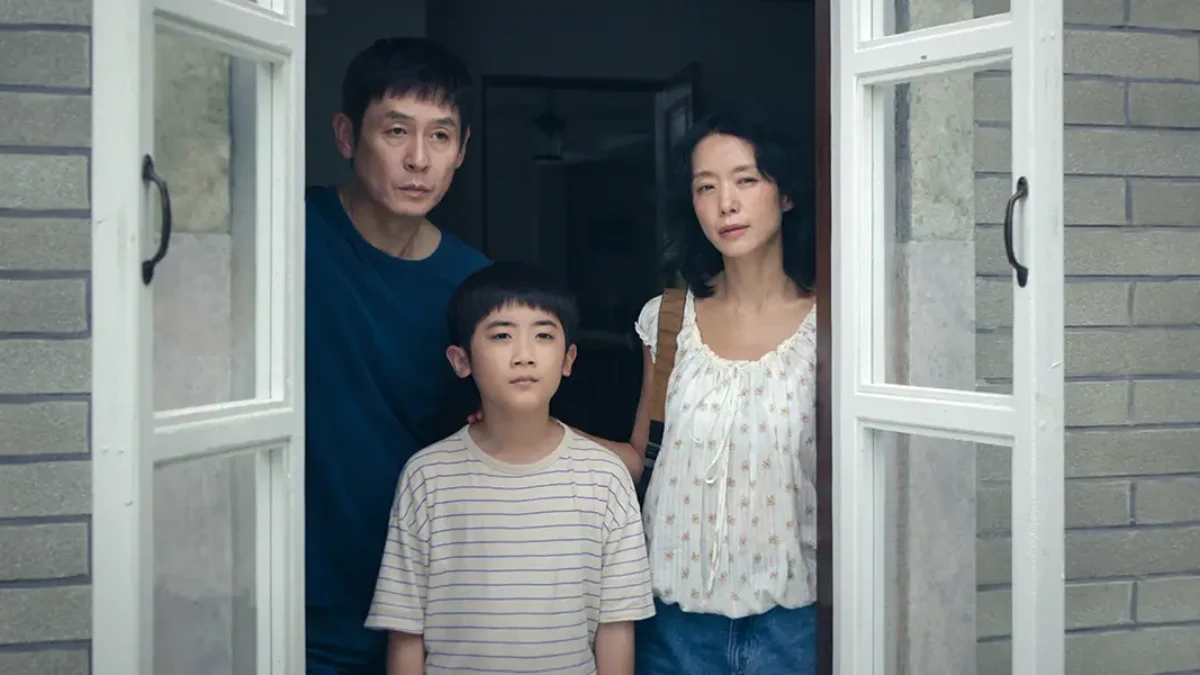
The film follows working-class couple Ho-seok (Sul Kyung-gu) and Mi-ok (Jeon Do-yeon), whose lives have been deeply affected by the aftermath of a disastrous labour dispute, and, in extreme opposition, a wealthy couple Ye-ji (Cho Yeo-jeong) and Sang-woo (Zo In-sung), whose privilege gives them an entirely different relationship to the world. We eventually see just how vicious that labour dispute really was through footage of the police beating the workers, and the violence is difficult to watch. The trauma has understandably affected Ho-seok, but it has also driven a wedge between him and his wife, Mi-ok, not because the love between them has disappeared, but because trauma has a way of separating us from the very love and support we need to heal.


Lee begins quietly, with Ho-seok and Mi-ok preparing to leave for a funeral, and even that simple journey carries an emotional weight that takes time to understand. Mi-ok’s wedding ring repeatedly slips from her finger, and the connection she encounters with the kind man who helps her find it feels significant. In that emotional complexity, the film refuses to hand us an immediate explanation for what it all means. That refusal becomes central to Possible Love. Lee asks us to breathe in the moment, hold it there, and resist the impulse to turn every gesture into an answer or a solution to the conflict he has created. His film is deeply interested in what people want from one another, but it is equally interested in the dangerous assumptions we make when we believe we already understand what another wants or needs.
That question becomes especially complicated as we watch Ye-ji film a documentary about the other couple’s experience. She wants to understand the damage done to them and the working-class community around them. She clearly believes in the importance of giving these people a voice, yet she is also visibly insulated from the reality she is trying to document. Her expensive clothes become particularly problematic when she arrives to interview labour workers seeking justice, creating an uncomfortable visual contradiction that Ahn Mi-ok quietly recognizes and wisely points out. We can feel the strong pull for camaraderie between the two women, but Ye-ji’s privilege keeps getting in the way of the connection she believes she wants to make. Her insistence on continuing to film, even when the circumstances become uncomfortable, raises the film’s most complex question. When does the desire to tell someone’s story become another way of taking something from them? The idea that “all those nice words give people hope” can also be “bullshit” lands with particular force because Ye-ji genuinely wants to help, or so she tells herself. Her intentions are not entirely the problem. Her position in relation to the people she wants to understand is.
Jeon Do-yeon is extraordinary as Mi-ok, gradually revealing a woman who initially seems uncertain of her place in her own life, then shows quiet dignity and a growing determination to change it. Her decision to form a local union gives that emotional journey another triggering dimension, turning private frustration into a desire for collective action. Sul Kyung-gu brings an aching sense of displacement to Ho-seok, a man whose experience of losing his job has shaken his pride, purpose, and sense of identity. There is a painful distance between Ho-seok and Mi-ok that feels rooted in everything they have survived, as though the two are still trying to figure out how to reach each other through the trauma that has come between them. With a film camera always within arm’s reach, Cho Yeo-jeong gives Ye-ji a complicated mixture of enthusiasm, privilege, and genuine curiosity, allowing her to remain human even as the film exposes the limits of her understanding and her oblivious, somewhat intrusive behavior. Zo In-sung’s Sang-woo completes the wealthy couple’s side of this uneasy arrangement, and he hangs out casually in his elegance and status, equally oblivious to the effect he has on the others. The four performances create a web of attraction, resentment, care, connection, and curiosity that keeps shifting like waves on their private beach. Kim Ji-yong’s patient cinematography holds these faces close, allowing tiny changes in expression to carry enormous emotional weight, while Jung Jae-il’s melancholy strings and piano give the film an emotional pulse that can be felt even during its most restrained stretches.

The extended weekend at the luxurious beachside mansion gradually becomes the place where all those differences begin to collide. The house promises communion, space, and escape, but the couples never truly occupy the same emotional ground. Yet somewhere within that strange, luxurious escape, Ho-seok and Mi-ok begin to find their way back to each other. The trauma that has separated them has not disappeared, but the weekend gives them enough space to see each other again, and their connection begins to feel possible in a way it has not for much of the film. There is something deeply affecting about watching them rediscover that the love between them is still there, even after everything that has happened to them.
The hierarchy of money and power is always present, even when nobody is openly discussing it, and the film’s psychological geometry keeps encouraging us to anticipate a conventional betrayal or erotic revelation before turning our attention somewhere more complicated. The bathroom encounter between the two husbands near the end is one of the clearest examples of Lee’s ability to make discomfort unexpectedly funny while exposing something deeply serious about the relationship between these two worlds. For Ye-ji and Sang-woo, however, the weekend widens a fracture that was already present between them. The film allows that disconnection to register without asking us to feel it in quite the same way, and that feels right. Their privilege gives them room to absorb the consequences of their choices in a way Ho-seok and Mi-ok simply do not have. One couple is fighting to recover something they need in order to move forward, while the other is discovering what happens when the security surrounding their relationship begins to crack.
As the minutes ticked forward, I struggled with my connection to “Possible Love“, and I don’t think that struggle needs to be hidden away. There were moments when my tired eyes were working hard simply to keep open and focused, when the film’s 164 minutes seemed to stretch out before me as if I was running a marathon. But Lee Chang-dong kept giving me reasons to stay with it, quietly revealing the distance between intention and impact, between caring for someone and believing we understand them, between telling a story and claiming ownership of it. Nothing arrives with the force of a declaration. The film lets its questions gather slowly, allowing the discomfort to settle before asking us to look again at what we thought we understood. Even through strained eyes and the accumulated fatigue of a long day at TIFF, I could feel that quiet power taking hold of my inner senses. By the time I left the movie theatre, I was still thinking about that slow breath the film had demanded from me, and about how difficult it can be to hold a moment long enough for another person’s life to come fully into focus.