




Quebec voters go to the polls Oct. 5 and the parties differ substantially over the number of immigrants the province should accept even as Québec’s population declines.
According to the Institut de la statistique du Québec, the province’s population dropped by 9,600 last year and was estimated at 9.03 million on Jan. 1. Total net migration also decreased by 7,150 people in 2025, while the number of non-permanent residents — which includes temporary foreign workers, international students and asylum seekers — decreased by 51,400.
The governing Coalition Avenir Québec (CAQ) proposes maintaining the current level of 45,000 permanent immigrants a year through 2029. The Parti Libéral du Québec (PLQ) suggests a range of 45,000 to 70,000 without setting a precise target.
Québec Solidaire (QS) would set the level of immigration at 70,000 a year and said it would restore the Québec Experience Program (PEQ), a fast-track immigration program for temporary residents, and create a regional version requiring participating newcomers to remain in the province for three years.
The Parti Québécois (PQ) — currently leading in the polls — would cap permanent immigration at 35,000 a year and cut temporary immigration in half, to between 250,000 and 300,000. It would also prioritize students and skilled workers already in Québec, and pause permanent immigration from outside the province.
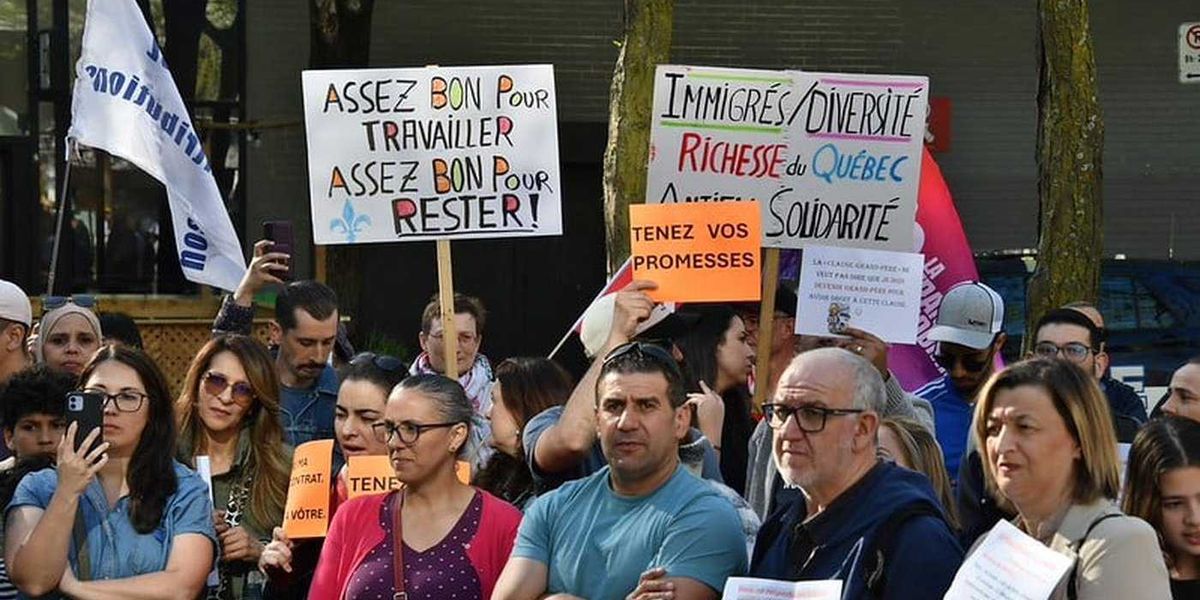
Following the PEQ closure in November 2025, thousands of migrants lost a near-guaranteed route to permanent residency. Photo: André QueryImmigration is also a divisive issue among Québec residents. According to a poll conducted by SEGMA, Radio-Canada and Le Soleil, 55 per cent of Québécois surveyed said the number of immigrants in the province should be reduced, while 34 per cent said the current level should be maintained. Seven per cent believe Québec should accept more immigrants.
The protection of the French language is an issue the parties have focused on because of its connection to immigration.
The PQ states that it would take a more restrictive approach, raising French-language requirements for work permits and requiring working age spouses to demonstrate a level of French corresponding to their occupation. The party would also require temporary immigrants who have been in Québec for 12 months to enroll their children in francophone schools.
The Conservative Party of Québec (PCQ) says it would focus on regionalization, giving municipalities and regional county municipalities a greater role in determining immigration needs, reception capacity and integration priorities.
The Québec Liberal Party (PLQ) promises to give newcomers up to two years before the government is required to communicate with them exclusively in French. The party would also give quicker access to “francization” services — courses that help newcomers improve their French language skills to better manage daily life in the province.
Québec solidaire (QS) says it would put more emphasis on workplace integration, proposing free French language courses partly financed by employers, and $100 million in additional funding for francization services, including $30 million for workplaces.
Many of the challenges faced by immigrants are not represented in the province’s political discourse, said Thibault Camara, president and co-founder of the Coalition Le Québec c’est nous aussi. The organization is dedicated to defending the rights and living conditions of immigrants in Québec.
Temporary and permanent residents cannot vote, Camara said, and he regrets that anti-immigration debates continue among politicians and the public.
“We’re fighting to say that we’re Québécois yet many people refuse to see us as Québécois, Camara said. “So perhaps political leaders should be careful about giving free rein to, or legitimizing, certain statements after they’ve been made.
“We’re used to taking the blame, to being held responsible for the housing crisis, the crisis in schools, the homelessness crisis. We’re blamed for all of Québec’s problems, even though that’s not true. It’s extremely exhausting.”
Marie-Jeanne Blain, senior researcher and affiliate assistant professor in Concordia University’s sociology and anthropology department, said there is clear polarization between “good” immigrants and “bad” immigrants.
“There is a discourse of the legitimate immigrant contributing to society, the economy and everything, and the immigrant that costs society,” Blain said.
She said these narratives have always been present in societies, but the definition of the good or bad immigrant changes depending on the context and who is in power.
She said Québec society has shifted from seeing immigrants as people who came to the country to contribute, to seeing them as a cost to the province.
Blain said the “banalization of racism,” is to blame for the sense that immigrants are to be blamed for various social and economic crises — in Québec as well as globally.
“Digitalization may have made polarization easier,” she said.
Camara believes Québec’s next government should focus on the challenges immigrants currently face in the province, such as reinstating the PEQ permanently as a pathway to permanent residency; renewing the work permits of thousands of temporary residents whose permits are nearing expiry; creating a regularization program for people without secure immigration status; and establishing measures to help clear the backlog of family reunification applications.
Copyright 2026, New Canadian Media. All rights reserved.
Natalia Rivero, Local Journalism Initiative Reporter, New Canadian Media.