





Engaging with the country of his birth has been a consistent part of Québec Liberal Member of the National Assembly (MNA) Frantz Benjamin for the nearly three decades of his political career.
Born in Haiti, Benjamin represents the electoral district of Viau in Montreal and was involved in the Haitian diaspora community’s response to the 2010 and 2021 earthquakes; served in the National Assembly’s Delegation for Relations with Haiti; and has been a public voice in Québec during major Haitian crises.
But Benjamin draws the line at wading into Haitian politics, a topic of conversation in Québec, where more than 156,000 residents reported Haitian origins in the 2021 census.
“It is important that I, as an MNA and also because I’m Canadian, do not bring the conflict in Haiti here to Canada,” he said. “For me, it’s a line.”
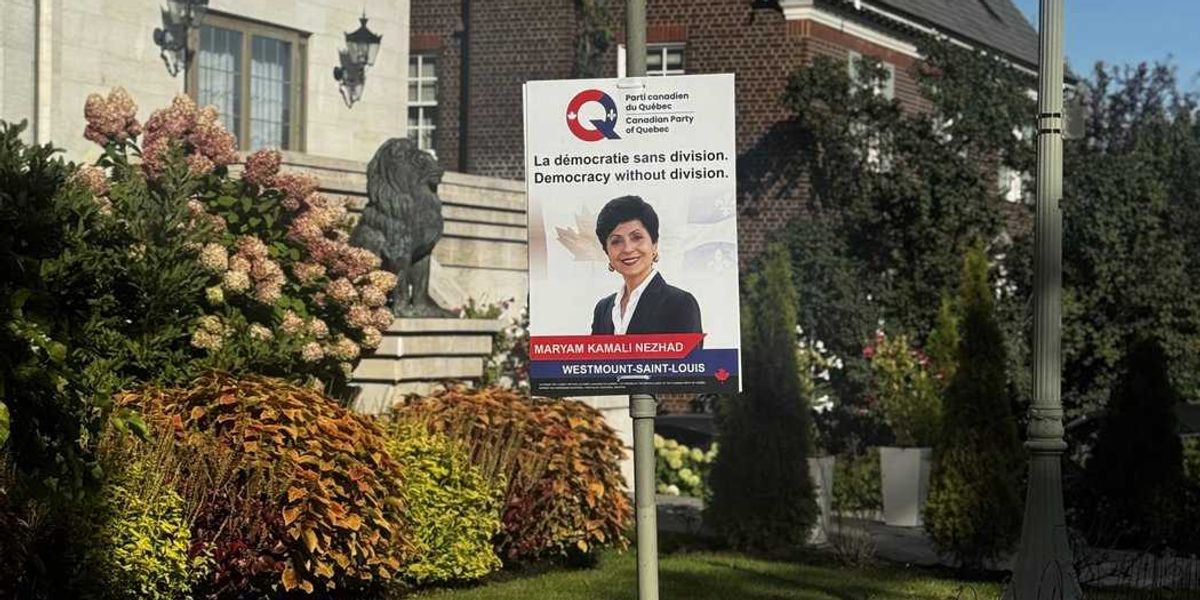
Maryam Kamali Nezhad, the Canadian Party of Quebec candidate in Montreal’s Westmount-Saint-Louis electoral district, spent half her life in Iran. For her, the line between her country of birth and Canada has been more difficult to draw amid divisions within the Iranian diaspora over the U.S.-Israel invasion of Iran.
Maryam Kamali Nezhad, Canadian Party of Quebec candidate for Westmount–Saint-Louis, speaks with a cyclist while campaigning at the Westmount lookout in Montreal. Photo: Mubin S. Khan“It’s so difficult. So difficult,” she said.
Ultimately, Nezhad decided to limit her public advocacy on Iran after entering Canadian politics, and even stopped posting about the country to her Instagram account after accepting the party’s nomination.
“I’m a Canadian politician and if there is something where I must decide between Canada and Iran, it’s normal that I take the side of Canada,” she said.
“I live here and I have a responsibility to the people who choose me.”
Sona Lakhoyan Olivier, the independent MNA for the Chomedey electoral district in Montreal, is seeking another term after being elected as a Liberal in 2022.
The daughter of Armenian immigrants, Lakhoyan Olivier says politicians may listen to concerns from their communities of origin, but they represent a much broader constituency.
“You cannot just count on one community because you’re from there. You’re representing Canadian Quebeckers.”
The struggle between dual identities is not exclusive to Québec politicians. Across Canada, foreign-born politicians have to negotiate the sometimes conflicting interests of their constituents and diaspora communities; their own political positions; and those of the parties they represent.
Diaspora politics, in which political identities, conflicts and causes rooted in countries of origin continue to shape political participation in Canada. Some politicians take strong positions on issues connected to their home countries, while members of their diaspora organize, lobby and mobilize around them.
The Iranian diaspora in Canada is divided over foreign intervention and sanctions; the former crown prince, Reza Pahlavi and the monarchy; and competing visions for a post-Islamic Republic.
Among Sikhs, one major divisive issue is support for the Khalistan movement and how far Canadian activism should remain tied to political struggles in India.
New Canadian Media interviewed researchers who study diaspora politics, migration and foreign policy to explore how these homeland ties can shape political participation in Canada — and where diaspora advocacy can create tensions in Canadian politics.
“The political system that people left doesn’t just fade from memory,” said Bantayehu Shiferaw Chanie, who leads a Centre for International Policy Studies (CIPS) project at the University of Ottawa.
“It keeps actively shaping how they engage in Canada, but in different ways depending on what kind of system it was.”
His research project is examining how diaspora politics in Canada affect conflict, peace and democracy in countries of origin.
Shiferaw Chanie says the implications vary by migrants’ relationships with their homeland, from imported state politics among Eritreans to political energy redirected towards Canadian institutions among Afghans and Rohingya.
Should politicians wade into diaspora politics?
Politicians can also become participants in disputes over who speaks for a diaspora.
In June, Iranian-origin Liberal MP Ali Ehsassi presented a petition to Parliament seeking an independent review of the Iranian Canadian Congress, and questioning whether it represents the broader community. A decade earlier, the same organization worked with then-Liberal MP Majid Jowhari on a petition calling for Canada to restore diplomatic relations with Iran.
David Carment, professor of international affairs at Carleton University in Ottawa, has long written about “conflict transportation” in which homeland rivalries make their way into Canadian politics through diaspora politics, and the risks associated with political parties pandering to such divisions for electoral purposes.
In a December 2024 policy paper for the Canadian Global Affairs Institute, Carment and his co-authors Danika Brown and Dani Belo argue that “favouritism shown by politicians and cabinet members toward certain diaspora groups” can “heighten tensions between communities,” potentially leaving Canada vulnerable to exploitation by foreign actors.
McGill University sociologist Thomas Soehl, whose research examines migrants’ political attachments and cross-border connections, draws a clear distinction between legitimate diaspora advocacy and foreign interference.
“Why should their concerns be dismissed? Non-migrants have opinions about foreign policy too,” he said. “Just because people are migrants, why should they stay out of that?”
Soehl said foreign-state activity is different: “We can’t have another state operate on this territory. That’s a big no-no in a modern nation state.”
Are diaspora politics reshaping Canadian politics?
During the recent North Vancouver-Capilano federal byelection, the Liberals won comfortably, but there were signs of stronger Conservative party support in some heavily Iranian neighbourhoods after Pierre Poilievre made a concerted appeal to Iranian-Canadian voters, including inviting Reza Pahlavi, Iranian political activist and the former Crown Prince of the Pahlavi dynasty, to visit Canada.
Diaspora advocacy is also entering Canadian policymaking through more formal channels.
A Canada-India trade consultation was swamped by submissions from the World Sikh Organization urging Ottawa not to deepen engagement without addressing alleged foreign interference, transnational repression and violence targeting Sikh Canadians.
But whether such advocacy changes Canadian policy is hard to establish.
Said Shiferaw Chanie of the Centre for International Policy Studies: “From my own research experience regarding foreign policy and foreign relations, I don’t think countries would make a decision on the basis of lobbying from diaspora groups.
“I think they will make a decision on the basis of their core national interests.”
McGill University sociologist Thomas Soehl said: “People will try to have an influence. How successful they are will depend.
“You can point to some examples where, yes, there are certain signs that people were successful in… putting something on the agenda. But people are never the only constituency, right?”
For Lakhoyan Olivier, Chomedey’s independent MNA, those competing interests are part of the job. Elected officials can listen to demands from diaspora communities without necessarily accepting them because their responsibility extends beyond any one community.
“I tell them that I can’t do that,” she said of demands she cannot support. “We are in Québec, Canada.”
She said that principle applies equally to her own Armenian community. When its interests conflict with those of the broader population she represents, she said she would take “the side of what is fair and what is right.”
Copyright 2026, New Canadian Media. All rights reserved.
Mubin S. Khan, Local Journalism Initiative Reporter, New Canadian Media.