


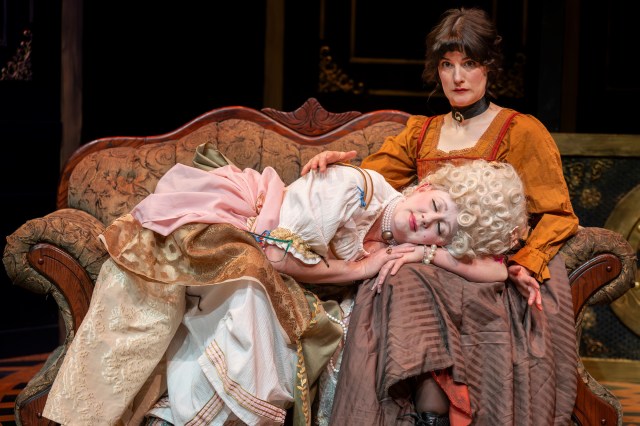



ARC’s A Mirror was the most eccentric wedding I’ve ever been to.
The delicate streamers and gauzy white panels adorning the lofty, high-ceilinged Sanctuary space at 918 Bathurst (designed by Nick Blais) charmed me from the start, although it soon became clear that this would be anything but a typical ceremony. The show is best experienced with little context to allow for full immersement, so read on at your own risk…
Written by British playwright Sam Holcroft and directed by ARC artistic director Tamara Vuckovic, A Mirror is a heady, convoluted entanglement of fact and fiction. What initially appears to be the union of Leyla and Joel actually proves to be a front for a perilous operation. In an Orwellian world that censors art and represses any remotely controversial language, the play’s cast is, in fact, staging their own production against the express orders of their totalitarian government. Over the course of two tense hours, A Mirror scrutinizes censorship, the responsibility of art, and the cost of insurgency.
Adem (the groom, played by Paul Smith) is a young playwright, nervous and readily sarcastic. He descends into a whirlwind of chaos when the Ministry of Culture flags his stage play (a verbatim account of conversations overheard between neighbours, including a military veteran and a sex worker) for infractions such as “forbidden language, hostile material, and politically sensitive content.” The domineering director of the Ministry, Mr. Čelik (Nabil Traboulsi), forces Adem to submit sample after sample in an attempt to mould his work to meet the government’s mandate for nationalist propaganda. Čelik’s aggrandized vision for the future of the Ministry entails art that meets autocratic standards, yet is aesthetically beautiful.
Adem’s play embroils Čelik’s executive assistant Mei (the bride, played by Jonelle Gunderson) and Čelik’s close friend Bax (Craig Lauzon, the best man) in the action, as they begin to question their allegiance to Čelik and his complicity in their oppression. Although ARC’s cast makes a superb ensemble, Gunderson’s stoic, controlled Mei and Lauzon’s swaggering Baz shine particularly brightly — both performers brilliantly harness the storm of emotions motivating their characters.
Holcroft pens her monologues, particularly those for Čelik, with a clear appreciation for language and an ear for the natural rhythms that strong actors can seduce from a block of text — Traboulsi is one such actor, spewing alliterative phrases such as “preening, pontificating hypocrisy” like bullets. In a play that concerns itself with the power of text and what happens when regimes strip away creative freedom, the precision and force of Holcroft’s word choices radiate.
At times, the dialogue calls for shifts in pacing: Vuckovic sustains a brisk tempo as the play reaches its climax, but this lends the dialogue a sing-songy rhythm that volleys like a tennis match and occasionally lulls.
Transitions from scene to scene are simple, marked by Chris Malkowski’s fuchsia and cerulean lights and Lyon Smith’s modern, synth pop-esque beats. Although going from a quiet, white stage to one filled with colour and sound can feel slightly discordant, I get the feeling that Vuckovic wants to keep the audience on their toes.
Snezana Pesic’s costumes necessitate quick-changes on stage as the actors transition between their wedding party façades and Adem’s story. Each actor dresses simply, donning and doffing blazers, jackets, glasses, and the like whenever they suspect that the Commission for Public Order (the police force) is onto them. Each costume feels contemporary without pinning the show to an exact time period, making it deliberately unclear whether we’re witnessing a near future or a representation of the current moment.
Any time the actors raise such an alarm, the house lights come up, and Traboulsi addresses the audience directly, giving Vukovic’s superb direction room to shine. The actors’ sombre inflection and body language communicate a marked tonal shift from their unencumbered performances during the play-within-a-play.
Seated on either side of an aisle as if at a true wedding, the audience becomes wholly complicit in the characters’ illegal performance (though we’re reminded that anyone who wishes to leave is free to do so). At one point, the wedding party even instructs the crowd to rise and recite the “Oath of Allegiance,” a disquieting pledge printed on the backs of our wedding invites.
By avoiding an explicit setting or time period, A Mirror cleverly situates itself anywhere, reminding us that threats to art and free expression continue to endanger democracy globally. The continual shattering of the fourth wall sharpened my personal awareness of the many ways censorship continues to plague today’s political landscape, from the suppression of dialogue about Palestine on social media to the erasure of 2SLGBTQ+ histories and critical race theory from official government websites.
Vuckovic expertly navigates ARC’s cast to a conclusion that detonates. Holcroft resists an easily digestible denouement, instead ensuring that A Mirror, like its namesake object, invites audiences to reflect on the truth lying just on the surface.
A Mirror runs at 918 Bathurst until March 28. More information is available here.
Abi Akinlade wrote this review as part of Page Turn, a professional development network for emerging arts writers, funded by the Canada Council for the Arts and administered by Neworld Theatre.
Intermission reviews are independent and unrelated to Intermission’s partnered content. Learn more about Intermission’s partnership model here.

WRITTEN BY
Abi Akinlade
Abi is a Nigerian-Canadian multidisciplinary artist based in Toronto. She holds a Bachelor of Arts degree in English Literature and Drama from the University of Toronto. Represented by AMI Talent Agency, she has performed in both film and theatre productions. She is currently a cohort member of the inaugural theatre criticism program Page Turn, as well as a journalism fellow at Inkspire. Driven by a strong passion for theatre, literature, and film, she aims to use storytelling as a means to uncover a deeper sense of identity and foster meaningful connection.
LEARN MORE