







A dark, ominous hallway, corpses dangling from the ceiling, and no weapons to defend myself against anything… non-human. Am I still playing the right game? Is this the ultra-violent science fiction shooter called Romeo Is a Dead Man?
Reaching the end credits in Grasshopper Manufacture’s latest action-adventure game confirmed something I’d suspected since I wrote my Romeo Is a Dead Man preview; this game is full of surprises. Sudden twists are found not only in the story and third-person gunplay but in the game’s visual style too, which features just about every kind of cartoon art. It’s a chaotic ensemble befitting an unusual tale about a young, semi-living FBI Space Agent who wears his grandpa on the back of his jacket as he battles mutants in search of his supernatural (and potentially murderous) girlfriend.
That’s what you’ll be doing in Romeo Is a Dead Man: Fighting your way through shopping malls and city halls that have been taken over by “rotters” (zombies) in the hope of finding Romeo’s beloved Juliet by the end. But even if the mission isn’t quite as successful as you might’ve anticipated, at least you’ll learn a bit more about Romeo’s pre-Space Agent life through various cutscenes. Following an action-packed mission, Romeo always returns to a 2D FBI spaceship, where he rebriefs with his captain and, optionally, hangs out with his sister, a talking painting, a humanoid cat, or his curry-loving mom.

Although I’ve experienced several bizarre plot twists, found friendship in the unlikeliest of places, changed between 3D and 2D screens more times than I can count, and farmed a small army of pet zombies in my 20+ hour Romeo Is a Dead Man playthrough, the greatest surprise of all occurred on my visit to an eerie asylum.
Naturally, one shouldn’t expect to make happy memories in an abandoned building with paint peeling off the walls and blood smeared across the floors, but this is an action game, isn’t it? You can hardly blame me for assuming I could draw my weapons and blast my way through. Instead, I got trapped in a time loop without my awesome DeadGear weapons (grenade launcher, energy pistol, chainsaw katana — that sort of thing). Romeo got demoted from an overpowered FBI space agent to a helpless human, and it was… surprisingly fun.

More than an odd change of pace, the asylum visit turned into a proper, bloodcurdling screamfest. Sneaking through dreary rooms laden with old laundry, restraint chairs, and bathtubs that should never be examined too closely, I was desperately looking for clues to escape, all while trying to avoid deadly monsters. The worst (and admittedly best) part was the jumpscares; every time I found new info on a patient, their ghost would appear somewhere behind me — they didn’t attack, but it was enough to send shivers down my spine.
While Romeo Is a Dead Man often jumps back and forth in time, the asylum timeloop is particularly well-executed as it never becomes too repetitive or confusing. Although I repeatedly returned to the asylum’s entrance, my extensive exploration would cause the rooms to change a little each time. And in the odd event where I failed to change the rooms, Romeo’s wise grandpa would yell a hint from the back of his grandson’s jacket, thus pointing me in the right direction.

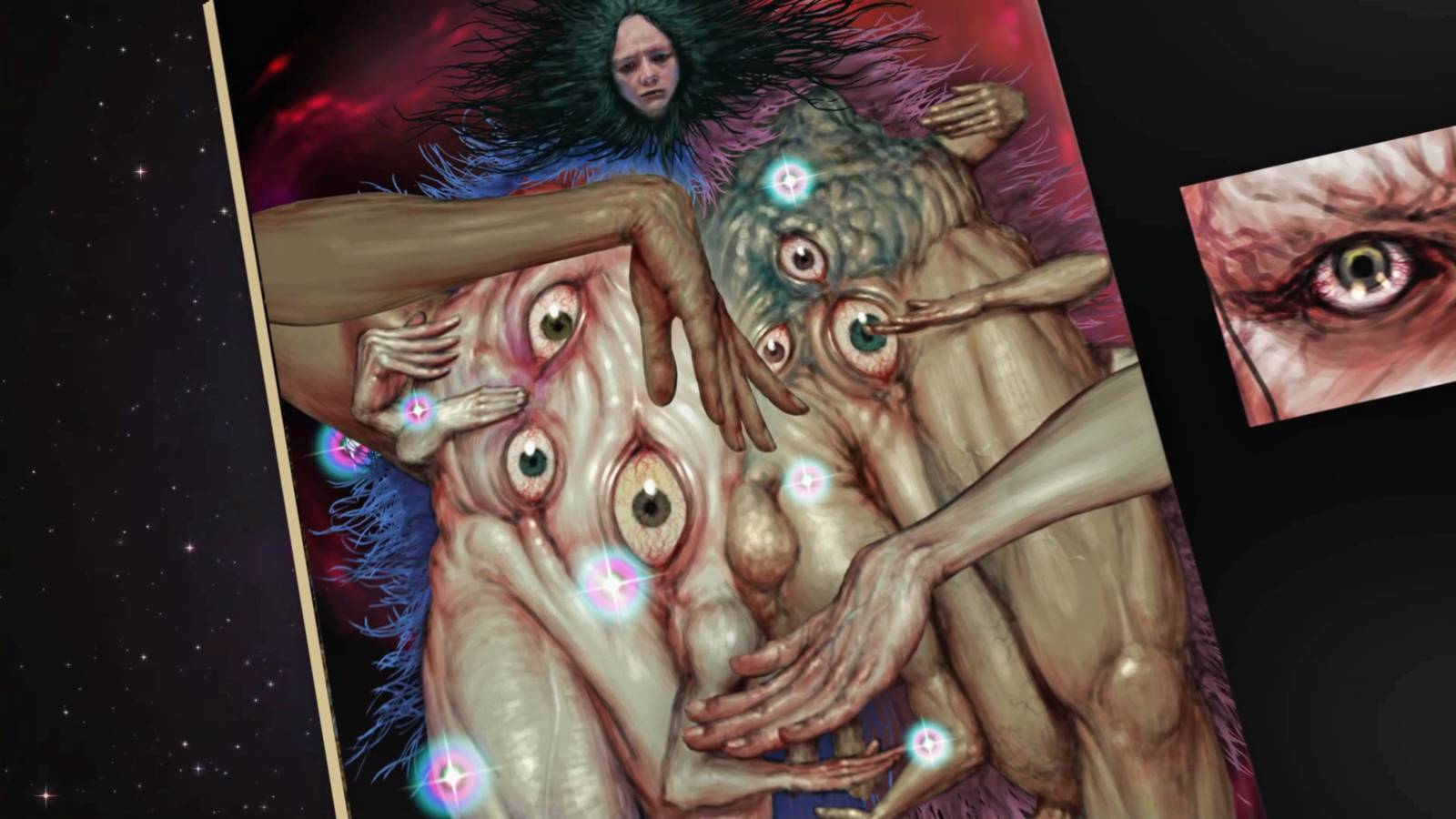
All this came with a package of exceedingly disturbing yet amusing puzzles; another part of the asylum sequence that exemplifies Romeo Is a Dead Man‘s uniqueness. I was tasked with morphing deceased patients’ puppet faces to resemble pictures of the once-living people, and by doing so, helping them rest in peace. The reward for my efforts was one of Rome Is a Dead Man‘s signature cutscenes. Although every chapter in the game tells its story through cartoons (with the camera panning from frame to frame), the art style is always different. Whereas colorful, clean drawings and moody, dark stippling pages formed the backbone of previous chapters, the scratchy marks and black, white, and blue color scheme in this chapter could not have been a better match for the asylum’s withered facade.

If you’re thinking: “That all sounds lovely, but I’m here for the ultra-violent sci-fi action,” don’t worry; there’s plenty of that, too. In fact, breaking the asylum’s time loop reactivated my weapons and abilities while spawning the usual troop of monstrosities, so there was ample opportunity for lootin’ and shootin’ before I left the place.
Had Romeo Is a Dead Man‘s battles been just that, shooting, it might’ve been a rather unwelcome activity following my horrifying asylum adventure, but luckily, the weirdness extends into the combat system through the inclusion of Bastards, a.k.a. farmable zombies. The Last Night, an FBI spaceship that functions as the game’s main hub, has a room for planting Bastard seeds in little garden plots; sowing, growing, harvesting, and breeding Bastards yields a small army of morbid minions, all of whom will gladly slow, poison, electrocute, or blast your opponents for you. Combine that with four melee and four ranged weapons, and there’s plenty of room to modify your combat style.

Eight weapons may not sound like much, but while Romeo Is a Dead Man‘s combat system is simple in nature, the freedom to pair vastly different weapon types (you can quickswap between them), choose between many Bastard abilities, and change Romeo’s character stats whenever you like (through a retro arcade game called DeadGear Cannonball), those who wish to experiment with different battle strategies may do so to their heart’s desire. As for myself, I was glad to try various weapons and Bastards without having to fuss over weapon mods.

Is every part of Romeo’s adventure strange and intriguing, then? It would be amiss to ignore Romeo Is a Dead Man‘s duality by ignoring that other horror (and this time, not in a positive sense): Sub-Space, the cubic neon realm that serves as a pathway between various places in the real world. Throughout the game, Romeo constantly jumps through floating TVs to enter this alternate dimension in search of special keys or other TVs leading into new areas. Sounds fascinating? Not really; I hate Sub-Space.
I’ve got to admit that my terrible sense of direction didn’t do me any favors here, but I just don’t find joy in running through a realm that looks almost exactly the same each time and is utterly devoid of creatures and challenges. There’s one type of puzzle in Sub-Space, but it hardly deserves the name; you must turn an anomaly into a perfect circle, which requires no more than a few button inputs. The real challenge is to find the exit as quickly as possible so you may continue Romeo’s story and get back to the fun part.

To a lesser extent, I found a similar lack of inspiration in the game’s enemy design; there’s little difference between Romeo Is a Dead Man‘s zombies and their kin as seen in a game like Left 4 Dead. New zombies are added to the enemy troops as you progress, but old ones are never replaced, and there’s a limit to how often I’d like to slash the same kind of pumpkin-headed fiend.
So, while Romeo Is a Dead Man offers a unique and refreshing experience, in some ways, predominantly its Sub-Space world, it’s oddly repetitive. But although I would’ve been thrilled to find major gameplay switch-ups like the asylum adventure in its Sub-Space realm, the joy found in the good parts far outweighs the occasional dullness. When this game gets weird, it really gets weird — by the end, you’ll consider it perfectly normal to chat with your own bomber jacket while fondling creepy puppets in an abandoned asylum.
Romeo is a Dead Man will be released Feb. 11 on PlayStation 5, Windows PC, and Xbox Series X. The game was reviewed on PC using a prerelease download code provided by Grasshopper Manufacture Inc. You can find additional information about Polygon’s ethics policy here.