![13th Jan: The Boyfriend (2026), 2 Seasons [TV-14] – New Episodes (6.9/10)](https://occ-0-953-999.1.nflxso.net/dnm/api/v6/Qs00mKCpRvrkl3HZAN5KwEL1kpE/AAAABRhhCmIuXZbEfVa-2q9kouj9krQwvhDVIn7vtb-bDL1ZZ90sJODiZnwZedxCCKWSj6RAwCtfJz19yxZizn208cIv927NIs9p5fo_RC-VLWUjNEOl4kHuqNr7ZRFpSh4VkdsTL3aQFzNnP8dD43cQEAfIONt5V1zIRKy_vtEh.jpg?r=8d6 "13th Jan: The Boyfriend (2026), 2 Seasons [TV-14] – New Episodes (6.9/10)")



Encounters between artists and practitioners are invariably profound experiences, where knowledge is exchanged in real time as a lived practice. Such meetings allow one to gain a holistic perception of each artist: you see them, hear them, and sense them with all faculties, making the encounter a truly human experience. Distinct voices, often divergent, suddenly discover codes of communication that emerge almost magically, particularly when they are attuned to a high level of knowledge and expertise.
This was precisely the case at the Between.Pomiędzy Festival 2025. The overarching theme—Tools and Techniques—provided the central axis for those capable of employing these instruments with mastery to come into resonance. While festivals of this kind sometimes risk dissolving into purely theoretical discussions, which, although valuable for the exchange of ideas often remain ephemeral in character, the opposite occurred in Gdańsk. There, it was a genuine meeting of artists and researchers, a convergence that transcended theory and became a living dialogue of practice and thought.
The workshop unfolded as a constellation of encounters, offering a series of sessions devoted to physical theatre and choreography. It became a living space where theory and practice intertwined, shaping a fertile ground for the exchange of knowledge and experience. Artists, researchers, and students gathered not merely to learn, but to share — weaving together their crafts into a collective tapestry of movement, thought, and creation.
What emerged with striking clarity was the urgent need for contemporary practices and methodologies in theatre and performance education. The sessions demonstrated that today’s pedagogical landscape must move beyond static models of instruction and embrace approaches that are embodied, process‑based, and responsive to the complexities of modern artistic creation. The festival highlighted how essential it is for training and educational institutions to cultivate environments where experimentation, interdisciplinarity, and embodied research are not only encouraged but structurally integrated. In this sense, the workshop served not simply as a series of artistic encounters but as a compelling argument for reimagining how we teach, learn, and transmit the performing arts in the twenty‑first century.
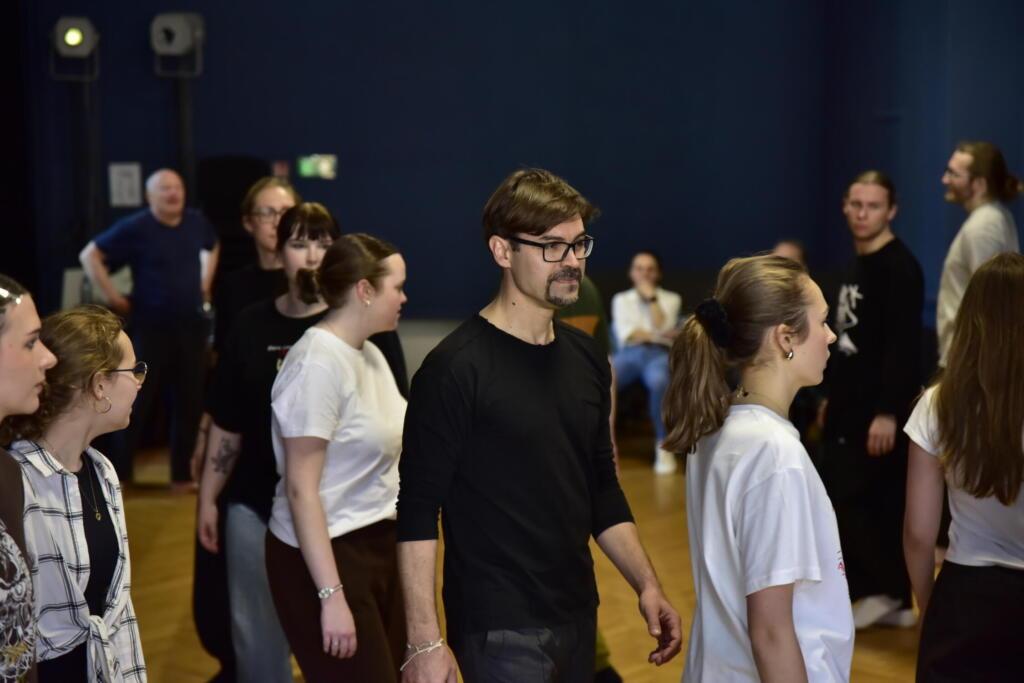
The workshop Dark Movement Human Spaces by Dionysios Tsaftaridis (Greece), during Between.Pomiędzy Festival 2025, Gdańsk (Poland).
Within the framework of The University of Gdańsk Samuel Beckett Seminar: Tools and Craft, the first part of this year’s Sharing Crafts workshop series took place. The opening session was led by Clara Simpson (Ireland/France), who guided participants into the delicate process of adapting a literary text into theatrical form.
The workshop, “Page to Stage: Not I,” unfolded as an interactive exploration of Beckett’s fragment. Clara Simpson offered a performative demonstration of how words could be translated into rhythm, gesture, and presence. The session became a living dialogue between text and performance, where theory and practice intertwined, and the written page dissolved into embodied theatre.
Participants experienced not only a practical approach to staging but also an interpretative reading of Beckett’s Not I. The encounter created a space of exchange — artists, researchers, and students shared perspectives, weaving together knowledge and craft. In retrospect, the workshop illuminated the fragile yet powerful passage from literature to theatre, leaving behind a resonance of voices, movements, and ideas.
“Dark Movement Human Spaces” and “Physical Acting and Space”
The workshop “Dark Movement Human Spaces” by Dionysios Tsaftaridis (Greece) introduced participants to a method of movement practice that deliberately obstructs vision in order to heighten awareness of other senses. The session began with exercises in Kinesis (movement within the personal sphere/kinesphere) and then expanded into Metakinesis (movement through shared external space/exosphere). By working in darkness, participants explored how the absence of sight sharpened their perception of spatial relations, timing, and physical contact. The exercises encouraged them to rely on touch, sound, and proprioception, creating a heightened sensitivity to both their own movement and the presence of others. This approach, known as the DMS method, provided a structured way to generate new movement material and improve dexterity.

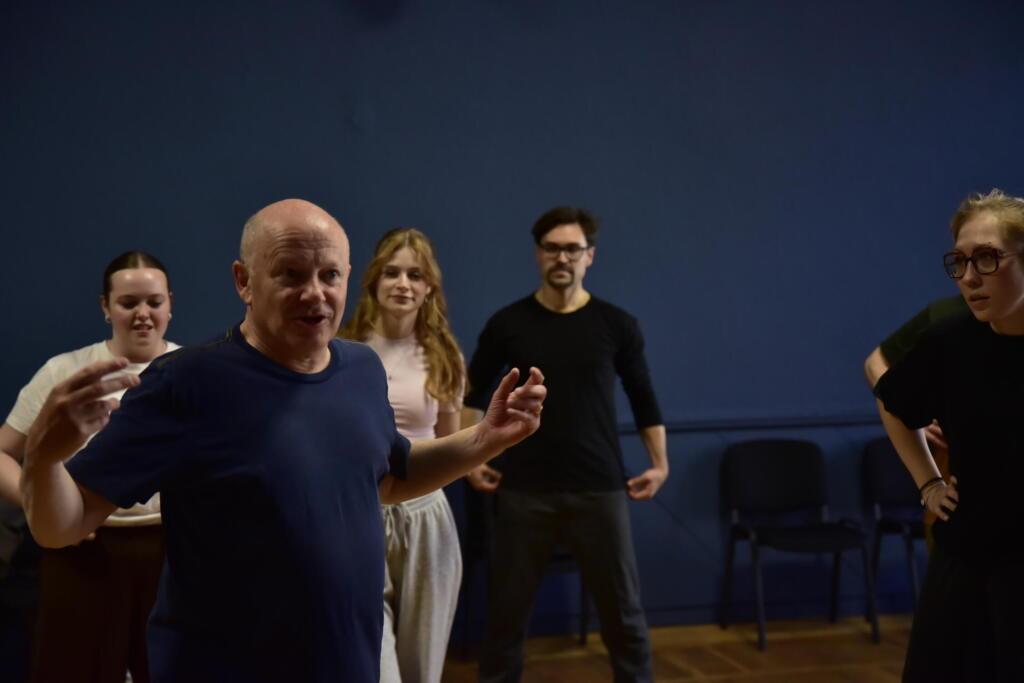
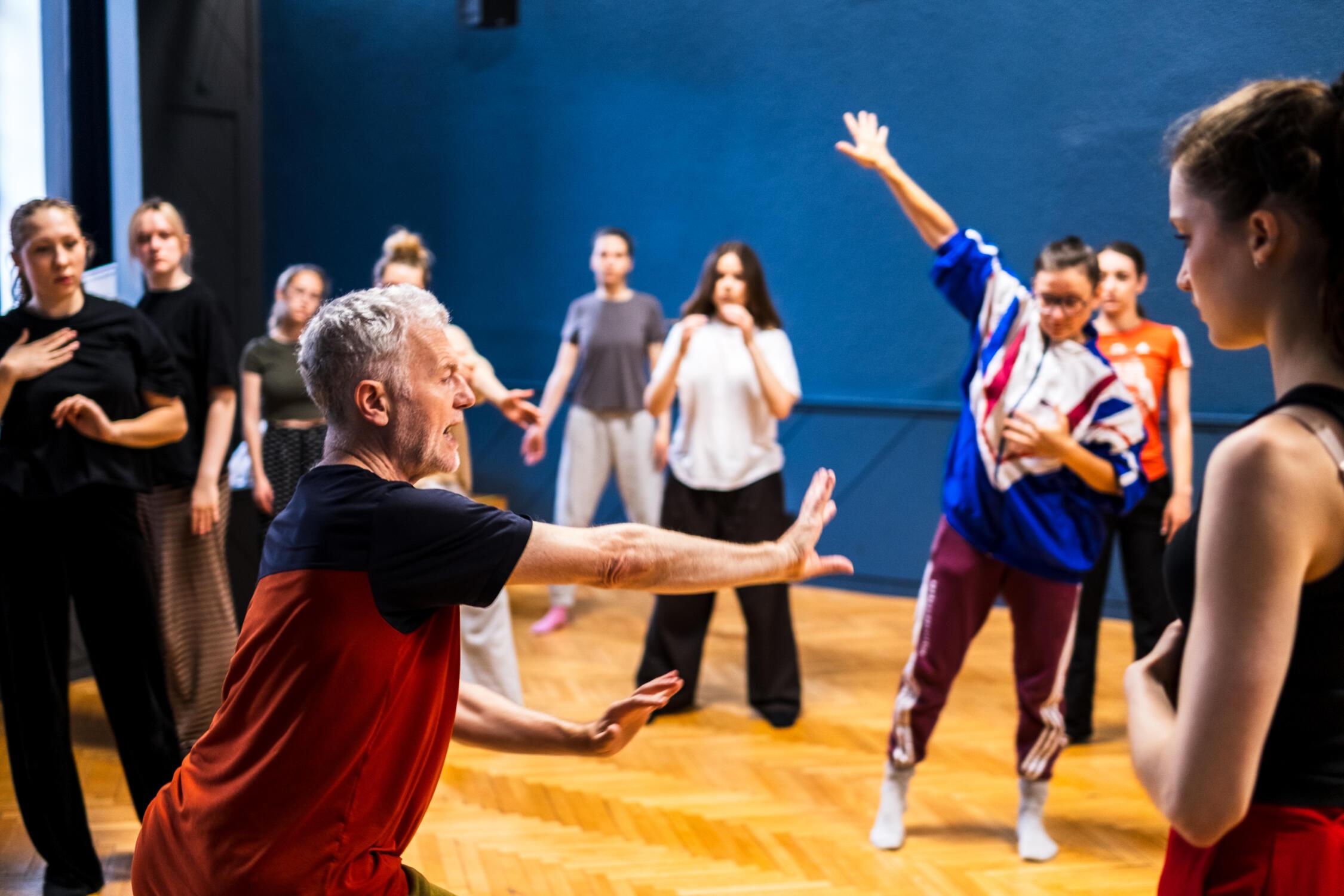
The workshop “Physical Acting and Space” led by Paul Allain (United Kingdom), during Between.Pomiędzy Festival 2025, Gdańsk (Poland).
The workshop “Physical Acting and Space” led by Paul Allain (United Kingdom) focused on how actors define and organize space when no text or external framework is provided. Participants worked individually and in groups to explore how physical presence alone can shape meaning in an empty environment. The exercises examined alignment, orientation, and collective organisation, encouraging actors to become aware of how their bodies interact with space and with one another. Towards the end, the workshop briefly addressed documentation: how the camera can be used to capture and reflect the actor’s work, considering angles, framing, and the relationship between live performance and recorded image.
Together, the two workshops offered complementary perspectives: one emphasizing sensory exploration in the absence of vision, the other highlighting the actor’s role in constructing space without textual guidance. Both provided practical tools and experiences that participants could integrate into their own artistic and research practices.
“The Fast Body” and “Laban–Aristotle: Zώον in Theatre Πράξις”
The workshop “The Fast Body,” led by Alice Veliche and Radu Alexandru (Romania), focused on speed as a fundamental yet challenging quality of movement. Participants engaged in a series of exercises designed to refine both precision and acceleration in bodily actions. The facilitators introduced methods that combined technical drills with analytical reflection, encouraging participants to observe how speed influences not only physical dexterity but also expressive potential. The session emphasized long-term strategies for training the “fast body,” highlighting how controlled acceleration can become a tool for both performance and research. Through practice, participants experienced the complexity of maintaining clarity and intention while working at heightened tempo and discussed how speed can transform the dynamics of presence on stage.
The workshop “Laban–Aristotle: Zώον in Theatre Πράξις,” presented by me (The Makings of the Actor, Greece), offered a blend of theory and practice rooted in my ongoing research. The session began with a theoretical introduction to the relationship between Rudolf Laban’s movement analysis and Aristotle’s concept of mimesis understood as zώον (life force). I explained how training, viewed through an Aristotelian lens, requires conscious and rational engagement, bridging science (episteme) and art. Following this framework, participants moved into practical exploration, applying principles of Laban’s system while reflecting on Aristotle’s ontological and poetic theory. Exercises encouraged them to embody and experience how the body becomes a site of knowledge through kinesthetic practice. The workshop intended to provide a structured methodology that connected philosophical concepts with tangible actor training, offering participants both intellectual insight and physical experimentation.
Together, these workshops complemented each other: one examined the technical refinement of speed and precision, while the other explored the philosophical and methodological foundations of movement. Both sessions gave participants practical tools and deeper understanding of how movement can be trained, analyzed, and transformed into expressive theatre practice.

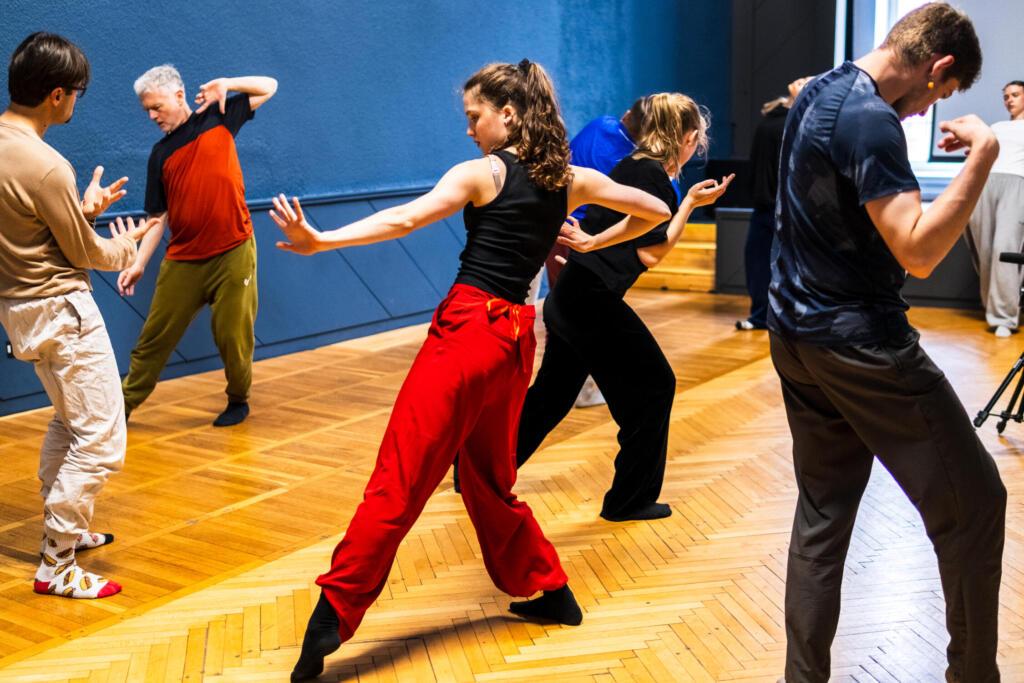
The workshop Bodies Moved and Moving: A Workshop on Volitional and Non-volitional Action, led by Nigel Stewart (United Kingdom), during Between.Pomiędzy Festival 2025, Gdańsk (Poland).
“Bodies Moved and Moving” and “Bones’ Landscape – Anatomy in Motion”
The workshop “Bodies Moved and Moving: A Workshop on Volitional and Non-volitional Action,” led by Nigel Stewart (United Kingdom), guided participants into a deeper awareness of how the body responds to both internal impulses and external forces. Drawing on Vsevolod Meyerhold’s concept of reflex excitability, Joan Skinner’s Skinner Releasing Technique (SRT), and the fall-and-recovery principles of Doris Humphrey and José Limón, the session combined theory with practice. Participants engaged in deceptively simple exercises, both individually and in pairs, that emphasized the experience of being moved rather than simply moving. Through these explorations, they discovered how external stimuli — gravity, touch, or group dynamics — could generate energy and shape movement. The workshop highlighted the balance between volitional control and surrender, encouraging participants to harness the interplay of intention and response.
The workshop “Bones’ Landscape – Anatomy in Motion,” led by Katarzyna Pastuszak (Poland), invited participants to explore the body’s materiality through dance and movement practices. The focus was on what Pastuszak terms “bonescapes” — landscapes of the skeletal structure experienced through motion. Exercises encouraged participants to map their bodies from within, tracing the dialogue between bones, muscles, and external environments. The workshop created an open space for practical research, where participants reflected on how movement can generate dialogues not only between human bodies but also between bodies and materials, places, and even non-human entities. As part of the ongoing Dance Ecologies project, the session emphasized the potential of dance as a tool for investigating corporeal relationships and ecological connections.
Together, these workshops offered complementary perspectives: Stewart’s session emphasized awareness of forces and reflexes shaping movement, while Pastuszak’s explored anatomical landscapes and the body’s dialogue with its environment. Both provided participants with practical tools and conceptual frameworks to expand their understanding of movement as both physical practice and research method.

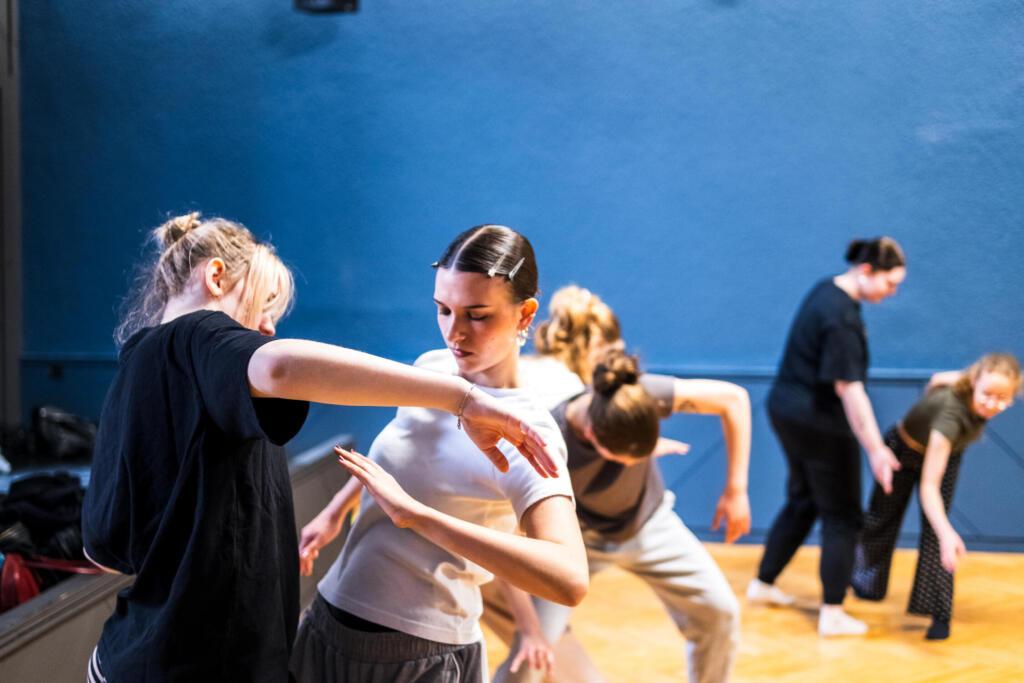
Workshop during Between.Pomiędzy Festival 2025, Gdańsk (Poland).
These workshops collectively demonstrate how essential such forms of collaboration are to the work of practising artists. Each encounter created a shared field where methods, perspectives, and embodied experiences could circulate freely, allowing participants to learn not only through observation or theory but through the physical act of doing. In this context, knowledge is not an abstract construct but an embodied process — something generated, tested, and transformed through movement, interaction, and collective exploration. By bringing together diverse practitioners, disciplines, and research approaches, these collaborations cultivate a dynamic environment in which artistic practice evolves through dialogue, experimentation, and the lived experience of the body in action.
All of this unfolded alongside a rich array of events in the beautiful city of Gdańsk. We became part of the city’s artistic life, moving through different venues and engaging with its vibrant cultural landscape. We met fellow artists and colleagues, exchanged ideas, and immersed ourselves in a community shaped by creativity and curiosity. For several days, we lived in a state of artistic and intellectual exhilaration, experiencing the city not only as visitors but as active participants in its ongoing creative pulse.
This experience ultimately led to a new collaboration and partnership between our company, The Makings of the Actor, and the Between.Pomiędzy for the year 2026. The days we spent in Gdańsk — immersed in artistic exchange, surrounded by fellow practitioners, and engaged in continuous creative dialogue — created the ideal conditions for this partnership to emerge and take shape.
This article is part of the report on Between.Pomiędzy Festival 2025, available on TheTheatreTimes.com.
This post was written by the author in their personal capacity.The opinions expressed in this article are the author’s own and do not reflect the view of The Theatre Times, their staff or collaborators.